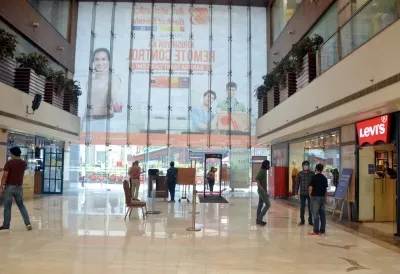
India retail leasing hits 2.4 MSF in Q2 2026, up 17.6% amid tight supply

Synopsis
India's retail real estate market is growing faster than new supply can keep up with. With 2.4 MSF leased in Q2 2026 — a 17.6% annual jump — and zero new Grade A malls added for two straight quarters, vacancies are tightening and rentals are firming. Retailers, both domestic and international, are competing hard for limited premium space, and some are now eyeing Grade B assets to stay in the game.
Key Takeaways
India's retail gross leasing volume hit 2.4 MSF in Q2 2026 , up 23.2% QoQ and 17.6% YoY across the top eight cities .
H1 2026 total leasing reached 4.35 MSF , a 3.1% rise over H1 2025 .
No new Grade A mall supply was added for a second consecutive quarter , tightening vacancies and firming rentals.
Malls captured 51.3% of leasing ( 1.23 MSF ); Main Streets accounted for 48.7% ( 1.17 MSF ).
Delhi NCR ( 0.67 MSF ), Mumbai ( 0.50 MSF ), and Hyderabad ( 0.37 MSF ) together drove 64% of Q2 leasing.
Fashion led category demand at 28.2% , followed by food and beverage at 17.2% .
India's retail real estate sector posted robust growth in Q2 2026, with gross leasing volume reaching 2.4 million square feet (MSF) across the top eight cities, marking a 23.2% quarter-on-quarter and 17.6% year-on-year rise, according to a report by property consultancy Cushman & Wakefield released on 1 July 2026. The expansion came despite a second consecutive quarter with no new Grade A mall supply entering the market.
H1 2026 Leasing Overview
Total leasing during the first half of 2026 reached 4.35 MSF, up 3.1% from H1 2025. Space uptake remained strong in projects completed in H2 2025, reflecting sustained retailer preference for organised retail formats. The absence of fresh Grade A supply for two straight quarters has tightened vacancies and pushed rentals higher across major markets.
Malls vs Main Streets
Malls accounted for 51.3% of total leasing at 1.23 MSF, registering a 33.4% QoQ and 21.9% YoY increase. Main Streets held a 48.7% share at 1.17 MSF, with leasing volumes growing 14.0% QoQ and 13.3% YoY, supported by continued demand for high-visibility, consumption-driven locations.
Notably, limited availability of premium mall space and rising rentals have led retailers to evaluate opportunities beyond Grade A assets, including select Grade B developments — a shift that signals the depth of occupier demand.
Domestic vs International Retailers
Domestic retailers maintained a dominant position, contributing 82.4% of total leasing, with roughly 54% of their activity concentrated in main streets. International retailers accounted for 17.6%, with nearly 76% of their leasing in malls, reflecting a clear preference for institutionally managed, high-quality retail environments.
Gautam Saraf, Executive Managing Director, Mumbai & New Business, Cushman & Wakefield, said: 'Even in an environment where quality retail supply remains constrained, occupiers have shown a clear willingness to compete for well-located assets, whether in premium malls or established high streets. This has resulted in tighter vacancies, firmer rentals and broader leasing momentum across major cities.'
City-wise and Category Breakdown
Delhi NCR, Mumbai, and Hyderabad together contributed 64% of Q2 leasing. Delhi NCR led with 0.67 MSF, followed by Mumbai at 0.50 MSF and Hyderabad at 0.37 MSF. By category, fashion led leasing with a 28.2% share, followed by food and beverage at 17.2%.
The gradual addition of new supply, combined with sustained consumption growth, is expected to improve market availability of quality retail space and create fresh expansion opportunities for retailers in the coming quarters.
Point of View
It signals that supply creation has fallen too far behind demand. The fashion and F&B categories driving leasing are also the most footfall-sensitive, meaning any consumption slowdown would hit these segments first. The real test for India's retail real estate story is whether developers can unlock new Grade A supply fast enough to prevent rental inflation from eroding retailer margins and, ultimately, expansion appetite.
NationPress
30 Sept 2026
Frequently Asked Questions
What was India's retail leasing volume in Q2 2026?
India's retail gross leasing volume reached 2.4 million square feet in Q2 2026, up 23.2% quarter-on-quarter and 17.6% year-on-year across the top eight cities, according to a Cushman & Wakefield report released on 1 July 2026.
Which cities led retail leasing in Q2 2026?
Delhi NCR, Mumbai, and Hyderabad together accounted for 64% of Q2 2026 retail leasing. Delhi NCR led with 0.67 MSF, followed by Mumbai at 0.50 MSF and Hyderabad at 0.37 MSF.
Why is Grade A mall supply constrained in India?
No new Grade A mall supply was added in Q2 2026, marking a second consecutive quarter without fresh supply. The report attributes this to a pipeline gap, which has tightened vacancies and pushed rentals higher, prompting some retailers to consider Grade B developments.
Which retail categories drove the most leasing demand?
Fashion was the top category with a 28.2% share of total leasing in Q2 2026, followed by food and beverage at 17.2%, reflecting strong consumption-driven demand in organised retail formats.
How are domestic and international retailers splitting leasing activity?
Domestic retailers contributed 82.4% of total leasing in Q2 2026, with most activity on main streets. International retailers accounted for 17.6%, with nearly 76% of their leasing concentrated in malls, reflecting a preference for institutionally managed retail environments.