Steady Demand in India's Retail Leasing for Q1 2026 Amid Supply Challenges

Synopsis
India's retail sector leasing remains consistent in Q1 2026, achieving 1.95 million square feet despite limited new mall supply. This report reveals key insights into the evolving landscape of retail space in major cities.
Key Takeaways
Total leasing in Q1 2026: 1.95 million square feet.
28% decrease quarter-on-quarter leasing activity.
Malls accounted for 47% of leasing activity.
Delhi NCR led in leasing with a 30% share.
Fashion and food & beverage sectors combined for 46% of total leasing.
New Delhi, April 7 (NationPress) The leasing activity in India's retail sector across its top eight cities remained stable, reaching 1.95 million square feet in Q1 2026, as indicated by a recent report. This stability comes amidst a backdrop of constrained new mall supply.
The findings from Cushman & Wakefield, a leading commercial real estate services firm, revealed that the leasing levels saw a 28 percent decrease quarter-on-quarter and a 10 percent drop year-on-year.
“This decline follows a robust performance in 2025, where leasing hit 9.21 million square feet, marking the highest annual figure since the pandemic, showcasing that occupier interest remains strong despite short-term supply challenges,” the report noted.
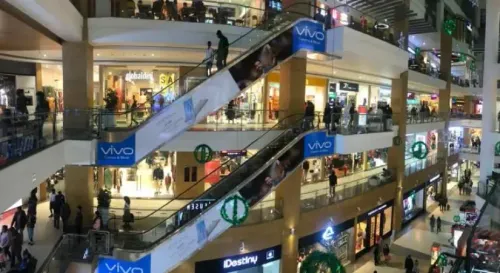
In the quarter under review, mall leasing gained traction, comprising 47 percent of the total leasing activities, a significant rise from 33 percent compared to the same period last year.
Meanwhile, main streets continued to dominate overall leasing, holding a substantial share of 53 percent, driven by ongoing demand for prominent, consumption-oriented locations.
“Currently, India's retail real estate market is characterized by a demand-driven scenario, where occupier interest consistently exceeds the supply of premium retail space,” stated Gautam Saraf, Executive Managing Director, Mumbai & New Business at Cushman & Wakefield.
“As new developments begin to emerge in 2026, primarily focused on high-end projects, we anticipate this robust demand will lead to more stable leasing activities, furthering the institutionalization of India’s retail real estate sector,” he added.
City-specific activity was predominantly based in Delhi NCR, which accounted for a 30 percent share with 0.59 million square feet, driven by consistent demand for both malls and main streets.
Hyderabad followed with 22 percent (0.43 million square feet), while Mumbai secured the third position at 13 percent (0.25 million square feet).
In terms of sector contributions, fashion and food & beverage together represented 46 percent of the total leasing, while entertainment rose to an 11 percent share largely within malls. Department stores made up 10 percent of leasing, and furniture & furnishings contributed 5 percent, with activity occurring across both malls and main streets.
aar/rad
Point of View
Indicating a resilient sector poised for growth as new developments are anticipated in the near future.
NationPress
20 Sept 2026
Frequently Asked Questions
What was the total retail leasing in Q1 2026?
The total retail leasing in India’s top eight cities reached 1.95 million square feet in Q1 2026.
How did Q1 2026 leasing compare to previous quarters?
Leasing in Q1 2026 showed a 28 percent decrease quarter-on-quarter and a 10 percent decline year-on-year.
What sectors contributed to the leasing activity?
Fashion and food & beverage sectors contributed 46 percent of total leasing, with entertainment and department stores also making significant contributions.
Which city had the highest leasing activity?
Delhi NCR led with a 30 percent share of leasing activity, totaling 0.59 million square feet.
What is the outlook for India's retail leasing market?
The outlook remains positive, with expectations of increased leasing activity as new high-quality supply enters the market from 2026 onwards.