Will the India-UK Free Trade Agreement Launch in April?
Synopsis
The anticipated India-UK free trade agreement, set to launch in April, promises a surge in Indian exports and enhanced economic ties. Key sectors like textiles and IT services stand to benefit greatly, while tariffs on Scotch whisky and automobiles will see significant reductions. This agreement is a major step towards strengthening bilateral trade relations.
Key Takeaways
The India-UK free trade agreement is expected to be implemented in April.
99% of Indian exports to the UK will benefit from zero duties.
Key sectors such as textiles and IT services will see significant growth.
Tariffs on Scotch whisky and automobiles will be reduced.
The agreement will bolster economic ties between India and the UK.
New Delhi, Feb 15 (NationPress) The India-UK free trade agreement is anticipated to come into effect in April this year, setting the stage for a boost in Indian exports to the UK, as stated by a senior official on Sunday.
Signed in July of the previous year, the agreement now awaits approval from the UK Parliament to become operational.
The discussion on the Free Trade Agreement (FTA) has already commenced in both Houses of the British Parliament.
According to an official statement, under the free trade agreement, 99% of Indian exports to the UK will enjoy the advantage of zero duty. This development opens vast export opportunities for sectors heavily reliant on labor, including textiles, marine products, leather, footwear, sports goods, toys, gems and jewellery, as well as key sectors like engineering goods, auto parts and engines, and organic chemicals.
Furthermore, India has guaranteed that non-tariff barriers will be effectively addressed to facilitate the seamless flow of goods and services, preventing any unjustified restrictions on Indian exports.
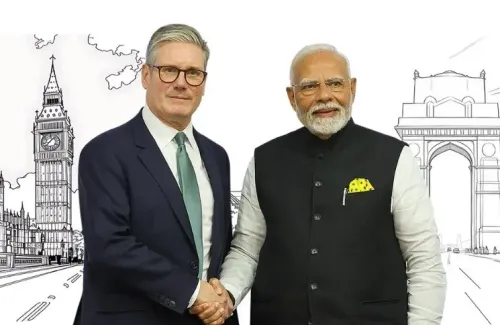
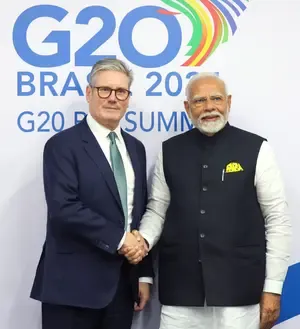
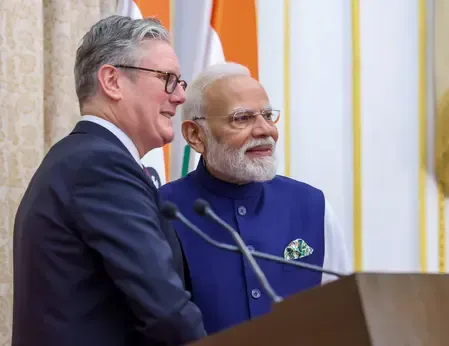
In May of last year, Prime Minister Narendra Modi and his UK counterpart, Keir Starmer, announced the successful conclusion of the mutually beneficial India-UK FTA.
The agreement was finalized after PM Modi communicated directly with the UK Prime Minister over the phone.
Alongside the FTA, a Double Contribution Convention has been established to safeguard the interests of Indian workers residing in the UK.
Trade in services is also poised for substantial growth, encompassing areas such as Information Technology/Information Technology Enabled Services, financial services, professional services, and educational services.
Moreover, India has secured an exemption for Indian workers temporarily in the UK, allowing them and their employers to avoid paying social security contributions in the UK for a period of three years under the Double Contribution Convention. This exemption will significantly enhance the competitiveness of Indian service providers in the UK.
Under the agreement, tariffs on Scotch whisky will be reduced from 150% to 75%, with a further decrease to 40% by 2035.
India will also progressively lower import duties on automobiles from as high as 110% to 10% over five years via a quota-based system. In return, Indian manufacturers will gain market access in the UK for electric and hybrid vehicles within a quota framework.
This FTA emerges against a backdrop of strengthening economic ties between India and the UK, highlighted by their bilateral trade, which currently stands at approximately $60 billion and is expected to double by 2030.
Point of View
It is crucial to note that the India-UK free trade agreement marks a significant milestone in enhancing the economic relationship between the two nations. This agreement not only fosters trade but also supports Indian workers and industries in the UK, showcasing a progressive step towards mutual benefit.
NationPress
10 Oct 2026
Frequently Asked Questions
What sectors will benefit from the India-UK FTA?
Sectors like textiles, marine products, leather, footwear, sports goods, toys, gems and jewellery, engineering goods, auto parts, and organic chemicals will significantly benefit from the India-UK FTA.
When was the India-UK free trade agreement signed?
The India-UK free trade agreement was signed in July of the previous year.
What is the significance of the Double Contribution Convention?
The Double Contribution Convention safeguards the interests of Indian workers in the UK by exempting them from social security contributions for three years.
How will tariffs change under the agreement?
Tariffs on Scotch whisky will be reduced from 150% to 75% and then to 40% by 2035, while import duties on automobiles will drop significantly over five years.
What is the projected impact on bilateral trade?
The bilateral trade between India and the UK, currently around $60 billion, is projected to double by 2030.