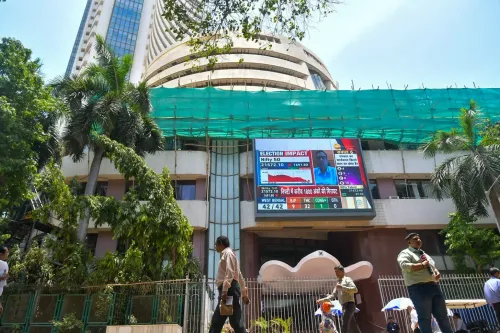
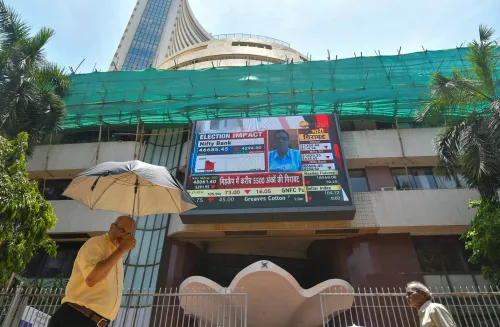
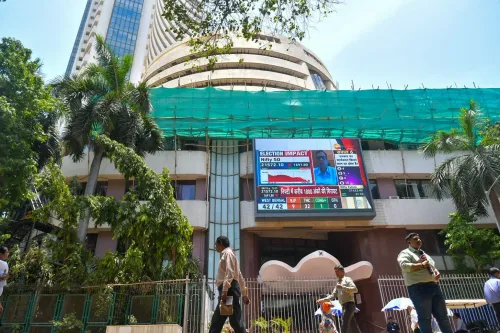
Why Did Sensex and Nifty Open Flat on Budget Day?

Synopsis
On Budget Day, the Indian equity markets displayed notable volatility as investors braced for fiscal changes amid a weak rupee. With key indices fluctuating and sector performances diverging, market watchers are keeping a close eye on potential tax reforms and defense spending increases. What will this mean for investors?
Key Takeaways
Sensex gained 9 points; Nifty dropped 28 points.
Increased volatility observed amidst Budget caution.
Major sectoral losses in Nifty Midcap and Nifty Smallcap .
Defense-linked stocks are expected to attract attention.
Market support and resistance levels identified.
Mumbai, Jan 31 (NationPress) The Indian equity markets experienced increased volatility on Sunday due to Budget caution and a weak rupee hovering around 92 per dollar.
At 9:24 am, the Sensex gained 9 points, or 0.01%, reaching 82,278, while the Nifty fell by 28 points, or 0.11%, settling at 25,291.
Main broad-cap indices saw significant losses, with the Nifty Midcap 100 decreasing by 0.73% and the Nifty Smallcap 100 declining by 1.55%.
Most sectoral indices traded in negative territory, with exceptions being auto, private banks, oil and gas, and consumer durables. The Nifty metal index was the largest loser, down by 3.10%, while the Nifty auto index was a standout performer, up 0.30%.
Bharat Electronics emerged as a significant gainer on the Nifty as investors anticipate increased defense allocations in the Budget.
Market analysts noted immediate support at the 25,100 level, with resistance expected in the 25,450–25,500 range.
Expectations for this Budget are tempered, as investors do not foresee major tax reliefs, following substantial income tax reductions in the 2025 Budget; however, minor adjustments in the tax framework might occur.
"An enhancement in the long-term capital gains tax exemption from the current Rs 1.25 lakhs to a more favorable limit is anticipated. A fiscally prudent and growth-focused Budget is what the market desires. Should rumors of exemptions for certain categories of FIIs prove accurate, a market rally could ensue," analysts commented.
Stocks related to defense are projected to attract investor interest, with a moderate rise of 8 to 10 percent in defense spending likely.
"A primary focus of the Budget could be on exports, especially manufacturing exports highlighted in the Economic Survey. Announcements regarding PSU bank mergers and disinvestment in PSUs will be closely monitored," they added.
India’s stock exchanges will conduct regular trading on Sunday from 9:15 am to 3:30 pm.
As it is a settlement holiday, shares purchased on January 30 will not be available for sale on February 1. Likewise, stocks bought on Budget Day cannot be sold the next day.
Market volatility is expected to remain high, with potential significant movements in either direction depending on key announcements regarding fiscal policy, capital expenditure pushes, sector-specific incentives, and the fiscal deficit target (forecasted to be around 4.3–4.4% of GDP for FY27), according to market analysts.
Investors are looking for insights from debt metrics, deficit outcomes, and scheduled borrowings for the upcoming year’s Budget to align with the government's strategic objectives.
On January 30, foreign institutional investors (FIIs) net purchased equities worth Rs 2,251 crore, while domestic institutional investors (DIIs) were net sellers of equities worth Rs 601 crore.
Point of View
It is crucial to maintain a balanced perspective on the evolving financial landscape. The Indian equity markets are witnessing fluctuations influenced by external factors such as the Budget and global economic conditions. With a focus on informed analysis, we aim to keep our audience abreast of developments that matter, ensuring that we provide valuable insights while adhering to a commitment to accuracy and trust.
NationPress
25 Sept 2026
Frequently Asked Questions
What is the current status of the Indian equity markets?
The Indian equity markets have shown increased volatility, with the Sensex gaining slightly while the Nifty has lost ground as investors await the Budget announcements.
What sectors are performing well despite the market volatility?
Sectors such as auto, private banks, oil and gas, and consumer durables have shown resilience, with notable gains in the Nifty auto index.
What are analysts expecting from the upcoming Budget?
Analysts expect no major tax reliefs in this Budget but anticipate minor adjustments in the tax regime and an emphasis on increased defense spending.
How are foreign institutional investors reacting?
On January 30, foreign institutional investors net bought equities worth Rs 2,251 crore, indicating continued interest in the market.
What are the key levels to watch for the Nifty?
Immediate support for the Nifty is seen at the 25,100 level, while resistance is expected in the 25,450–25,500 zone.