How Does India's Growth Path Serve as a Model for the Global South?
Synopsis
India's development model presents a powerful opportunity for the Global South, with over 250 million people lifted out of poverty through innovative policies and reforms. Minister Mansukh Mandaviya emphasizes the importance of sharing these successes and fostering international collaboration for inclusive growth.
Key Takeaways
India's development model can serve as an example for the Global South.
Over 250 million people have escaped poverty in the last decade.
Women's employment has significantly increased through Self Help Groups .
Social security coverage in India has expanded from 19% to 64.3% .
Direct Benefit Transfer ensures efficient delivery of welfare programs.
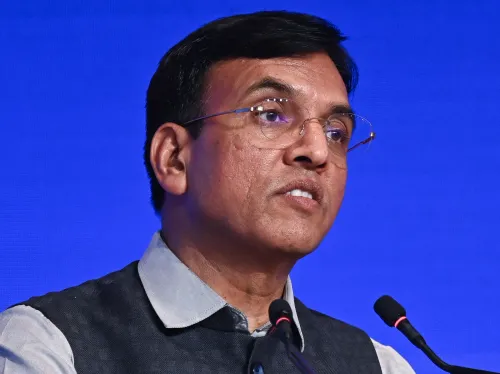
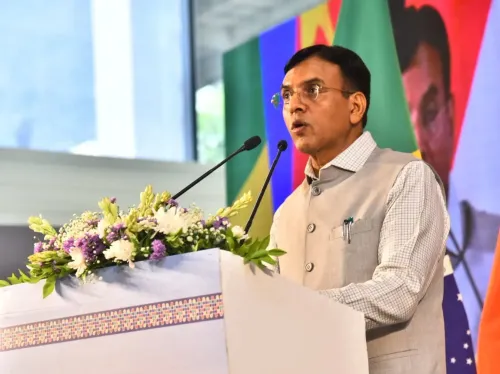
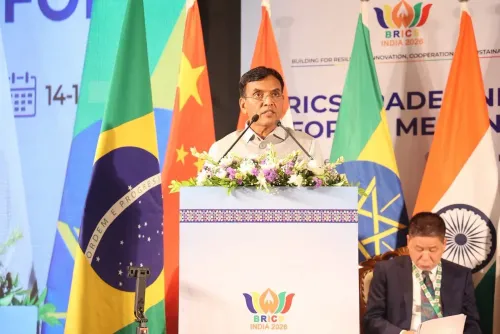
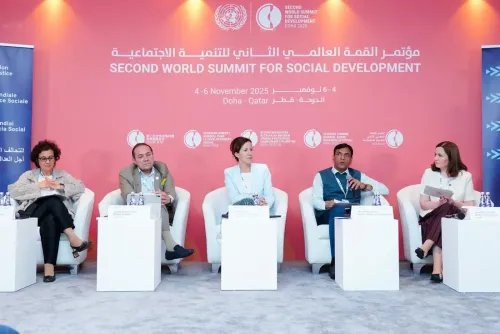
New Delhi, Nov 5 (NationPress) India's development pathway serves as a replicable model for the Global South, and the nation is prepared to share its successful practices and enhance global collaborations, according to Minister of Labour and Employment, Mansukh Mandaviya, during the Second World Summit for Social Development held in Doha.
"It is crucial that this forum recognizes and appreciates the unique circumstances, economic demands, and social needs of each nation," stated the minister.
Emphasizing the significance of India’s growth narrative for impoverished nations, he highlighted that over the last decade, around 250 million Indians have emerged from multidimensional poverty due to ongoing reforms, welfare initiatives, and digital advancements.
"Guided by Prime Minister Narendra Modi's vision of 'Sabka Saath, Sabka Vikas' (Together for Development for All), we believe that social advancement is possible when people are prioritized in policy-making, innovation fosters inclusion, and development is a collective effort," the minister remarked.
He elaborated that India's journey is driven by the profound philosophy of Antyodaya, which means uplifting the last person in line. Currently, 118 million schoolchildren benefit from nutritious mid-day meals, while over 800 million citizens enjoy food security. Additionally, health security has been extended to 425 million Indians, and more than 37 million houses have been built for individuals with low incomes.
From 2017-18 to 2023-24, the unemployment rate in India has dropped from 6 percent to 3.2 percent, with the employment rate of women nearly doubling. Millions of women have been organized into Self Help Groups, and credit disbursements have bolstered these women-led local organizations, Mandaviya noted.
Furthermore, he mentioned that India's social security coverage has surged from 19 percent in 2015 to 64.3 percent by 2025. Acknowledging these efforts, the International Social Security Association awarded India the "ISSA Award for Outstanding Achievement in Social Security" this year.
Central to our initiatives is the emphasis on seamless program delivery. Through a network of bank accounts, mobile internet access, and unique citizen IDs, we have achieved efficient last-mile delivery via Direct Benefit Transfer, explained the minister.
"The Political Declaration we are endorsing at this summit aligns with global priorities, particularly the recognition of women-led development, traditional medicine systems, digital public infrastructure, and cooperatives as catalysts for inclusive growth," Mandaviya stated.
The minister also indicated that India’s economic and social development strategies are in harmony with the sustainable development goals and the country’s commitments regarding climate change.
"We remain dedicated to the agenda of the 17 Sustainable Development Goals of the UN," he emphasized.
Additionally, the minister voiced strong objections to the "certain unfounded remarks made by the President of Pakistan regarding India on Tuesday."
He asserted that this was an exploitation of an international forum to divert attention from social development by spreading disinformation against India.
The reality is that regarding the Indus Waters Treaty, Pakistan has undermined its essence through ongoing hostility and cross-border terrorism. It has also misused the treaty mechanisms to hinder India's legitimate projects, he explained.
Concerning the Union Territory of Jammu and Kashmir, Pakistan has no standing to comment on India's internal matters, especially when it engages in cross-border terrorism against Indian citizens, he noted.
"Pakistan should reflect on and tackle its own severe development challenges that have led to its reliance on international aid. It must cease the misuse of international platforms," added the Indian minister.
Point of View
It is crucial to recognize India's progress as a beacon of hope for developing nations. The emphasis on inclusive growth and the empowerment of marginalized communities aligns with global social development goals. While the minister's remarks towards Pakistan reflect a necessary defense of India's sovereignty, the focus should remain on the transformative potential of India's development strategies for the Global South.
NationPress
19 Sept 2026
Frequently Asked Questions
What is the significance of India's development model?
India's development model showcases successful strategies for poverty alleviation, social welfare, and inclusive economic growth, making it a valuable reference for other nations.
How many people have been lifted out of poverty in India?
Approximately 250 million individuals have been raised from multidimensional poverty in India over the last decade.
What initiatives support women's employment in India?
Millions of women in India have joined Self Help Groups, contributing to a significant increase in their employment rate.
What is the goal of the Sustainable Development Goals?
The Sustainable Development Goals aim to address global challenges such as poverty, inequality, and climate change through collaborative efforts.
What recent recognition did India receive for its social security efforts?
India was awarded the ISSA Award for Outstanding Achievement in Social Security by the International Social Security Association.