India's Trade Deficit Shrinks as Exports Surge and Services Soar
Synopsis
In March 2026, India's trade deficit narrowed to $21 billion, driven by a drop in precious metal imports and a significant rise in exports. The resilient services sector surplus continues to balance the trade dynamics, despite challenges ahead.
Key Takeaways
Trade deficit narrowed to $21 billion in March 2026.
Goods imports fell by 6% , while exports rose by 6% .
Net services exports increased to $18.2 billion .
Gold and silver imports dropped 59% and 63% respectively.
Future challenges may arise from the ongoing conflict in the Middle East.
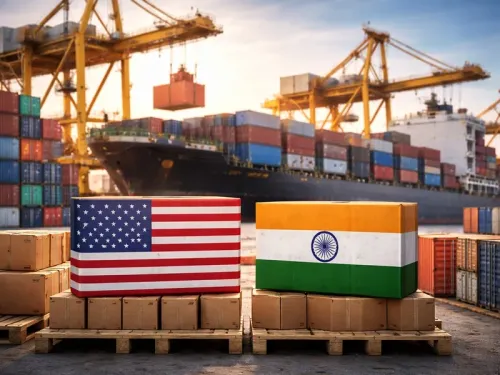
New Delhi, April 16 (NationPress) In March 2026, India's external financial position demonstrated strength as the goods trade deficit decreased to $21 billion, driven by a significant reduction in imports of precious metals alongside a rebound in exports, according to a report released on Thursday.
Simultaneously, a strong surplus in the services sector continued to counterbalance the widened goods deficit, as highlighted in the report by Emkay Global Financial Services.
Total imports for India saw a decline of approximately 6 percent month-on-month, falling to $59.6 billion, while total exports experienced an increase of 6 percent, reaching $38.9 billion. Net services exports surged to $18.2 billion in March, marking a robust growth of 13 percent for FY26.
Interestingly, despite the surge in oil prices, oil imports dipped by around 6 percent month-on-month, likely due to a 35-40 percent drop in volume caused by the closure of the Strait of Hormuz. Exports for FY26 rose by 1 percent, as the impact of US tariffs was softened through diversification of destinations.
The decrease in the goods trade deficit was significantly influenced by a 59 percent decline in gold import values and a 63 percent drop in silver imports month-on-month.
The volume of crude oil imports may have been impacted by as much as 35-40 percent due to the restricted flows from the Strait of Hormuz. Conversely, oil exports saw a remarkable rise of 51 percent month-on-month, reaching $5.2 billion, the highest since May 2025, as global refined product prices surged.
Exports to Saudi Arabia and the UAE witnessed significant declines of 44 percent and 60 percent month-on-month, respectively, attributed to ongoing conflicts, which likely contributed to a 22 percent month-on-month decrease in the export of gems and jewellery.
The report projected a baseline scenario for fiscal 2027, anticipating Brent crude prices at $80 per barrel, which may lead to a current account deficit estimated at 1.7 percent of GDP and a balance of payments shortfall exceeding $35 billion.
While services exports remained robust in FY26, buoyed by GCCs, they may encounter challenges in FY27 due to potential global economic shocks if the crisis in the Middle East persists, according to the firm's analysis.
Point of View
India's economic resilience is evident as trade dynamics shift positively. The reduction in goods trade deficit, bolstered by a thriving services sector, showcases potential for sustainable growth. However, future global economic uncertainties could pose challenges that need addressing.
NationPress
20 Sept 2026
Frequently Asked Questions
What caused the reduction in India's trade deficit?
The reduction in India's trade deficit was primarily due to a significant decrease in precious metal imports, particularly gold and silver, alongside a rebound in overall exports.
How did the services sector impact the trade balance?
The services sector maintained a strong surplus, which helped offset the higher goods trade deficit, contributing positively to the overall trade balance.
What is the forecast for India's current account deficit in FY27?
The report projects a current account deficit of approximately 1.7% of GDP for FY27, assuming Brent crude prices stabilize at $80 per barrel.
How did geopolitical issues affect India's trade?
Geopolitical issues led to significant declines in exports to key markets like Saudi Arabia and the UAE, impacting sectors like gems and jewelry.
What challenges might India face in FY27?
India may face challenges in FY27 due to potential global economic shocks, particularly if the crisis in the Middle East continues.