Why Should the Karnataka Government Embrace Cooperation for 'Viksit Bharat'?
Synopsis
Union Minister Ashwini Vaishnaw urges Karnataka's government to adopt a broader, cooperative approach to achieve the vision of a 'Viksit Bharat' by 2047. His remarks come during the inauguration of a new electronics manufacturing facility, highlighting the importance of unity in driving economic growth.
Key Takeaways
Collaboration is essential for achieving national goals.
Viksit Bharat is the vision for a developed India by 2047.
Investments in electronics are rapidly increasing.
Significant progress in semiconductor technology is underway.
Talent development in the semiconductor sector is a priority.
Bengaluru, Feb 7 (NationPress) Union Minister for Railways, Electronics, and Information Technology Ashwini Vaishnaw urged the Congress-led government in Karnataka to move away from a narrow-minded perspective. He emphasized that the Centre is committed to cooperative federalism and called on all parties to collaborate towards achieving Viksit Bharat by 2047.
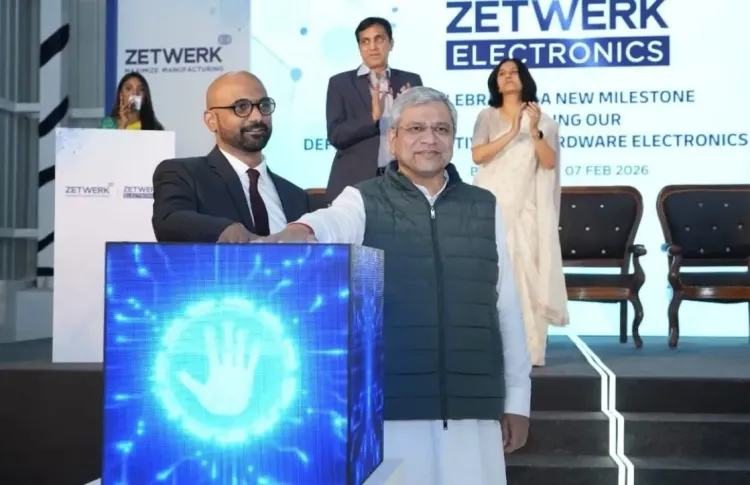
This appeal came after he inaugurated the 'Zetwerk Electronics' manufacturing facility at the KIADB Hi-Tech Hardware Park in Bengaluru's Mahadeva Kodigehalli.
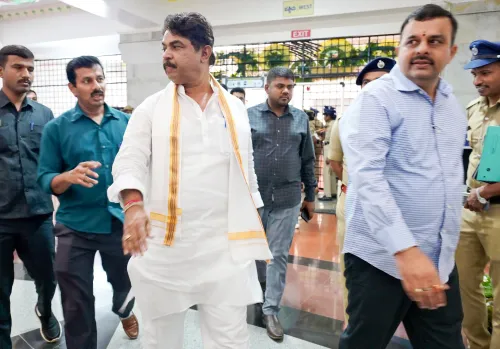
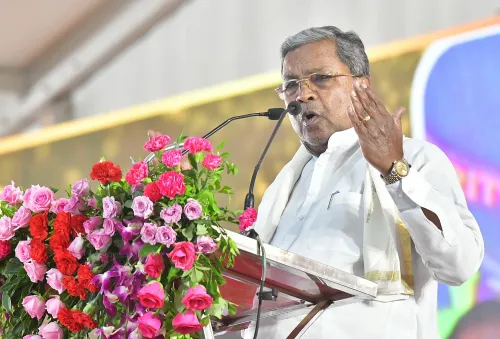
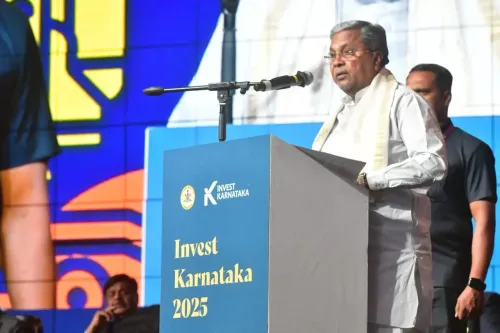
It is noteworthy that Chief Minister Siddaramaiah and Deputy Chief Minister D.K. Shivakumar have frequently criticized the Centre for allegedly undermining the principles of cooperative federalism and neglecting Karnataka.
Addressing Karnataka Minister for Large and Medium Industries M.B. Patil, who was in attendance, Minister Vaishnaw remarked, "We believe in cooperative federalism. When all states prosper, the nation as a whole flourishes. The Union Budget ultimately reflects in the states. Therefore, I urge everyone to adopt a broader vision rather than a limited outlook."
He added, "Our goal is to transform India into a Viksit Bharat by 2047, a vision articulated by our Prime Minister. Let’s unite and focus intently on this objective."
Discussing the electronics component manufacturing scheme, he noted significant progress in a short span.
"With the shift in focus from finished products to electronics components, the sector has experienced exponential growth. We have already secured 46 approvals, with investments exceeding Rs 10,000 crore flowing into Karnataka," he stated.
He highlighted that investments are being made nationwide and that Finance Minister Nirmala Sitharaman had boosted the budget for the electronics component manufacturing scheme from Rs 22,000 crore to Rs 40,000 crore.
"This journey is just commencing, and we expect rapid acceleration in the electronics manufacturing sector," he expressed.
Minister Vaishnaw revealed that Prime Minister Modi has set an ambitious target of $500 billion in electronics production by the fiscal year 2030–31.
"We need to act swiftly. We are open to new ideas and willing to adjust our policies to support industry needs," he added.
Pleased with recent advancements, he remarked, "It’s encouraging to witness the development of end-to-end two-nanometre chip designs in India, marking a significant milestone. Equipment manufacturers are beginning to establish a presence in India, with companies like Applied Materials and Lam Research already on board. Our next goal is to attract ASML."
ASML Holding N.V., a Dutch multinational, is recognized as the leading supplier of photolithography systems for the semiconductor industry.
Expressing satisfaction with the ongoing progress, he noted that commercial production is set to commence this year.
"In a few weeks, the first commercially produced chip will emerge from a semiconductor plant. Stay tuned! Semicon 2.0 will be larger, focusing on design, equipment manufacturing, chemicals, gases, validation, yield enhancement, and all functions necessary for a sustainable semiconductor ecosystem," he stated.
He mentioned that talent development in the sector is on track.
"We aim to produce 85,000 semiconductor engineers in the next decade. In just four years, we have trained 67,000 engineers. A significant portion of chip design will occur in India, representing a major advancement in the coming years," he concluded.
"We have outlined a roadmap from 28 nanometres to 7 nanometres under Semicon 2.0, and afterward, we will target 2 to 3 nanometres. I thank all industry partners for their support," the Union Minister remarked.
Point of View
It's vital to recognize that collaborative efforts between state and central governments can drive significant progress. The push for 'Viksit Bharat' by 2047 reflects a shared vision that can only be realized through unity and cooperation across all levels of governance.
NationPress
19 Sept 2026
Frequently Asked Questions
What is 'Viksit Bharat'?
Viksit Bharat refers to the vision of a developed India by the year 2047, marking 100 years of independence.
What role does cooperative federalism play?
Cooperative federalism encourages collaboration between state and central governments to achieve common goals effectively.
Why is the electronics sector important?
The electronics sector is crucial for economic growth, innovation, and job creation, contributing significantly to India's global competitiveness.
How many semiconductor engineers are targeted for training?
The goal is to train 85,000 semiconductor engineers over the next ten years.
What is Semicon 2.0?
Semicon 2.0 is an initiative aimed at advancing India's semiconductor ecosystem, focusing on design, manufacturing, and sustainable practices.