Lee Jae Myung Returns from India, Vietnam with Major Economic Deals
Synopsis
South Korean President Lee Jae Myung returned from a six-day India-Vietnam tour with 15 MOUs, a shipyard joint-venture framework with India, and dual CEPA upgrade pledges targeting $50B bilateral trade by 2030, a strategic hedge against Middle East energy disruptions.
Key Takeaways
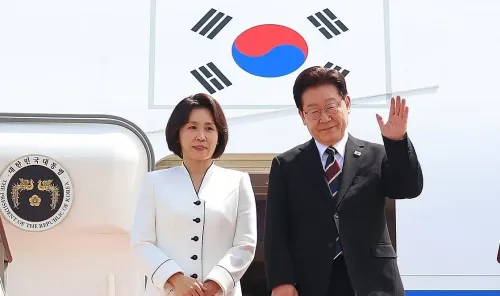
President Lee Jae Myung completed a six-day diplomatic tour of India and Vietnam , returning to Seoul on April 25, 2025 .
15 MOUs were signed during the Lee-Modi summit in New Delhi , spanning critical minerals, energy, AI, finance, and shipbuilding.
Both India and Vietnam pledged to upgrade their respective CEPA agreements with South Korea, targeting $50 billion in bilateral trade by 2030 from the current $25 billion .
A landmark agreement was signed to explore the joint construction of a shipyard in India , a potential flagship project in the bilateral relationship.
President Lee cited Middle East instability as a key driver for strengthening energy and raw material supply chain cooperation with both nations.
India , now the world's fourth-largest economy with a 1.5 billion population , and Vietnam are central to South Korea's Indo-Pacific economic diversification strategy.
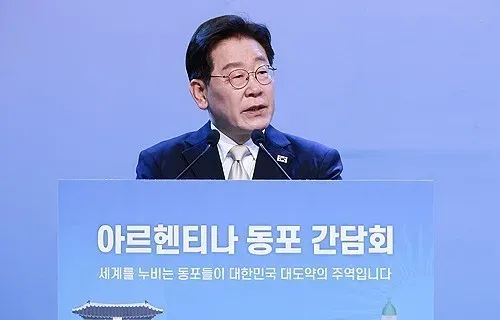
South Korean President Lee Jae Myung returned to Seoul on Friday, April 25, after completing a high-stakes six-day diplomatic tour covering India and Vietnam, with a sharp focus on securing energy supply chains, critical minerals, and strategic economic partnerships amid growing instability triggered by the Middle East conflict.
Summit Outcomes with India
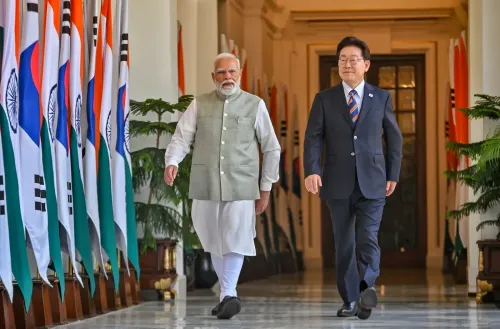
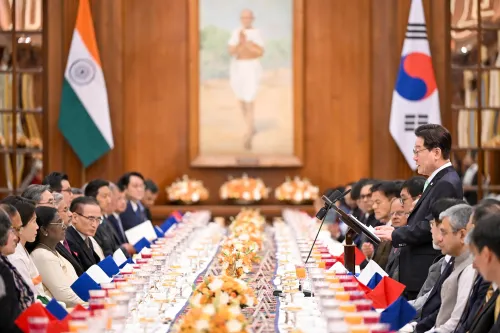
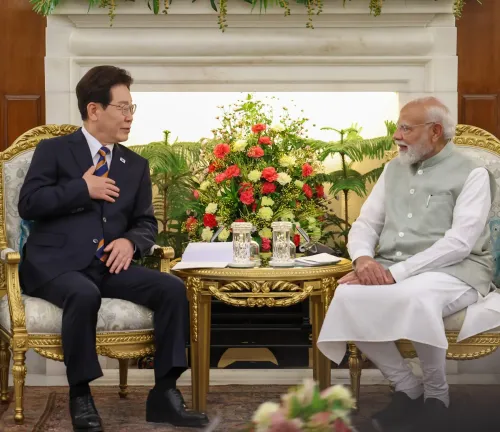
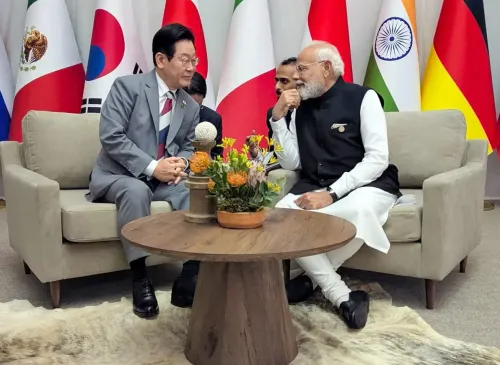
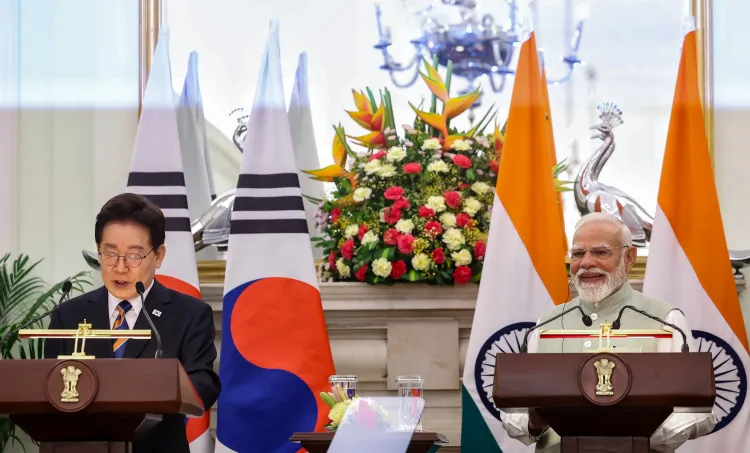
On Monday, President Lee held a bilateral summit with Indian Prime Minister Narendra Modi in New Delhi, resulting in a broad agreement to deepen cooperation across critical minerals, energy, artificial intelligence, finance, and shipbuilding. The meeting produced 15 Memorandums of Understanding (MOUs), signalling the depth of intent from both sides.
A key highlight was the signing of an agreement to explore the joint construction of a shipyard in India, a sector where South Korea holds world-class expertise and India offers vast cost advantages and growing maritime ambitions. President Lee personally expressed optimism about collaboration in shipbuilding, calling it a sector of mutual strategic interest.
Both nations also pledged to fast-track negotiations to upgrade their Comprehensive Economic Partnership Agreement (CEPA), with a shared target of doubling bilateral trade from the current $25 billion to $50 billion by 2030. India, now the world's fourth-largest economy with a population of approximately 1.5 billion, represents a significant growth market for South Korean exports and investment.
Vietnam Summit: Supply Chain Resilience at the Core
On Wednesday, President Lee met Vietnam's top leader To Lam in Hanoi, where discussions centred on energy infrastructure, technology collaboration, and tightening supply chain coordination. Vietnam, a manufacturing powerhouse deeply integrated into global electronics and semiconductor supply chains, is a critical node for South Korea's industrial network.
In light of recent developments in the Middle East, we will continue to strengthen bilateral cooperation to ensure a stable supply of energy resources and key raw materials, Lee stated following the Hanoi summit. The two sides also agreed to accelerate their own CEPA upgrade talks, mirroring the framework agreed upon with India.
Why This Trip Matters Beyond Diplomacy
President Lee's choice of India and Vietnam as the destinations for one of his earliest major foreign trips is strategically deliberate. Both countries sit at the intersection of China+1 supply chain diversification strategies that South Korea, heavily dependent on Chinese rare earth and semiconductor material imports, is urgently pursuing.
This comes amid a broader global realignment, where nations are racing to secure critical mineral supply chains and reduce single-source dependency. India's vast reserves of rare earth elements and Vietnam's manufacturing infrastructure make them natural partners for Seoul's industrial resilience agenda.
Notably, the CEPA upgrade push with India reflects a pattern: South Korea has been recalibrating its trade architecture since 2022, when supply chain shocks exposed vulnerabilities. The original India-South Korea CEPA was signed in 2009 and has been widely regarded as underperforming its potential, making the current upgrade push both economically and politically significant.
Geopolitical Context: Middle East Uncertainty as a Catalyst
President Lee's explicit reference to Middle East developments as a driving factor behind the energy cooperation agenda underscores how regional conflicts are reshaping global trade diplomacy. South Korea imports over 60% of its crude oil from the Middle East, making supply disruption scenarios an existential economic concern.
By locking in energy and raw material cooperation frameworks with India and Vietnam, Seoul is effectively building a geopolitical hedge, reducing exposure to any single conflict zone while expanding its influence in the rapidly growing Indo-Pacific economic corridor.
What Comes Next
The immediate next steps will involve translating the 15 MOUs signed with India into binding agreements and initiating formal CEPA upgrade negotiations with both nations. Industry watchers will closely monitor progress on the India shipyard joint venture, which could become a flagship project in the bilateral relationship. The $50 billion trade target by 2030 with both India and Vietnam will serve as the key benchmark for measuring the real-world impact of President Lee's diplomatic outreach.
Point of View
Exposed brutally by post-2022 global disruptions. The push to double trade with India to $50 billion and fast-track CEPA upgrades with both nations signals that Seoul is finally treating the Indo-Pacific not as a secondary theatre but as its primary economic lifeline. What the mainstream narrative misses is the shipyard deal with India, combining South Korea's global dominance in shipbuilding with India's desperate need for maritime capacity, making this potentially the most commercially transformative outcome of the entire trip. If these MOUs translate into binding agreements, India and South Korea could emerge as anchor partners in each other's industrial futures, a shift with profound implications for the regional balance of economic power.
NationPress
23 Sept 2026
Frequently Asked Questions
What did South Korean President Lee Jae Myung achieve during his India visit?
President Lee Jae Myung signed 15 MOUs with India during his summit with Prime Minister Narendra Modi in New Delhi, covering critical minerals, energy, AI, finance, and shipbuilding. Both nations also agreed to upgrade their CEPA to target $50 billion in bilateral trade by 2030.
What was agreed between South Korea and Vietnam during Lee's Hanoi summit?
President Lee Jae Myung and Vietnam's top leader To Lam agreed to strengthen cooperation in energy, infrastructure, and technology, and to coordinate on supply chain resilience. Both sides also pledged to accelerate CEPA upgrade negotiations.
Why did South Korea prioritise India and Vietnam for this diplomatic tour?
South Korea is actively diversifying its energy and supply chain dependencies away from volatile regions, particularly amid the Middle East conflict. India and Vietnam offer critical mineral reserves, manufacturing capacity, and growing consumer markets essential to South Korea's industrial resilience strategy.
What is the India-South Korea CEPA and why is it being upgraded?
The India-South Korea Comprehensive Economic Partnership Agreement was originally signed in 2009 and has been widely seen as underutilising its potential. The upgrade aims to modernise trade terms and help both nations achieve a $50 billion bilateral trade target by 2030, up from the current $25 billion.
What is the significance of the shipyard agreement between India and South Korea?
The agreement lays the groundwork for the joint construction of a shipyard in India, combining South Korea's world-leading shipbuilding expertise with India's cost advantages and growing maritime sector ambitions. This could become one of the most commercially significant outcomes of President Lee's India visit.