Anand Mahindra hails India's sprint surge after 10.09 record
Synopsis
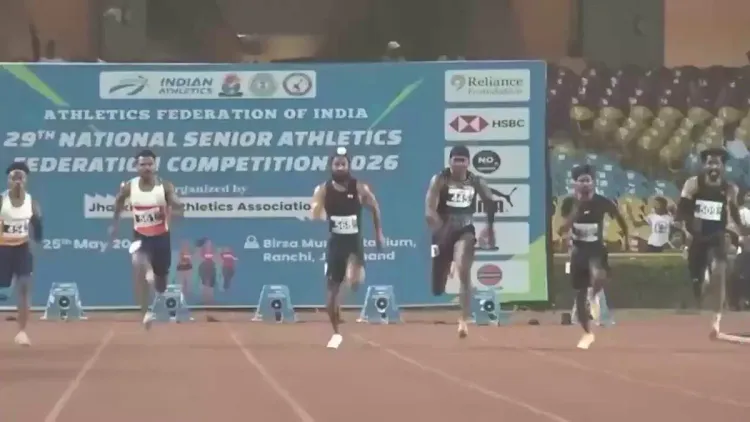
Mahindra Group chairman Anand Mahindra has praised sprinters Gurindervir Singh and Animesh Kujur after India's 100m national record improved sharply to 10.09 seconds, calling them proof that India can compete at the highest level and eyeing the elusive sub-10 barrier.
Key Takeaways
Mahindra Group chairman Anand Mahindra posted on May 25, 2026 praising India's 100-metre sprinting breakthrough.
India's national record in the 100m has improved from 10.26 seconds (as recently as 2023) to 10.09 seconds .
Sprinters Gurindervir Singh and Animesh Kujur were specifically credited for the surge in performance.
Mahindra placed the 10.09 mark in global context: Olympic finalists run 9.8–9.9 seconds ; World Championship semifinalists around 10.0–10.1 seconds .
He cited Su Bingtian of China's 9.83-second run at the 2021 Tokyo Olympics as the Asian benchmark India must chase.
The sub-10-second barrier was described as 'the final frontier' — the milestone that would confirm India's arrival in elite global sprinting.
Mahindra Group chairman Anand Mahindra took to X on Monday, May 25, 2026, to celebrate a new chapter in Indian sprinting, calling the recent performances of Gurindervir Singh and Animesh Kujur 'significant' and declaring that they 'make us believe we do have what it takes to compete at the highest level.'
Context
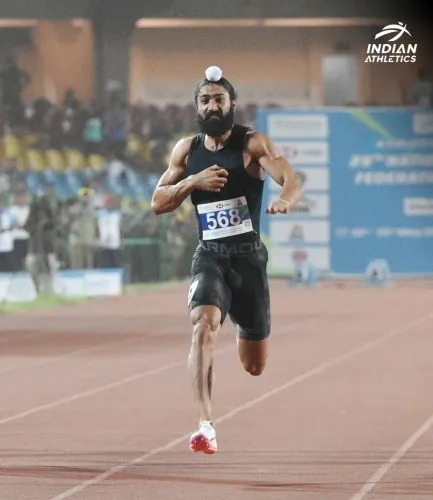
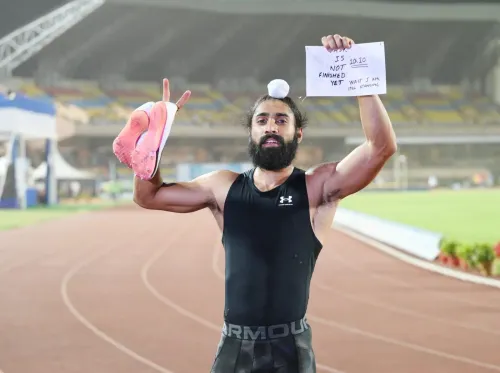
The post arrives days after Gurindervir Singh's performance captured widespread attention — described by Mahindra as the idea of an all-new 'Flying Sikh' — a reference to the legendary Milkha Singh, who earned that nickname for his iconic 400-metre runs at the 1958 Asian Games and the 1960 Rome Olympics. The comparison signals just how rare it is for an Indian male sprinter to enter elite 100-metre territory.
Mahindra noted that India's national record stood at 10.26 as recently as 2023 and has now moved to 10.09 — a sharp improvement in a short window. 'One of sport's rarest achievements,' he wrote of the sub-10-second barrier that still lies ahead.
Policy Backdrop
India has historically channelled Olympic resources into a narrow band of sports, leaving athletics — and sprinting in particular — underdeveloped relative to its population. Incremental investments in talent identification and overseas training exposure since the early 2010s have begun to bear fruit, with track athletes gradually closing the gap to global benchmarks.
Mahindra himself contextualised the progress against global standards: Olympic finalists typically run in the 9.8–9.9 second range; World Championship semifinalists cluster around 10.0–10.1; and Asian and Commonwealth medal contention can begin around 10.0–10.15 depending on the field. By that yardstick, a 10.09 puts Gurindervir 'at the edge of genuine international competitiveness,' Mahindra wrote.
For additional perspective, Mahindra cited Su Bingtian of China, who clocked 9.83 seconds in the 100-metre semifinals at the 2021 Tokyo Olympics — the Asian benchmark that frames how far, and how close, India's best now stand.
Stakeholders and Impact
The Athletics Federation of India and national coaches will find in Mahindra's post a high-visibility endorsement of the sprint programme at a moment when public attention is unusually focused on the discipline. For young athletes, the chairman's framing — invoking Jim Hines, the American sprinter who became the first to officially break the 10-second barrier at the 1968 Mexico City Olympics — places India's current runners inside a global historical narrative rather than a purely domestic one.
Mahindra's large social media following means the post amplifies awareness of Gurindervir and Animesh beyond the athletics community, potentially influencing sponsor interest and grassroots participation in track events across the country.
What's Next
The immediate horizon for Indian sprinters includes qualification campaigns for the 2028 Los Angeles Olympics and performance targets at the next World Athletics Championships and Asian Games. The sub-10-second barrier — which Mahindra called 'the final frontier' and 'one of sport's rarest achievements' — remains the defining milestone that would confirm India's arrival as a genuine force in global sprinting.
As Mahindra put it, 'A huge challenge still lies ahead' — but the trajectory, compressed into a remarkably short timeframe, has opened a conversation that was unimaginable to a generation of Indian schoolchildren who watched Hines make history in Mexico City more than five decades ago.
Point of View
Mahindra performs a function that athletics administrators rarely manage: translating raw timings into a narrative of national ambition. The 'Flying Sikh' framing deliberately connects the present to Milkha Singh's legacy, suggesting a generational relay baton is finally being picked up. With the 2028 Los Angeles Olympics on the horizon, such visibility from business leaders could accelerate the private sponsorship and infrastructure investment that government programmes alone have not delivered.
NationPress
9 Oct 2026
Frequently Asked Questions
What is India's current 100m national record in athletics?
India's 100-metre national record has improved to 10.09 seconds, down from 10.26 seconds recorded as recently as 2023, according to Anand Mahindra's post on May 25, 2026.
Who is Gurindervir Singh and why is he called the Flying Sikh?
Gurindervir Singh is an Indian sprinter whose recent 100-metre performances prompted comparisons to Milkha Singh, the legendary athlete originally nicknamed the Flying Sikh for his 400m feats at the 1958 Asian Games and 1960 Rome Olympics.
What time do you need to run to reach the Olympics in the 100 metres?
Olympic 100-metre finalists typically run in the 9.8–9.9 second range, while World Championship semifinalists are often around 10.0–10.1 seconds, according to research cited by Anand Mahindra.
What was Su Bingtian's 100m time at the Tokyo Olympics?
Chinese sprinter Su Bingtian clocked 9.83 seconds in the 100-metre semifinals at the 2021 Tokyo Olympics, setting the Asian benchmark that Indian sprinters are now working towards.
When did Jim Hines first break the 10-second barrier in the 100 metres?
Jim Hines of the United States became the first athlete to officially break the 10-second barrier in the 100 metres at the 1968 Mexico City Olympics.