Anand Mahindra Hails India's Deeptech Startup Wave

Synopsis
Mahindra Group chairman Anand Mahindra declared India's startup ecosystem 'on steroids' on Oct 19, 2026, spotlighting a shift toward deeptech and hardware, and endorsed the new book 'Lift-Off Nation' by Rajan Anandan and Saurabh Srivastava as an apt description of India's tech moment.
Key Takeaways
Mahindra Group chairman Anand Mahindra on October 19, 2026 , called India's startup ecosystem 'on steroids,' emphasising deeptech and hardware over software services.
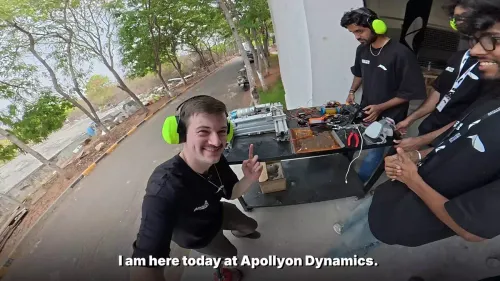
He shared videos by technology journalist Ashlee Vance and @RuntimeBRT showcasing Indian labs, workshops, and factories building advanced technology.
Rajan Anandan (former MD, Google India) and Saurabh Srivastava (co-founder, NASSCOM) have released a book calling India a 'Lift-Off Nation.' India's policy groundwork — Startup India (2016) and Make in India (2014) — alongside production-linked incentives has supported the pivot toward hardware and advanced manufacturing.
Global supply-chain diversification is adding external tailwind to India's domestic tech-manufacturing ambitions.
Mahindra called young Indian entrepreneurs 'daring to build things we once assumed could only be built elsewhere,' saluting them directly.
India's startup story is shifting gears — and Mahindra Group chairman Anand Mahindra wants the world to pay attention. On Monday, October 19, 2026, Mahindra took to X to declare that the Indian startup ecosystem is 'on steroids,' pivoting sharply from the software-services narrative toward something far more ambitious: deeptech, hardware, advanced manufacturing, and cutting-edge chemical processes.
Sharing videos credited to technology journalist Ashlee Vance and the @RuntimeBRT handle, Mahindra described the footage as 'just a glimpse of what's being cooked up in labs, workshops and factories across India.' The message was pointed: this generation of Indian entrepreneurs is not building apps. They are building things.
A 'Lift-Off Nation' — and the book making the case
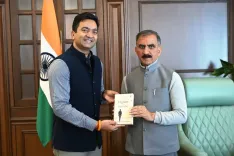
Mahindra's post arrived in near-perfect sync with the release of a new book titled 'Lift-Off Nation' — co-authored by Rajan Anandan, former Managing Director of Google India and a prominent deeptech investor, and Saurabh Srivastava, co-founder of NASSCOM and one of the architects of India's early IT-services industry. Mahindra called the title 'an apt description,' adding that he believes 'the world is about to witness a tidal wave of technological innovation emerging from India.'
The pairing of Anandan and Srivastava gives the book unusual authority. Srivastava helped wire together the scaffolding of India's first tech wave in the 1990s; Anandan has spent the years since betting on what comes next. Together, they represent a line of continuity from the outsourcing era to the invention era.
From IT services to hardcore hardware — the structural shift
The excitement Mahindra is pointing to did not appear overnight. India has been moving, deliberately if unevenly, from IT services exports toward building indigenous capability in hardware, semiconductors, and advanced manufacturing. The Startup India initiative, launched in 2016, simplified regulations and opened tax pathways for new ventures. The Make in India programme, announced in 2014, pushed for domestic manufacturing depth. More recently, production-linked incentive schemes and R&D grants have been directed specifically at encouraging the shift into physical technology.
Global supply-chain diversification — driven partly by geopolitical realignments away from concentrated manufacturing in a single geography — has added tailwind. International companies hunting for alternative production bases have begun looking at India not just as a low-cost assembly destination but as a potential technology partner.
Mahindra's salute — and what the moment signals
Mahindra closed his post with a direct tribute: 'My salute to them' — the young entrepreneurs 'daring to build things we once assumed could only be built elsewhere.' The phrase carries weight coming from the chairman of a conglomerate that itself spans automobiles, aerospace components, and farm equipment. He knows what it takes to manufacture at scale in India.
The immediate question the book and the post together raise is whether government policy will keep pace. Observers are watching for the next Union Budget to signal whether deeptech funding and semiconductor fabrication incentives will be expanded. The entrepreneurs in those labs and workshops Mahindra referenced are building regardless — but the velocity of liftoff depends, in part, on what runway policy lays down.
India has spent three decades exporting talent and code. The bet now is that the next three will be about exporting the machines, the molecules, and the breakthroughs themselves.
Point of View
From labour-arbitrage IT services to capital-intensive deeptech. For conglomerates like Mahindra that straddle manufacturing and technology, validating this narrative also positions the group as a natural partner or investor for the next cohort of hardware entrepreneurs. The 'Lift-Off Nation' book by two credible institution-builders adds intellectual scaffolding to what has largely been an investor-community talking point, potentially pulling in policy attention ahead of the next Union Budget. The broader pattern — a nation using geopolitical supply-chain anxiety as an opportunity to move up the value chain — mirrors South Korea and Taiwan's industrial trajectories, though India's path remains more pluralistic and policy-dependent.
NationPress
19 Oct 2026
Frequently Asked Questions
What did Anand Mahindra say about Indian startups?
On October 19, 2026, Anand Mahindra said the Indian startup ecosystem is 'on steroids,' emphasising that the excitement is not just about software but about deeptech, manufacturing technology, hardware, and cutting-edge chemical processes being built by a new generation of Indian entrepreneurs.
What is the book 'Lift-Off Nation' about?
'Lift-Off Nation' is a book by Rajan Anandan, former Managing Director of Google India, and Saurabh Srivastava, co-founder of NASSCOM, which describes India as a nation on the cusp of a major wave of technological innovation. Specific contents of the book are yet to be widely reported.
Who is Rajan Anandan?
Rajan Anandan is the former Managing Director of Google India and a prominent investor focused on Indian startups and deeptech ventures.
Who is Saurabh Srivastava?
Saurabh Srivastava is a pioneering Indian entrepreneur and co-founder of NASSCOM, the industry body that helped shape India's IT services sector in the 1990s.
What government schemes support India's deeptech startups?
India's Startup India initiative (launched 2016) simplified regulations and offered tax benefits to new ventures, while the Make in India programme (launched 2014) promoted domestic manufacturing. Production-linked incentive schemes and R&D grants have more recently been directed at hardware and advanced manufacturing sectors.