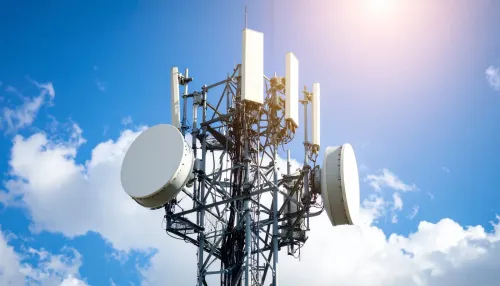
Is NFAP 2025 a Major Advancement for 5G Expansion? COAI Thinks So!

Synopsis
In a pivotal move, COAI praises NFAP 2025 for aligning India's spectrum planning with global trends, significantly boosting the telecom sector. The allocation of the 6425–7125 MHz band is set to enhance 5G and future 6G networks, promising faster and more affordable mobile services for millions of users nationwide.
Key Takeaways
NFAP 2025 aligns India's spectrum planning with global trends.
The 6425–7125 MHz band is critical for enhancing 5G and 6G networks.
Mid-band spectrum is essential for fast mobile broadband services.
Affordable network equipment will lead to cheaper mobile services.
COAI urges the government to designate additional spectrum for IMT use.
New Delhi, Dec 31 (NationPress) The Cellular Operators Association of India (COAI), representing India's telecom sector, expressed strong support for the government's recent announcement regarding the National Frequency Allocation Plan (NFAP) 2025. They view this initiative as a progressive measure that synchronizes India's spectrum planning with global trends and the escalating demands of digital connectivity.
In an official statement, COAI acknowledged the proactive stance of the Department of Telecommunications, emphasizing that this newly established framework illustrates the government's recognition of the critical role of spectrum in shaping the future of mobile networks and the digital economy.
One of the standout features of NFAP 2025 is the allocation of the 6425–7125 MHz frequency band for International Mobile Telecommunications (IMT), a pivotal decision that greatly increases the availability of mid-band spectrum. This will be instrumental in facilitating the rollout of 5G, 5G Advanced, and forthcoming 6G technologies in India,” COAI stated.
Another significant aspect of NFAP 2025 is the allocation of the 6425–7125 MHz band for IMT.
“This sends a positive message to global Original Equipment Manufacturers (OEMs) and other nations, paving the way for the development of an ecosystem for network equipment within this frequency range, thus enhancing service affordability,” the association added.
COAI noted that this strategic decision will greatly augment the availability of mid-band spectrum, bolstering the growth of 5G, 5G Advanced, and future 6G services throughout the nation.
The association highlighted that mid-band spectrum is vital for providing fast, high-capacity, and dependable mobile broadband services to users.
Moreover, COAI reiterated that this move conveys a positive outlook to global equipment manufacturers and other countries, thereby fostering a robust ecosystem for network equipment in this band.
This is anticipated to lower costs and enhance the affordability of mobile services for consumers in India.
Nevertheless, the industry body reiterated its ongoing request for the designation of the remaining 500 MHz spectrum within the 5925–6425 MHz range for IMT purposes.
COAI emphasized the necessity of this allocation, considering India's unique market dynamics, including its high population density, rapidly growing mobile data consumption, and comparatively low fixed broadband penetration.
Lt Gen Dr. S.P. Kochhar, Director General of COAI, reaffirmed the industry’s commitment to collaborating closely with the government and other stakeholders.
Point of View
NFAP 2025 signifies a landmark moment in India's digital evolution. The COAI's praise for the government's initiative highlights a collaborative approach towards enhancing mobile connectivity, crucial for a nation with unique challenges and opportunities.
NationPress
2 Oct 2026
Frequently Asked Questions
Why is NFAP 2025 important for 5G?
NFAP 2025 is crucial for 5G as it identifies the 6425–7125 MHz band for International Mobile Telecommunications, enhancing mid-band spectrum availability for the rollout of advanced mobile networks.
How will NFAP 2025 affect mobile service costs?
The allocation of the new frequency bands is expected to lower costs for network equipment, thereby making mobile services more affordable for consumers.
What does COAI say about mid-band spectrum?
COAI emphasizes that mid-band spectrum is essential for delivering reliable, high-capacity mobile broadband services, which are vital for the growing digital economy.
What are the future implications of NFAP 2025?
The strategic planning under NFAP 2025 is expected to support the expansion of not just 5G but also future 6G technologies, positioning India as a leader in digital communication.