Will India Take Every Necessary Step to Defend Itself? EAM Jaishankar
Click to start listening
Synopsis
External Affairs Minister S Jaishankar emphasizes India's right to self-defense and its commitment to addressing threats independently. His address at IIT Madras highlights India's unique trajectory as a civilizational power and the importance of clear communication in diplomacy.
Key Takeaways
- India's right to self-defense is emphasized by EAM Jaishankar.
- Cross-border terrorism undermines cooperation and goodwill.
- India's democracy is inclusive and representative.
- Effective communication is vital for successful diplomacy.
- India's humanitarian efforts during COVID-19 highlight its role in global stability.
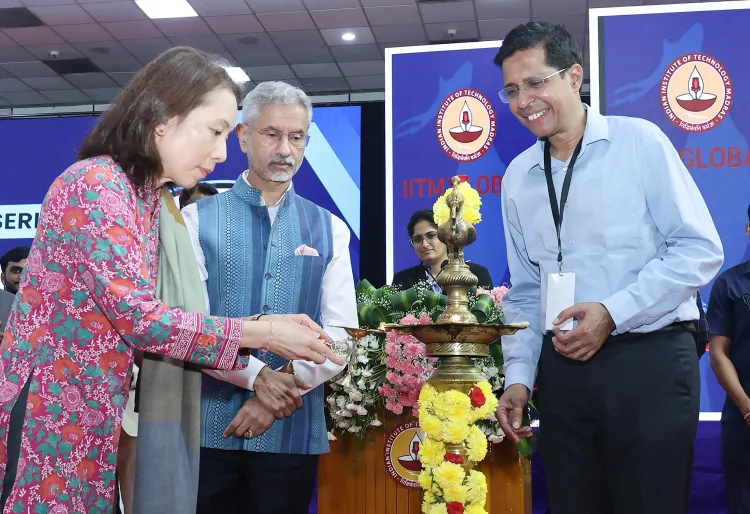
Chennai, Jan 2 (NationPress) External Affairs Minister S Jaishankar stated on Friday that India has the right to defend itself and will autonomously decide its course of action in response to any threats or acts of terrorism that jeopardize its citizens.
“India will do whatever is necessary to ensure its defense,” he declared during the inauguration of the Shaastra 2026- IIT Madras Techno-Entertainment fest in Chennai.
In a subtle reference to Pakistan, EAM Jaishankar pointed out that ongoing cross-border terrorism erodes goodwill and negates advantages like water-sharing agreements, as cooperation cannot thrive in an atmosphere of violence.
Addressing students and faculty at IIT Madras on themes such as democracy, diplomacy, and India's expanding role on the world stage, his speech illustrated a vibrant image of a nation steeped in ancient wisdom yet confidently addressing modern global challenges.
Jaishankar also described India’s unique evolution as a civilizational power and its contribution to a contemporary, multi-polar world. He stressed that India’s foreign policy is deeply rooted in its historical context, values, and cultural confidence while adapting to current global issues.
“India is one of the few ancient civilizations that has successfully transitioned into a modern nation-state,” Jaishankar remarked.
He emphasized this continuity grants the nation a robust historical awareness and a distinctive global perspective, setting it apart from countries that have emerged more recently.
Highlighting India's civilizational richness, the minister observed that India is among the few ancient civilizations that has effectively become a modern democratic nation.
The Union Minister underlined that India’s choice to embrace the democratic political framework at the time of Independence transformed the system from being a Western-centric model to a universal concept. He noted that Indian democracy is intricately linked to its cultural and social diversity, ensuring the nation remains both inclusive and representative.
Jaishankar highlighted the significance of clear and effective communication in diplomacy, stating that transparent dialogue aids in preventing misunderstandings between nations and fosters mutual respect globally.
“Effective communication in diplomacy is vital to avert misunderstandings between nations,” the Minister added, underscoring India's commitment to partnerships based on mutual respect and open dialogue.
Reflecting on recent global challenges, Jaishankar noted India's humanitarian efforts during the COVID-19 pandemic.
He characterized the provision of vaccine assistance to other countries as a major global contribution, underscoring India’s dedication to international stability. Jaishankar encouraged the academic community to maintain a global perspective while staying grounded in Indian values.
Point of View
I affirm that India’s proactive stance on self-defense and diplomacy reflects its commitment to safeguarding its citizens and upholding its sovereignty. In a world filled with challenges, this approach is vital for national and international stability.
NationPress
03/01/2026
Frequently Asked Questions
What did EAM Jaishankar say about India's defense?
EAM Jaishankar stated that India has the right to defend itself and will independently determine its response to threats or acts of terrorism.
How did Jaishankar address cross-border terrorism?
He highlighted that persistent cross-border terrorism undermines goodwill and negates benefits like water-sharing agreements.
What is India's stance on democracy according to Jaishankar?
He emphasized that India's democracy is deeply linked to its cultural and social diversity, ensuring it remains inclusive and representative.
What did Jaishankar say about communication in diplomacy?
He stressed that effective communication is crucial to prevent misunderstandings between nations and to foster mutual respect.
What humanitarian efforts did India undertake during the COVID-19 pandemic?
India provided vaccine assistance to other nations, showcasing its commitment to international stability.