Why Are Imported Agricultural Prices Rising in South Korea?
Click to start listening
Synopsis
Amid the weakening of the South Korean won, imported agricultural prices are soaring, significantly affecting food costs. This article explores how these price hikes impact consumers and the agricultural market in South Korea, shedding light on the role of currency depreciation.
Key Takeaways
- Imported agricultural prices in South Korea are rising significantly.
- The South Korean won has weakened against the US dollar, affecting import costs.
- Prices for coffee, beef, and pork have surged dramatically.
- Climate change is impacting the cost of domestically produced goods.
- Consumers should prepare for higher food prices in the near future.
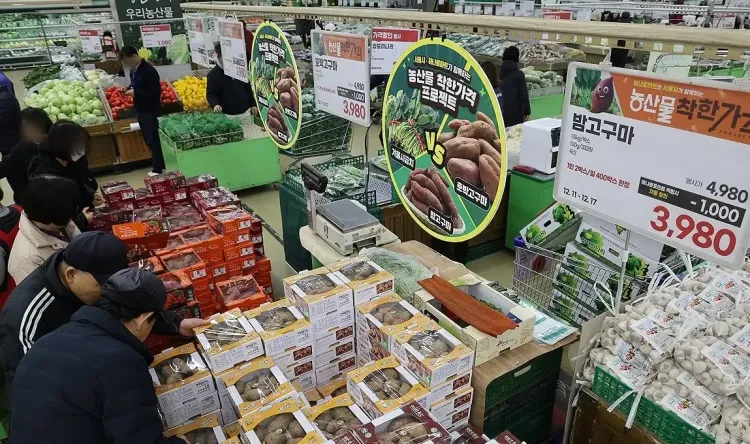
Seoul, Dec 21 (NationPress) The costs of key imported agricultural products in South Korea have surged dramatically in recent years, surpassing global price hikes due to the depreciation of the South Korean won against the US dollar, data revealed on Sunday.
As reported by the Bank of Korea, the import price index for coffee reached 307.12 in November when measured in U.S. dollars and 379.71 in Korean won, using 2020 as the base year set at 100, according to Yonhap news agency.
This data indicates that global coffee prices have escalated approximately threefold over the last five years, yet they have nearly quadrupled when expressed in Korean won.
The data further revealed that the price of imported beef rose by 30% during this period in U.S. dollar terms but skyrocketed by 60.6% in Korean won terms.
Similarly, the price of imported pork increased by 5.5% in U.S. dollars while it surged by 30.5% in Korean won terms.
The Korean won traded at about the 1,100-won mark in 2021 before weakening to the upper 1,200-won range in 2022. By the fourth quarter of 2025, the average exchange rate was recorded at 1,450 won per dollar.
The price of imported fresh seafood saw an 11% decline in U.S. dollar terms, yet increased by 10% in Korean won, illustrating the effects of currency depreciation.
South Korea relies heavily on imports of raw materials like sugar and flour, remarked Choi Chul, a professor of consumer economics at Sookmyung Women's University.
With the rise in prices of domestically produced agricultural products due to climate change, an increase in imported goods linked to foreign exchange rates will elevate overall food prices, including processed items, Chul concluded.
Point of View
It is crucial to acknowledge the implications of rising agricultural import prices on food security and consumer spending. This trend highlights a pressing issue that requires attention from policymakers to support both domestic producers and consumers in South Korea.
NationPress
21/12/2025
Frequently Asked Questions
What factors are driving the rise in agricultural prices in South Korea?
The depreciation of the South Korean won against the US dollar and the rising costs of domestically produced agricultural products due to climate change are key factors.
How much have coffee prices increased in South Korea?
Coffee prices have surged nearly fourfold when converted to Korean won over the past five years.
What impact does currency depreciation have on food prices?
Currency depreciation increases the cost of imported goods, which in turn raises overall food prices, including processed products.
What role do imports play in South Korea's agricultural market?
South Korea imports a significant amount of raw materials, such as sugar and flour, which are essential for food production.
What should consumers expect in terms of food prices moving forward?
Consumers may face higher food prices due to the combined effects of rising import costs and domestic agricultural price increases.