Thermal shocks unlock drug delivery, RRI scientists find
Synopsis
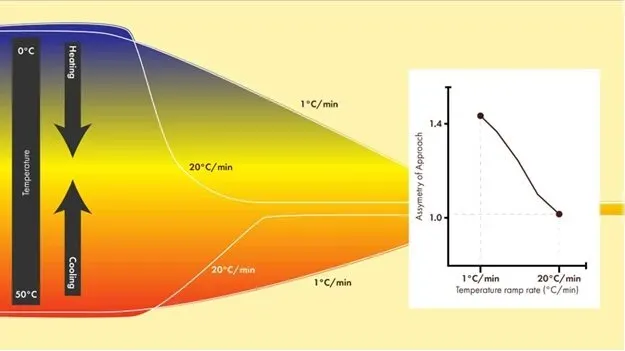
Indian scientists at RRI have found that rapid temperature spikes can make otherwise static, memory-retaining jammed materials flow temporarily — a discovery that could transform how drugs are delivered inside the body. The key insight: the heating and cooling paths are not symmetric, and that asymmetry is the mechanism worth exploiting.
Key Takeaways
Raman Research Institute (RRI) scientists discovered that thermal shocks can momentarily liquefy jammed, glassy materials by erasing their memory imprints.
Experiments used microgel particles capable of absorbing 300–500 times their weight in water, refrigerated at 4 degrees Celsius for stability.
The suspension showed asymmetry between heating and cooling paths to a target of 20 degrees Celsius — behaviour dependent on the thermal route, not just end temperatures.
Findings were published in the Journal of Colloid and Interface Science , with Sonali Kawale as first author.
The research could enable targeted, controlled drug release that reduces side effects.
Next phase will compare thermal shocks with mechanical shocks to understand path-dependent dynamics more broadly.
Scientists at the Raman Research Institute (RRI), an autonomous institute under the Department of Science and Technology, have discovered that sudden temperature ramps — thermal shocks — can momentarily liquefy jammed materials by erasing their memory imprints, a breakthrough that could enable more precise, targeted drug delivery. The findings were published in the Journal of Colloid and Interface Science and announced in an official statement on Wednesday, 2 September.
What the Research Found
The team used densely packed microgel particles to simulate glassy, jammed materials — substances that behave structurally like liquids but mechanically like solids, and crucially, retain memory of past conditions. By applying rapid heating, researchers triggered particle rearrangements that pushed the system into a temporary liquid state, simultaneously wiping out path-dependent asymmetries.
Notably, the path the suspension followed to reach the target temperature of 20 degrees Celsius during heating was not a mirror image of the path taken during cooling — a phenomenon the team terms 'asymmetry.' The system's behaviour depended not just on starting and ending temperatures, but on the specific thermal route taken.
The Experiment in Detail
Sonali Kawale, a PhD student at RRI and first author of the paper, conducted the experiments using microgel particles — a material capable of absorbing 300 to 500 times its own weight in water, widely used in diapers and sanitary napkins. The particles were synthesised, ground to a fine powder, suspended in water, stirred for 24 hours, sonicated for 15 minutes, and refrigerated at 4 degrees Celsius for stability before testing.
Why It Matters for Drug Delivery
Jammed or glassy systems are common in pharmaceutical formulations, where controlled flow and release are critical. The study's findings suggest that thermal shocks could serve as a non-invasive trigger to initiate flow in otherwise static drug-carrying materials, enabling targeted and controlled drug release that reduces side effects. According to the official statement, 'it is essential to understand how external perturbations, thermal shocks in their case, influence the structural recovery of these materials.'
What Comes Next
The RRI team plans to extend this line of inquiry by examining how mechanical shocks — as opposed to thermal ones — influence path-dependent dynamics in jammed systems, and how the two types of perturbations compare. The research opens a broader question about whether similar memory-erasing effects can be achieved through non-thermal means, with implications for materials science and biomedical engineering alike.
Point of View
The field gains a toolkit, not just a finding.
NationPress
18 Oct 2026
Frequently Asked Questions
What did RRI scientists discover about thermal shocks and drug delivery?
Scientists at the Raman Research Institute found that sudden temperature ramps can momentarily push jammed, glassy materials into a liquid state by erasing their memory imprints. This temporary liquefaction could be used to trigger targeted drug release with fewer side effects.
What are jammed or glassy materials and why do they matter in medicine?
Jammed or glassy materials behave mechanically like solids but structurally like liquids, and they retain memory of past conditions. They are relevant to drug delivery because many pharmaceutical formulations use similar dense suspensions where controlled flow is essential for releasing medication at the right site.
What were the microgel particles used in the RRI experiment?
The microgel particles used by PhD researcher Sonali Kawale can absorb 300 to 500 times their weight in water and are the same material found in diapers and sanitary napkins. They were prepared through a precise process involving grinding, suspension in water, 24-hour stirring, sonication, and refrigeration at 4 degrees Celsius.
Where was the RRI study published?
The study was published in the Journal of Colloid and Interface Science, with Sonali Kawale, a PhD student at RRI, listed as the first author.
What is the next step in this research?
The RRI team plans to investigate how mechanical shocks — as opposed to thermal ones — affect path-dependent dynamics in jammed systems, and how the two types of perturbations compare in erasing material memory.