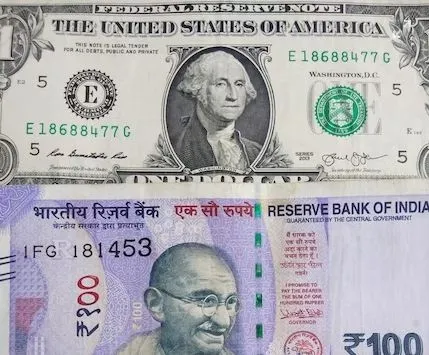
Rupee seen appreciating vs dollar in H1 FY27 as risks ease: Elara Securities

Synopsis
A new Elara Securities report projects the rupee appreciating against the dollar in H1 FY27, with FPI debt inflows via the FAR route surging to $1.7 billion in just 10 trading days after the RBI policy — more than seven times the prior pace. But three anticipated Fed rate hikes through January 2027 and a globally shrinking FDI pool cast a shadow over FY28.
Key Takeaways
Elara Securities projects the Indian rupee appreciating against the US dollar in H1 FY27 , oscillating in a 93–95 range.
FPI debt inflows via the FAR route surged to $1.7 billion in 10 trading days post-RBI policy, up from $229 million in the prior 10 days.
The Income-Tax Ordinance of 5 June 2026 made India's G-Sec investments tax-free for FPIs, driving the inflow acceleration.
Potential inclusion in the Global Bloomberg Bond Index could push combined flows to $80–85 billion .
Three US Fed rate hikes of 25 bps each — in September 2026 , December 2026 , and January 2027 — pose the primary risk to rupee strength.
The report flags structural concerns for FY28 amid a shrinking global FDI pool and soft FPI equity flow prospects.
The Indian rupee is likely to appreciate against the US dollar in the first half of FY27, supported by easing Middle East tensions and a clutch of policy measures by the Reserve Bank of India (RBI) and the government, according to a report by Elara Securities released on Monday, 22 June. The brokerage projects the rupee oscillating within a 93–95 range as current account pressures moderate and capital flows improve.
Key Drivers Behind the Rupee's Expected Strength
Elara Securities credited FX market stabilisation measures, tax relaxations on government bonds, and targeted incentives to attract debt-linked foreign exchange inflows for easing near-term stress on the currency. The landmark Income-Tax Ordinance of 5 June 2026 — which made India's G-Sec investments tax-free for Foreign Portfolio Investors (FPIs) — has, according to the report, triggered a resumption of meaningful flows into the Indian debt market while also moderating yields.
Notably, FPI inflows into India's debt via the Fully Accessible Route (FAR) surged to $1.7 billion in just 10 trading days following the RBI policy announcement, compared with a mere $229 million in the 10 trading days prior. This sharp acceleration underscores the policy's immediate market impact.
Bloomberg Bond Index Inclusion Could Add Billions
The report flagged a potentially transformative development: the possible inclusion of India in the Global Bloomberg Bond Index. If materialised, combined debt inflows — including the post-ordinance FPI surge — could total $80–85 billion, providing a substantial cushion for the rupee and the broader balance of payments position through FY27.
US Rate Hike Cycle Poses a Key Risk
Despite the near-term optimism, Elara Securities cautioned that a renewed US Federal Reserve rate hike cycle could cap the rupee's appreciation. The firm forecasts three rate hikes of 25 basis points each from the Fed — in September 2026, December 2026, and January 2027 — with a cumulative 50 basis-point hike expected in H2 FY27. Such tightening could reinvigorate stress on emerging market currencies, including the rupee, limiting how much ground it can gain.
This comes amid a continued global concentration of AI-related capital flows into the United States, which is drawing risk appetite away from emerging markets. The report described the outlook for FPI equity inflows into India as 'sombre' under this scenario.
FY28 Outlook: Structural Concerns Remain
Even as current account funding risks for FY27 appear to be dissipating, the report raised concerns about the durability of foreign capital flows in FY28. A globally shrinking FDI pie, tightening US monetary policy, and likely soft FPI equity flows into India present headwinds beyond the near-term window of relative stability.
The trajectory of the rupee in the second half of FY27 and into FY28 will hinge critically on how aggressively the Fed tightens and whether India can sustain its appeal as a debt market destination amid rising global yields.
Point of View
But it reflects a policy-induced spike rather than a structural shift in India's capital account attractiveness. The real question is whether the G-Sec tax exemption creates durable demand or merely front-loads flows that would have arrived anyway. With the Fed potentially hiking three times through January 2027 and global FDI contracting, the window of rupee comfort in H1 FY27 may prove narrower than the headline range of 93–95 suggests. India's FY28 external financing outlook deserves more scrutiny than the near-term optimism is currently getting.
NationPress
20 Sept 2026
Frequently Asked Questions
Why is the Indian rupee expected to appreciate against the dollar in H1 FY27?
According to an Elara Securities report, easing Middle East tensions, RBI policy measures, and the government's Income-Tax Ordinance of 5 June 2026 — which made G-Sec investments tax-free for FPIs — have reduced near-term current account pressures and boosted capital inflows. These factors are expected to keep the rupee in an appreciating trend within a 93–95 range through H1 FY27.
What is the FAR route and how much have FPI inflows surged?
The Fully Accessible Route (FAR) allows foreign portfolio investors to invest in specified Indian government securities without any limit. FPI inflows via this route surged to $1.7 billion in 10 trading days after the RBI policy announcement, compared with $229 million in the 10 trading days before it.
How could US Federal Reserve rate hikes affect the rupee?
Elara Securities forecasts three Fed rate hikes of 25 basis points each in September 2026, December 2026, and January 2027. A cumulative 50-basis-point hike in H2 FY27 could reinvigorate stress on emerging market currencies including the rupee, capping its appreciation potential.
What is the significance of India's possible inclusion in the Bloomberg Bond Index?
If India is included in the Global Bloomberg Bond Index, combined foreign debt inflows — including the surge already triggered by the tax ordinance — could total $80–85 billion, significantly supporting the rupee and India's balance of payments position.
What are the risks to the rupee outlook for FY28?
The report flags a globally shrinking FDI pool, tightening US monetary policy, and likely soft FPI equity inflows into India as structural headwinds for FY28. The concentration of AI-related capital flows into the US is also expected to dampen emerging market risk appetite, keeping the FPI equity outlook for India subdued.