How is S. Korea Leading at APEC Amid Global Challenges?
Synopsis
As global multilateralism faces unprecedented challenges, South Korea steps into a leadership role at the APEC summit. This pivotal moment showcases their commitment to fostering international dialogue on trade and cooperation, making it a landmark event in contemporary diplomacy.
Key Takeaways
South Korea showcased its leadership at APEC amidst global trade tensions.
The Gyeongju Declaration emphasizes collaboration on cultural and creative industries.
Significant agreements were achieved between the U.S. and China during the summit.
AI Initiative marks a major diplomatic breakthrough involving both superpowers.
South Korea aims to address regional challenges and enhance international cooperation.
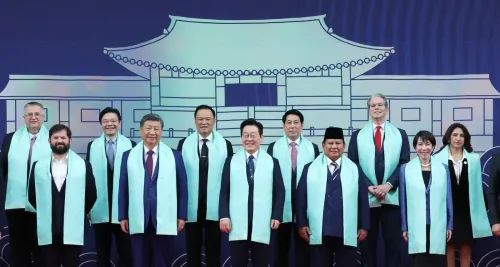
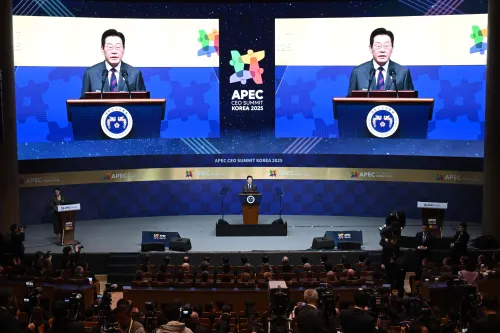
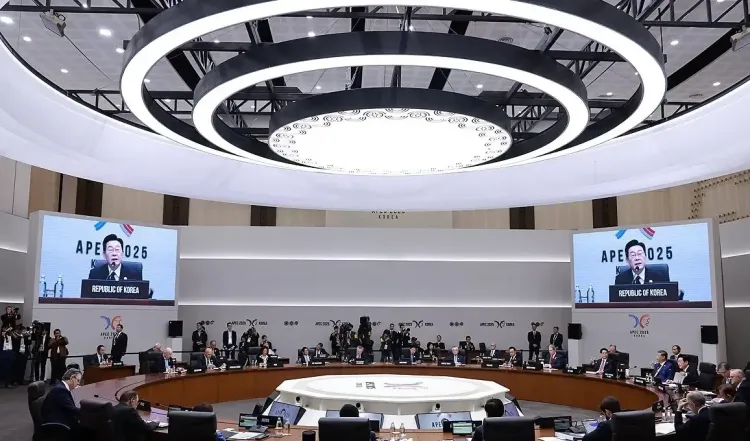
Seoul, Nov 2 (NationPress) In the face of significant challenges to the global multilateral framework and rising protectionist tendencies, South Korea emerged as a pivotal leader during last week's Asia-Pacific Economic Cooperation (APEC) summit, offering a vital platform for global leaders to deliberate on the free trade system and collaborative future initiatives.
Hosted in the southeastern city of Gyeongju, the summit was particularly critical as tensions escalated between the United States and China regarding tariffs and trade disputes, amidst a notable shift in global trade dynamics largely influenced by the Trump administration's stringent tariff policies, as reported by the Yonhap news agency.
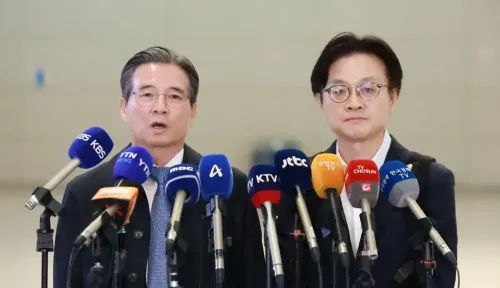
The presidential office stated, "Through extensive negotiations right up to the summit, we worked diligently to reconcile differences among APEC members, including the U.S., China, Japan, and Russia, ultimately achieving consensus on the Gyeongju Declaration and two other significant outcome documents."
This declaration urges member countries, representing over half of the global economy, to unite in promoting cultural and creative industries, which are crucial for stimulating economic growth.
Concerns loomed over a potential failure to issue a joint declaration, reminiscent of the 2018 APEC summit in Papua New Guinea, where the U.S. and China could not agree on WTO reforms, resulting in only a chair's statement being released.
However, South Korea "demonstrated robust leadership to formulate a text acceptable to both the U.S. and China," noted the presidential office.
Furthermore, South Korea tackled shared challenges in the region, such as artificial intelligence (AI) development and demographic shifts.
The AI Initiative established at the summit signifies the first leaders-level agreement on AI involving both the U.S. and China, according to the presidential office.
Reflecting the changing global landscape, this year's leaders' declaration notably excluded direct references to the World Trade Organization (WTO), a staple in prior APEC leaders' declarations. Instead, a compromise text found its place in the ministerial-level joint statement.
The Gyeongju APEC summit also served as a diplomatic stage, facilitating the inaugural face-to-face meeting between Trump and Chinese President Xi Jinping since Trump's second term began amid their escalating trade conflict.
During their discussions in Busan on Thursday, the two leaders reached a groundbreaking "ceasefire" agreement and expressed a mutual interest in future visits.
President Lee Jae Myung concluded the APEC summit with tangible outcomes, marking the event as a significant diplomatic challenge since his inauguration in June.
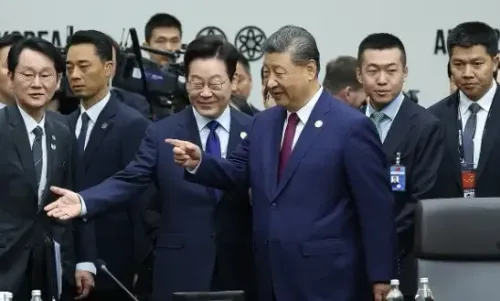
Lee engaged with world leaders on pressing security and economic matters through practical diplomatic measures, including one-on-one discussions with Trump, Xi, and Japanese Prime Minister Sanae Takaichi.
Following his summit with Trump, Seoul and Washington finalized a long-awaited framework tariff agreement, which includes a $200 billion cash investment in the U.S., with annual investments capped at $20 billion as part of a broader $350 billion investment commitment.
During his talks with Xi, Lee fostered a positive atmosphere in relations with Beijing, with both leaders acknowledging the necessity for cooperation to promote peace on the Korean Peninsula and enhance practical collaboration.
Point of View
South Korea's proactive engagement at the APEC summit exemplifies its commitment to fostering international collaboration. By addressing pressing global issues and facilitating dialogue among major powers, South Korea not only reinforces its position on the world stage but also emphasizes the importance of multilateral cooperation in overcoming contemporary challenges.
NationPress
23 Sept 2026
Frequently Asked Questions
What was the significance of the APEC summit?
The APEC summit served as a crucial platform for global leaders to discuss the free trade system and cooperation amid rising protectionist sentiments.
What were the outcomes of the Gyeongju Declaration?
The Gyeongju Declaration calls for member nations to collaborate on promoting cultural and creative industries to enhance economic growth.
How did South Korea demonstrate leadership during the summit?
South Korea successfully bridged differences between the U.S. and China, leading to a consensus on key issues, including a joint declaration.
What challenges were faced during the APEC summit?
Concerns were raised about the potential failure to adopt a joint declaration, similar to the 2018 summit in Papua New Guinea.
What was agreed upon regarding artificial intelligence?
The summit resulted in the first leaders-level agreement on AI involving both the U.S. and China, highlighting a collaborative approach to technology.