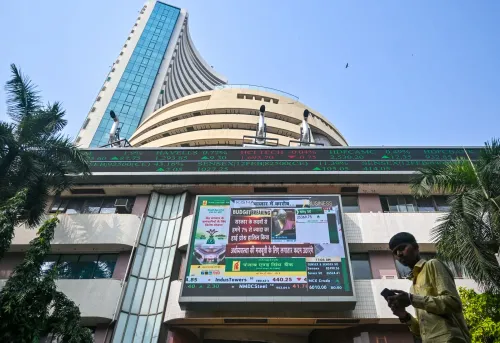
Sensex drops 564 points, Nifty slides 205 as US bond yields top 5%
Synopsis
Indian markets opened sharply lower on 24 September as the US 10-year Treasury yield crossed 5% for the first time in years, wiping out gains from cheaper crude. With the Fed signalling further hikes, a stronger dollar squeezing emerging markets, and US-Iran tensions simmering ahead of a Trump-Xi meeting, the pressure on Indian equities may not ease quickly.
Key Takeaways
Sensex fell 564 points to 74,263 and Nifty dropped 205 points to 23,240 as of 9:23 am IST on 24 September .
US 10-year Treasury yield moved above 5% , the primary trigger for the sell-off.
Nifty Financial Services 25/50 was the top sectoral loser, down 1.73% ; private banks fell 1.67% .
Brent crude eased to around $97 after a surprise 2.97-million-barrel US inventory build, but provided limited relief.
FIIs net bought ₹1,617 crore worth of equities on 23 September ; DIIs bought ₹2.341 crore worth.
Nifty support is seen at 23,000–23,150 ; resistance at 23,450–23,500 .
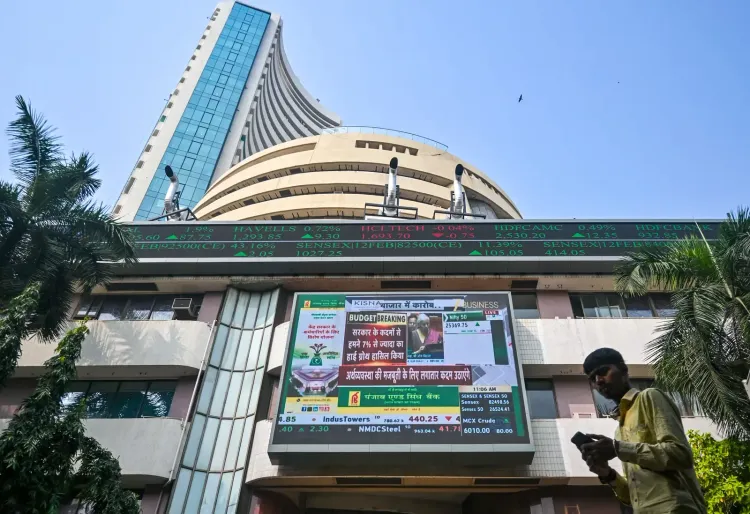
The BSE Sensex tumbled 564 points, or 0.75%, to 74,263 and the Nifty50 fell 205 points, or 0.88%, to 23,240 in early trade on Thursday, 24 September, as surging US Treasury yields overwhelmed the cushion provided by softer crude oil prices. The sell-off was broad-based, with financial and banking stocks bearing the heaviest losses.
Where the Damage Was
Sectoral indices on the National Stock Exchange (NSE) were almost uniformly in the red. Nifty Financial Services 25/50 led losses, shedding 1.73%, followed closely by private banks, which fell 1.67%. The Nifty Midcap 100 declined 0.95% and the Nifty Smallcap 100 lost 0.66%, tracking the benchmarks lower. Only Nifty IT and Nifty Pharma managed marginal gains, bucking the broader downtrend.
The Bond Yield Trigger
The primary catalyst was the US 10-year Treasury yield breaching 5%, a psychologically significant level that has historically pressured risk assets globally. Strong US business-activity data rekindled expectations of another Federal Reserve rate hike, sending Wall Street lower in the previous session — the Nasdaq shed 1.13%, the S&P 500 lost 0.75%, and the Dow Jones declined 0.68%. A rising Dollar Index added further pressure on emerging-market sentiment, including Indian equities.
Crude Relief Offset by Geopolitical Risk
Brent crude retreated to around $97 per barrel after the US Energy Information Administration (EIA) reported an unexpected 2.97-million-barrel build in crude inventories, against a forecast decline of 0.6 million barrels. While softer oil is broadly positive for India as a large importer, analysts noted it was insufficient to counter the weight of rising yields. Renewed uncertainty around the US-Iran conflict kept risk aversion elevated, while markets are also closely watching an anticipated meeting between US President Donald Trump and Chinese President Xi Jinping for signals on trade and technology policy.
Asian Markets and Institutional Flows
The mood across Asian markets was mixed. China's Shanghai Composite shed 1.04% and the Shenzhen index fell 1.88%, while Hong Kong's Hang Seng declined 0.46%. Japan's Nikkei added 1.33% and South Korea's Kospi gained 0.9%. On the domestic institutional front, foreign institutional investors (FIIs) net bought equities worth ₹1,617 crore on 23 September, while domestic institutional investors (DIIs) purchased equities worth ₹2.341 crore.
Key Technical Levels to Watch
In the previous session, Nifty had closed at 23,446, up 0.50%. Analysts place immediate support in the 23,000–23,150 range, with resistance at 23,450–23,500. Bank Nifty, which had closed the prior session at 56,548, faces support at 56,000–56,200 and resistance at 56,700–57,000. A sustained hold above the 23,000 level will be critical for near-term market direction as global yield pressures persist.
Point of View
And India is feeling it directly. The fact that cheaper crude has failed to offset the bond-yield pressure underscores how structurally exposed Indian financials are to global rate cycles. More concerning is the confluence of risks: a hawkish Fed, a stronger dollar, US-Iran tension, and an uncertain Trump-Xi summit. FII buying on 23 September offers a mild counterpoint, but it would be premature to read it as a floor. If yields stay elevated, the banking and financial-services sectors — already today's biggest losers — face a prolonged re-rating.
NationPress
24 Sept 2026
Frequently Asked Questions
Why did the Sensex and Nifty fall on 24 September 2026?
The Sensex fell 564 points to 74,263 and the Nifty dropped 205 points to 23,240 as the US 10-year Treasury yield crossed 5%, reigniting fears of another Federal Reserve rate hike. Strong US business-activity data drove Wall Street lower overnight, spreading risk aversion to Asian and Indian markets.
Which sectors were worst hit in today's market fall?
Nifty Financial Services 25/50 was the biggest loser, down 1.73%, followed by private banks at 1.67%. Only Nifty IT and Nifty Pharma posted marginal gains. Midcap and smallcap indices also fell, down 0.95% and 0.66% respectively.
Did lower crude oil prices help the Indian market?
Brent crude eased to around $97 per barrel after an unexpected 2.97-million-barrel build in US crude inventories, but the relief was insufficient to counter the weight of rising bond yields and a stronger Dollar Index. Softer crude is broadly positive for India as an importer, but not enough to offset global risk-off sentiment today.
What are the key technical support levels for Nifty?
Immediate support for the Nifty is placed in the 23,000–23,150 range, with resistance at 23,450–23,500. Bank Nifty support is seen at 56,000–56,200, with resistance at 56,700–57,000.
What global events are markets watching next?
Markets are closely tracking any further Federal Reserve signals on rate hikes, developments in the US-Iran conflict, and the anticipated meeting between US President Donald Trump and Chinese President Xi Jinping for trade and technology-related cues. The direction of the US 10-year Treasury yield will remain the key variable for emerging-market sentiment.