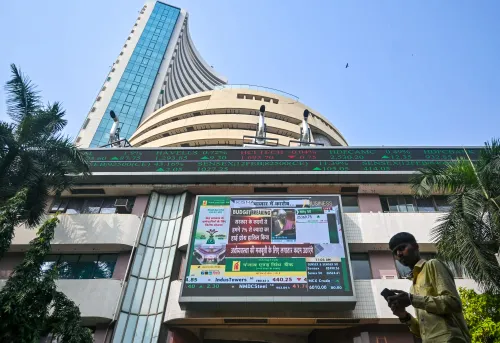
Sensex falls 330 points on US-Iran tensions as crude surges past $109
Synopsis
Banking stocks are showing signs of consolidation, while pharma and FMCG may see selective buying in the current volatile environment, the expert added.
US-Iran Conflict and Crude Oil Surge
Global sentiment remained fragile as market participants closely tracked the US-Iran standoff and its potential ripple effects on energy markets and global trade. According to reports, US President Donald Trump was reportedly dissatisfied with Iran's latest proposal, as it did not adequately address the country's nuclear programme. A US official was quoted as saying, "He doesn't love the proposal."
Trump had discussed the proposal with his top national security aides, and the conflict reportedly remains at a stalemate, with energy supplies from the region affected. However, Iran has reportedly offered to reopen the Strait of Hormuz if the US lifts its blockade and hostilities cease.
Brent crude rose 1% to $109.46 per barrel, while US West Texas Intermediate (WTI) gained 1.22% to $97.55 per barrel, adding to inflationary pressures on import-dependent economies like India.
Global Market Cues
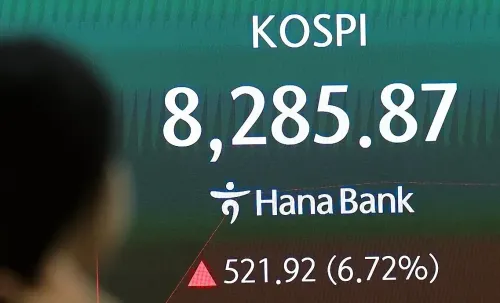
Asian markets traded mixed on Tuesday. Japan's Nikkei was down about 1%, and Hong Kong's Hang Seng was trading nearly 1% lower, while South Korea's Kospi gained around 1%. On Wall Street, US markets ended marginally higher overnight, with the S&P 500 rising 0.12% to 7,173.93 and the Nasdaq climbing 0.20% to 24,887.10. The divergence between a firmer Wall Street close and a weaker Asian open underscores the degree to which the crude oil shock is being priced differently across regions.
With the US-Iran standoff showing no immediate sign of resolution, energy market volatility is likely to remain the dominant risk factor for Indian equities in the near term.
Key Takeaways
Sensex fell 330 points to an intraday low of 76,973 on 28 April ; Nifty50 slipped 93 points to 23,999 .
Nifty PSU Bank , Private Bank , Pharma , Healthcare , and FMCG were top sectoral laggards, falling up to 1% .
Broader markets showed resilience — Smallcap 250 , Microcap 250 , and Midcap 150 traded up to 1% higher.
Brent crude surged 1% to $109.46/barrel ; WTI gained 1.22% to $97.55/barrel amid the US-Iran standoff.
President Trump reportedly rejected Iran's proposal as it did not address the nuclear programme; the Strait of Hormuz remains a flashpoint.
Expert sees Nifty support at 23,800–23,700 and resistance at 24,200–24,300 ; a move above 24,500 needed for bullish momentum.
The BSE Sensex slipped as much as 330 points or 0.42% to an intraday low of 76,973 on Tuesday, 28 April, as investors turned cautious amid escalating US-Iran geopolitical tensions and a sharp rise in global crude oil prices. The Nifty50 mirrored the decline, falling 93 points or 0.38% to trade at 23,999 in early morning trade.
Sectoral Breakdown
Nifty PSU Bank, Nifty Private Bank, Nifty Pharma, Nifty Healthcare, and Nifty FMCG indices were among the top laggards, falling up to 1%. Among individual Nifty constituents, Eternal, Bajaj Auto, Axis Bank, HDFC Life, IndiGo, Bajaj Finserv, and Trent led the losses.
In contrast, Nifty MidSmall IT and Telecom, Nifty MidSmall Healthcare, Nifty Consumer Durables, and Nifty Realty indices bucked the trend and traded in positive territory.
Broader Markets Show Resilience
Despite the headline index weakness, broader markets held firm. Nifty Smallcap 250, Nifty Microcap 250, and Nifty Midcap 150 were all trading up to nearly 1% higher, signalling that retail and domestic investor appetite remained intact even as large-caps came under pressure.
The Sensex had opened the session at 77,094.79, while the Nifty began at 24,049.90.
What Experts Are Watching
A market expert noted that the Nifty remains range-bound, with support seen at 23,800–23,700 and resistance at 24,200–24,300. According to the expert,
Point of View
Pharma, and FMCG stocks sold off, broader markets — smallcap, microcap, and midcap — held firm or gained. This divergence suggests domestic retail investors are not panicking, even as foreign institutional money reacts to the crude oil shock. The real risk for India is not the equity market per se but the fiscal arithmetic: Brent at $109 strains the import bill, pressures the rupee, and complicates the RBI's inflation management. If the US-Iran standoff prolongs and crude stays elevated, the second-order effects on fuel subsidies and the current account deficit could prove more consequential than today's 330-point Sensex dip.
NationPress
20 Sept 2026
Frequently Asked Questions
Why did the Sensex fall on 28 April 2025?
The Sensex fell 330 points to an intraday low of 76,973 on 28 April 2025, primarily due to investor caution over escalating US-Iran geopolitical tensions and a surge in global crude oil prices. Brent crude rose 1% to $109.46 per barrel, adding pressure on import-dependent markets like India.
Which sectors were the worst hit in today's market fall?
Nifty PSU Bank, Nifty Private Bank, Nifty Pharma, Nifty Healthcare, and Nifty FMCG were the top laggards, falling up to 1%. Individual losers included Eternal, Bajaj Auto, Axis Bank, HDFC Life, IndiGo, Bajaj Finserv, and Trent.
How did broader markets perform despite the Sensex decline?
Broader markets showed resilience, with Nifty Smallcap 250, Nifty Microcap 250, and Nifty Midcap 150 all trading up to nearly 1% higher, suggesting domestic investor sentiment remained relatively stable.
What is the current status of the US-Iran conflict affecting markets?
The US-Iran conflict remains at a stalemate, according to reports. President Trump was reportedly dissatisfied with Iran's latest proposal as it did not address the nuclear programme. Iran has reportedly offered to reopen the Strait of Hormuz if the US lifts its blockade, but no resolution has been reached.
What are the key technical levels to watch on the Nifty?
According to a market expert, the Nifty has support at 23,800–23,700 and faces resistance at 24,200–24,300. A decisive move above 24,500 would be needed to confirm a return of bullish momentum.