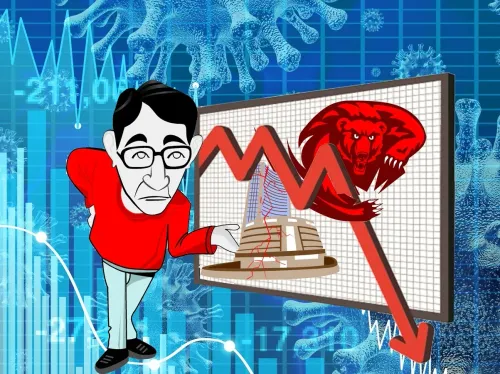
Sensex falls 1,483 points, Nifty slips 1.75% on profit booking

Synopsis
Sensex lost 1,483.72 points and Nifty fell 1.75%, ending a two-session winning streak. Metal and banking shares led the decline, but Nifty IT gained about 2% as investors shifted into select technology stocks.
Key Takeaways
The Sensex fell 1,483.72 points , or 1.77% , to 82,435.99 on 23 November .
The Nifty dropped 450.95 points , or 1.75% , to 25,349.65 .
Tata Steel , Axis Bank and HDFC Bank were among the leading Nifty laggards.
Nifty Metal was the worst-performing sectoral index, while Nifty IT gained about 2% .
The Nifty MidCap 100 fell 1.01% and the Nifty SmallCap 100 declined 0.66% .
The Sensex plunged 1,483.72 points to 82,435.99 on Monday, 23 November, as selling in metal, banking and financial stocks ended a two-session winning streak for Indian equities. The Nifty fell 450.95 points to 25,349.65, while technology shares moved against the wider market decline.
The Mumbai market sell-off came as investors booked profits after a recent rally, according to market experts. They also cited a late global sell-off in the preceding week and weak foreign institutional investor sentiment as factors weighing on Indian stocks.
Benchmark indices end sharply lower
The Sensex closed down 1.77%, while the Nifty lost 1.75%. The fall reversed the direction of both benchmarks after their gains over the previous two sessions.
Tata Steel, Axis Bank and HDFC Bank were among the leading laggards on the Nifty. Their declines reflected the pressure on metal and financial counters that weighed on the headline indices.
Metal and banking shares lead the decline
The Nifty Metal index was the worst performer among sectoral indices as investors reduced exposure to commodity-linked shares. Banking and financial stocks also fell, pulling down the Nifty Bank, Nifty PSU Bank, Nifty Financial Services and Nifty Private Bank indices.
Auto shares joined the decline, with the Nifty Auto index closing lower. The losses across these sectors meant the pressure was not confined to a single group of stocks.
Broader-market indices also ended lower, although their percentage falls were smaller than those of the headline benchmarks. The Nifty MidCap 100 declined 1.01%, and the Nifty SmallCap 100 fell 0.66%.
Technology stocks move against the market
Information technology shares were an exception to the wider sell-off. The Nifty IT index gained about 2%, even as metal, banking, financial and auto indices finished lower.
Market experts attributed the contrasting moves partly to investors rotating into select technology stocks while booking profits elsewhere after the recent rally. The divergence meant that the overall fall in benchmark indices masked gains in one major sector.
Global cues and the outlook
Experts said the preceding week's late global sell-off had been triggered by concerns about an artificial intelligence bubble and tighter US monetary policy. They said the resulting pressure on Indian equities was concentrated in heavyweight banking and commodity stocks amid weak foreign institutional investor sentiment.
Analysts cautioned that further weakness in global equities could spill over into India. They also said the impact might be relatively limited, citing India's lower exposure to AI-driven investment and a resilient domestic economy.
They identified improving manufacturing activity and expectations of 7.7% growth in Q2 GDP as potential supports for a constructive medium- to long-term outlook. That growth figure was an expectation cited by analysts, not a reported GDP result; the direction of global equities remains a factor to watch.
Point of View
Not evidence of an outcome, and should be judged against the eventual release. The more immediate test is whether global weakness continues to affect Indian equities after this profit-booking session.
NationPress
23 Nov 2026
Frequently Asked Questions
Why did the Sensex and Nifty fall on 23 November?
The Sensex and Nifty fell as investors sold metal, banking and financial stocks and booked profits after a recent rally. Experts also cited a late global sell-off and weak foreign institutional investor sentiment.
How much did the Sensex and Nifty fall?
The Sensex fell 1,483.72 points, or 1.77%, to 82,435.99, while the Nifty dropped 450.95 points, or 1.75%, to 25,349.65.
Which stocks and sectors led the market decline?
Tata Steel, Axis Bank and HDFC Bank were among the leading Nifty laggards, while Nifty Metal was the worst-performing sectoral index. Banking, financial and auto indices also closed lower.
Did any sector rise despite the market fall?
Yes, the Nifty IT index gained about 2% despite the wider market decline. Market experts said investors rotated into select technology stocks.
What are analysts watching after the market sell-off?
Analysts are watching whether further global equity weakness spills over into India. They also cited improving manufacturing activity and expectations of 7.7% Q2 GDP growth as potential supports.