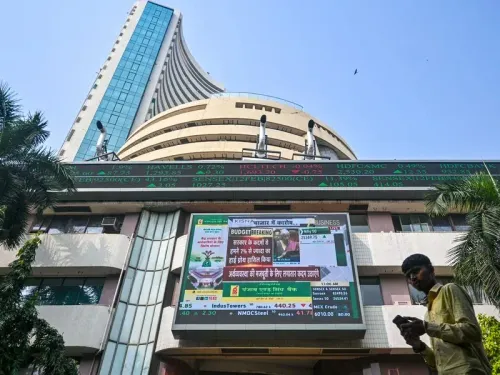
Sensex drops 893 points, Nifty below 23,850 as metal and IT stocks sink
Synopsis
Indian markets logged one of their sharpest single-day falls in recent weeks on 23 June, with the Sensex shedding 893 points and the Nifty slipping below 23,850. Metal stocks cratered over 3 per cent, IT shed over 2 per cent, and even mid-caps were not spared — all while pharma quietly held its ground as the session's only real shelter.
Key Takeaways
BSE Sensex fell 893.39 points (1.16%) to close at 76,200.68 on 23 June .
Nifty50 dropped 278.80 points (1.16%) to settle at 23,824.10 .
Nifty Metal index was the worst-performing sector, plunging more than 3 per cent .
Nifty IT index fell over 2 per cent ; Infosys , TCS , and JSW Steel were among the top laggards.
Nifty MidCap ended 1.05 per cent lower; Nifty SmallCap slipped 0.48 per cent .
Nifty Pharma and Nifty Healthcare bucked the trend, outperforming as defensive bets.
Indian equity benchmarks suffered a sharp sell-off on Tuesday, 23 June, as the BSE Sensex plunged 893.39 points, or 1.16 per cent, to settle at 76,200.68, while the Nifty50 shed 278.80 points, or 1.16 per cent, to close at 23,824.10. Heavy selling in metal, information technology, and public sector banking stocks — amplified by weak global market cues — drove the broad-based decline.
Sectors That Led the Fall
Metal stocks bore the heaviest brunt, with the Nifty Metal index plunging more than 3 per cent — the steepest sectoral loss of the session. The Nifty IT index followed, declining more than 2 per cent, with every constituent ending in the red and individual stocks falling as much as 3 per cent. The Nifty PSU Bank index also underperformed amid continued weakness in state-owned lenders.
Among the most prominent laggards on the Nifty were Infosys, JSW Steel, and Tata Consultancy Services (TCS), all of which faced significant selling pressure through the session.
Broader Market Also Under Pressure
The weakness was not confined to large-caps. The Nifty MidCap index ended 1.05 per cent lower, while the Nifty SmallCap index slipped 0.48 per cent, indicating that caution spread well beyond blue-chip counters. Notably, this marks a reversal of the recent momentum that had lifted mid- and small-cap indices to multi-month highs.
What Analysts Said
Market experts attributed the downturn to a combination of negative global cues and profit-booking after a recent rally, which together proved too strong a headwind for early gains to sustain. According to analysts, investors remained cautious about global growth prospects and persistent uncertainty in international markets. Stable crude oil prices and some easing of geopolitical tensions offered limited support, but were insufficient to arrest the decline.
Experts also noted that market participants were closely tracking the progress of the monsoon season and the trajectory of US-India trade discussions — two variables seen as critical for near-term domestic sentiment.
Defensive Sectors Offer Partial Cushion
Not all sectors ended in the red. The Nifty Pharma and Nifty Healthcare indices outperformed the broader market, attracting investor interest as a defensive play amid the heightened volatility. These sectors have historically served as safe havens during risk-off sessions driven by global macro uncertainty.
What to Watch Next
Traders will closely monitor global equity trends, any fresh developments in US-India trade talks, and domestic monsoon data in the sessions ahead. A sustained recovery in global risk appetite — particularly in US technology stocks — would be key to stabilising IT and metal indices on the domestic front.
Point of View
Particularly for IT — structurally tied to US discretionary spending — and metals, which track China demand signals. The simultaneous weakness in both sectors on a single session is unusual and points to a broader de-risking rather than sector-specific news. What is underreported is the market's growing sensitivity to the monsoon trajectory and US-India trade talks: these are domestic variables that could either cushion or deepen the next leg of volatility. Pharma's outperformance, meanwhile, is less a vote of confidence and more a flight to the familiar.
NationPress
22 Sept 2026
Frequently Asked Questions
Why did the Sensex fall on 23 June?
The Sensex fell 893.39 points to 76,200.68 on 23 June due to heavy selling in metal, IT, and PSU bank stocks triggered by weak global market cues. Profit-booking after a recent rally added to the downside pressure.
Which stocks and sectors were the biggest losers?
The Nifty Metal index was the worst-hit sector, falling more than 3 per cent. The Nifty IT index declined over 2 per cent, with Infosys, TCS, and JSW Steel among the top laggards on the Nifty50.
How did the broader market perform?
The broader market also declined, with the Nifty MidCap index ending 1.05 per cent lower and the Nifty SmallCap index slipping 0.48 per cent, reflecting widespread caution across market segments.
Were any sectors spared from the sell-off?
Yes — the Nifty Pharma and Nifty Healthcare indices outperformed the broader market and attracted buying interest as defensive plays during the volatile session.
What factors are investors watching going forward?
Market participants are closely tracking global equity trends, progress of the monsoon season, and developments in US-India trade discussions, all of which are expected to influence near-term domestic sentiment.