Sensex slumps 816 points, Nifty IT cracks 4% on US-Iran flare-up

Synopsis
A fresh US-Iran flare-up sent Indian equities into the red, with the Sensex sliding 816 points and Nifty IT cracking nearly 4%. TCS alone plunged 6% as Brent topped $97 and India VIX spiked over 8% — a clear signal that markets are pricing in a longer geopolitical overhang, not a one-day scare.
Key Takeaways
Sensex fell up to 816 points ( 1.09% ) to 73,833 in early trade on 3 June .
Nifty50 slid 200 points ( 0.86% ) to an intraday low of 23,280 .
Nifty IT slumped nearly 4% ; TCS plunged around 6% , with Infosys , Tech Mahindra and HCLTech down up to 4% .
Brent crude rose above $97 and WTI jumped 2.47% on fresh US-Iran tensions.
India VIX surged more than 8% , reflecting a sharp rise in volatility expectations.
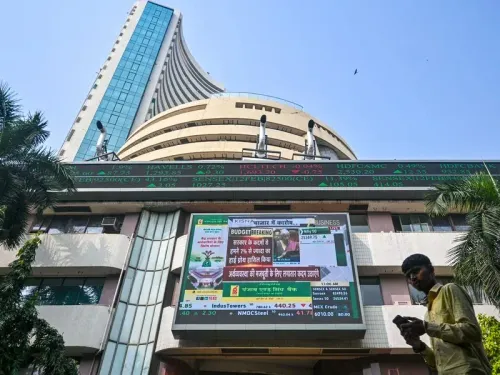
Indian equities opened sharply lower on Wednesday, 3 June, with the BSE Sensex tumbling as much as 816 points or 1.09% to an intraday low of 73,833, as fresh escalation between the United States and Iran rattled risk sentiment. The Nifty50 mirrored the slide, shedding 200 points or 0.86% to touch 23,280 in morning trade.
Where the damage was
Sectoral indices traded almost uniformly in the red, with technology counters emerging as the biggest drag. The Nifty IT index slumped nearly 4%, while the Nifty MidSmall IT & Telecom index fell close to 2%. Realty, financial services, PSU banking and media stocks were also under pressure.
Mid-cap and small-cap indices slipped up to 1%, while the India VIX — the street's fear gauge — jumped more than 8%, signalling a sharp uptick in near-term volatility expectations.
Biggest losers on the benchmark
Among Nifty constituents, Tata Consultancy Services (TCS) plunged around 6%, while Tech Mahindra, Infosys and HCLTech declined up to 4%. Bajaj Finserv, Axis Bank and Shriram Finance were among the other top losers of the benchmark index.
What spooked the street
According to market experts, rising crude prices and geopolitical uncertainty remain the biggest near-term risks for domestic equities despite otherwise positive global cues. Investor sentiment stayed weak amid uncertainty around a potential US-Iran peace deal, with diplomatic efforts between Washington and Tehran reportedly showing limited progress.
International benchmark Brent crude rose more than 1% to $97.16 per barrel, while US West Texas Intermediate (WTI) jumped 2.47% to trade around $96 a barrel — a combination that typically pressures India's import bill and corporate margins.
Global cues mixed
Asian markets traded mixed: Japan's Nikkei surged around 3%, even as Hong Kong's Hang Seng slipped nearly 2% and Indonesia's Jakarta Composite declined about 4%. On Wall Street overnight, the S&P 500 edged up 0.13% and the Nasdaq added 0.03%, ending largely flat.
What to watch next
Traders will track the trajectory of Brent crude, any official commentary from Washington or Tehran, and follow-through selling in Indian IT — a sector structurally exposed to US discretionary spending. A sustained move above $95 on WTI could keep risk assets on the defensive in the coming sessions.
Point of View
And a softening US discretionary spend outlook if oil-driven inflation forces the Fed to stay hawkish. The 8% spike in India VIX is the more telling signal than the Sensex print itself; the street is bracing for volatility, not just digesting a single bad session. Until Brent cools and Washington-Tehran channels show concrete progress, every rally risks being sold into.
NationPress
19 Sept 2026
Frequently Asked Questions
Why did the Sensex fall on 3 June?
The Sensex fell as much as 816 points or 1.09% to 73,833 in early trade due to fresh escalation in US-Iran tensions, which pushed crude prices higher and weakened global risk appetite. IT and banking stocks led the decline.
How much did Nifty IT fall and which stocks were worst hit?
Nifty IT slumped nearly 4%, making it the worst-performing sectoral index. TCS plunged around 6%, while Infosys, Tech Mahindra and HCLTech declined up to 4%.
How did crude oil prices move?
Brent crude rose more than 1% to $97.16 per barrel, while US West Texas Intermediate crude jumped 2.47% to around $96 a barrel. Elevated crude prices typically pressure India's import bill and corporate margins.
What does the India VIX spike indicate?
The India VIX jumped more than 8%, signalling a sharp rise in near-term volatility expectations. A rising VIX usually reflects investor anxiety and the likelihood of larger market swings in coming sessions.
How did global markets perform?
Asian markets were mixed — Japan's Nikkei surged about 3%, while Hong Kong's Hang Seng fell nearly 2% and Indonesia's Jakarta Composite dropped about 4%. Wall Street ended largely flat overnight, with the S&P 500 up 0.13% and the Nasdaq up 0.03%.