Sensex, Nifty Plunge 2% as IT Rout & West Asia Crisis Rattle Markets

Synopsis
Indian markets fell for the second straight week as IT stocks crashed 10% on weak guidance from Infosys and TCS, while crude oil surged 15% to $107/barrel after Iran re-imposed Strait of Hormuz restrictions. DIIs pumped Rs 9,782 crore to cushion the blow as FIIs sold Rs 1,369 crore worth of equities.
Key Takeaways
Sensex fell 2.3% and Nifty declined 1.9% for the week ending April 25 , marking the second consecutive week of losses for Indian benchmark indices.
The BSE IT index crashed nearly 10% following weak FY27 earnings guidance from sector leaders Infosys and TCS , despite in-line quarterly results.
Crude oil prices surged over 15% to $107 per barrel after Iran re-imposed restrictions on the Strait of Hormuz following a confrontation with US naval forces .
FIIs sold equities worth Rs 1,369 crore during the week, while DIIs bought Rs 9,782 crore worth of shares, cushioning the market's downside.
FMCG stocks outperformed with companies reporting double-digit volume growth , while BFSI showed stable asset quality despite emerging stress in MSME and commercial vehicle segments.
Key triggers for the coming week include India's March 2026 IIP data , US PCE inflation , and rate decisions from the US Federal Reserve , Bank of England , and European Central Bank .
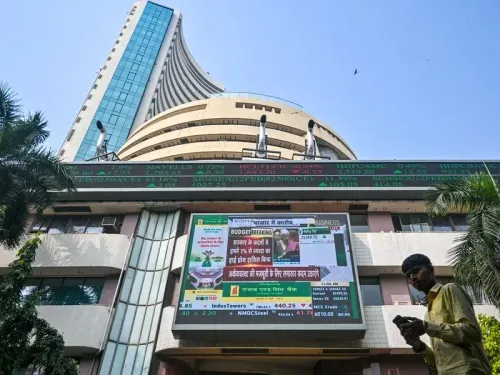
Mumbai, April 25 — Indian equity markets suffered a second consecutive weekly decline, with benchmark indices Sensex and Nifty shedding approximately 2 per cent as a brutal selloff in IT stocks, surging crude oil prices, and escalating West Asia geopolitical tensions hammered investor sentiment. The carnage was broad-based at the top, even as mid and small-cap indices showed relative resilience.
Weekly Market Performance at a Glance
On a week-on-week basis, the BSE Sensex fell 2.3 per cent while the NSE Nifty 50 declined 1.9 per cent, closing at 76,664 and 23,897.95 respectively on Friday, April 25. The Sensex alone shed over 1,000 points in Friday's session, a sign of intensifying selling pressure near the close.
Broader markets, however, showed greater staying power. The BSE Midcap index slipped just 0.6 per cent, while the BSE Smallcap index edged down a marginal 0.2 per cent week-on-week, suggesting domestic retail investors continued to hold their ground in smaller counters.
IT Sector Collapse Leads the Selloff
The IT sector was the week's biggest casualty, plunging nearly 10 per cent on the BSE IT index — one of the steepest weekly declines in recent memory for the sector. The trigger was weaker-than-expected management guidance from top-tier companies, which raised fresh alarms over the FY27 earnings outlook.
This came despite broadly in-line quarterly results from sector heavyweights Infosys and TCS. Analysts note that when guidance disappoints even after decent earnings, it signals deeper structural concerns — in this case, slowing discretionary tech spending by global clients, particularly in the US and Europe, where recession risks persist.
Notably, this is not the first time IT guidance has rattled Dalal Street. A similar pattern played out in Q2 FY24, when cautious outlooks from major IT firms triggered a sector-wide correction exceeding 8 per cent. The recurrence raises questions about whether India's IT sector is entering a prolonged growth moderation cycle.
West Asia Crisis & Crude Oil Shock
Geopolitical developments in West Asia added a significant macro overhang. After Iran initially announced the reopening of the strategically critical Strait of Hormuz shipping lane, US naval forces intercepted an Iranian vessel, prompting Tehran to re-impose restrictions on the waterway.
The move triggered a sharp spike in global crude oil prices, which surged over 15 per cent during the week to $107 per barrel — a level not seen in over a year. For India, which imports approximately 85 per cent of its crude oil requirements, this is a critical macro risk. Higher crude directly threatens the current account deficit, fiscal math, and retail fuel prices.
Separately, US President Donald Trump reportedly extended a ceasefire arrangement with Iran indefinitely, adding layers of uncertainty rather than providing clarity. Markets abhor ambiguity, and this geopolitical fog kept institutional investors cautious throughout the week.
FII Outflows vs DII Support: A Structural Shift
Foreign institutional investors (FIIs) remained net sellers during the week, offloading equities worth Rs 1,369 crore. This continues a broader trend of FII caution toward emerging markets amid global risk-off sentiment triggered by elevated commodity prices and geopolitical instability.
In contrast, domestic institutional investors (DIIs) stepped in aggressively, purchasing equities worth Rs 9,782 crore — more than seven times the FII outflow. This DII firepower, largely driven by mutual fund SIP inflows and insurance money, has become the primary cushion preventing sharper market declines. It reflects a maturing domestic investor base that increasingly absorbs foreign selling pressure.
Analysts argue this is a structural shift in Indian capital markets — one where domestic liquidity has grown large enough to partially insulate the market from FII volatility, a phenomenon that was not possible even five years ago.
Bright Spots: FMCG and BFSI Resilience
Not all sectors were in the red. FMCG companies delivered a positive performance, reporting double-digit volume growth in their quarterly results — a sign that rural consumption recovery is gaining traction. This is particularly significant given the context of a challenging global environment.
The BFSI segment also posted steady results, with asset quality remaining largely stable. However, analysts flagged emerging stress in the MSME and commercial vehicle (CV) segments, which could be early warning signs if geopolitical disruptions persist and fuel costs remain elevated.
What to Watch in the Coming Week
Investors will closely monitor India's IIP data for March 2026, which will offer a fresh read on industrial momentum. Global cues include manufacturing PMI readings for April from the US, China, and Japan, as well as US PCE inflation data — the Federal Reserve's preferred inflation gauge.
Critically, major central banks including the US Federal Reserve, Bank of England, and European Central Bank are all scheduled to announce their monetary policy decisions in the coming week. Any hawkish signals from the Fed could further pressure emerging market equities, including India. The Q4FY26 earnings season also continues, and any further guidance disappointments — particularly from IT or banking — could extend the market's negative bias.
Point of View
Domestic institutional investors are now large enough to absorb the blow — a structural resilience that India's market lacked even five years ago. However, complacency would be dangerous. If crude stays above $100 and IT earnings downgrades deepen into FY27, the DII cushion alone cannot prevent a more serious correction. The real question policymakers must answer: with the Strait of Hormuz weaponized and US-Iran diplomacy in flux, does India have a credible energy security contingency plan — or is it still flying blind on crude?
NationPress
26 Sept 2026
Frequently Asked Questions
Why did Indian stock markets fall this week?
Indian stock markets fell for the second consecutive week due to a combination of a sharp 10% crash in IT stocks following weak management guidance from Infosys and TCS, a 15% surge in crude oil prices to $107/barrel triggered by Iran's re-imposition of Strait of Hormuz restrictions, and persistent FII selling. Sensex declined 2.3% and Nifty fell 1.9% on a weekly basis.
How much did IT stocks fall this week and why?
The BSE IT index plunged approximately 10% during the week, making it the worst-performing sector. The selloff was triggered by weaker-than-expected management guidance on FY27 earnings from major IT companies, despite broadly in-line quarterly results from Infosys and TCS, raising concerns about slowing global tech spending.
What is the impact of rising crude oil prices on India?
Crude oil surging over 15% to $107 per barrel is a major macro risk for India, which imports approximately 85% of its crude oil requirements. Higher crude prices widen India's current account deficit, strain fiscal calculations, and could push retail fuel prices higher, impacting inflation and household budgets.
What is the Strait of Hormuz and why does it matter for markets?
The Strait of Hormuz is a critical global oil shipping chokepoint through which approximately 20% of the world's oil supply passes. Iran's re-imposition of restrictions on the strait triggered a sharp spike in global crude oil prices this week, directly impacting energy-importing nations like India and adding geopolitical risk to global financial markets.
What should investors watch in the coming week for Indian markets?
Key data points for the coming week include India's IIP data for March 2026, US PCE inflation figures, and manufacturing PMI readings from the US, China, and Japan. Critically, the US Federal Reserve, Bank of England, and European Central Bank are all scheduled to announce monetary policy decisions, which could significantly influence FII flows into Indian equities.