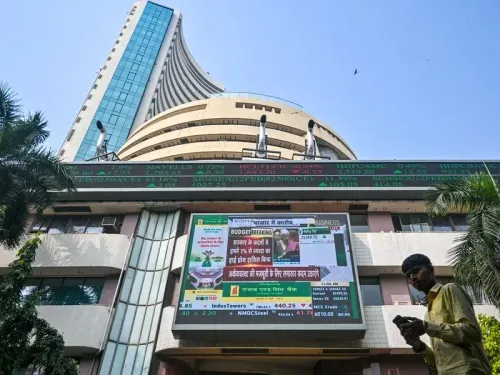
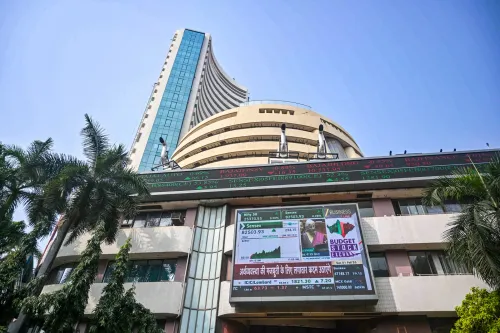
Sensex drops 2,000 points, Nifty loses 532 as crude surge hits markets
Synopsis
India's benchmark indices posted their worst weekly performance in recent memory — Sensex down over 2,000 points, small-caps off nearly 4% — as Brent crude held above $105 a barrel and West Asia showed no sign of de-escalation. With FII selling ongoing and macro headwinds stacking up, the only cushion is a record ₹31,115 crore SIP inflow that is buying time, not solving the underlying problem.
Key Takeaways
Sensex fell 2,000+ points (2.7%) to 75,238 and Nifty50 dropped 532 points (2.2%) to 23,643.5 for the week ending 16 May .
BSE Realty was the worst-hit sector, down nearly 8 per cent ; BSE IT fell 5.7 per cent .
Small-cap index lost nearly 4 per cent ; mid-cap index shed over 2 per cent .
Titan Company was the top Sensex loser at 7.6 per cent , followed by Reliance Industries , Tech Mahindra , and Mahindra & Mahindra .
Brent crude held in the $105–110 per barrel range on Strait of Hormuz disruption fears.
SIP inflows in April reached ₹31,115 crore , providing a partial buffer against FII selling.
The BSE Sensex plunged over 2,000 points — a decline of 2.7 per cent — to close the week at 75,238, while the Nifty50 shed 532 points or 2.2 per cent to settle at 23,643.5, as surging crude oil prices and unresolved geopolitical tensions in West Asia rattled domestic equity markets through the week ending 16 May. The sell-off extended beyond large caps, with mid- and small-cap indices absorbing even sharper blows.
Sectoral Damage
BSE Realty was the worst-hit sector, plunging nearly 8 per cent over the week. BSE IT followed with a 5.7 per cent decline, as US-linked earnings concerns compounded domestic pressure. Auto, capital goods, and consumer durables also ended significantly lower. BSE Bankex and BSE PSU indices each fell 3 per cent, reflecting broad-based institutional selling.
The broader market bore a heavier toll: the mid-cap index fell over 2 per cent, while the small-cap index lost nearly 4 per cent — underscoring how risk aversion cascaded down the market-cap ladder.
Top Losers from the Sensex Basket
Titan Company was the steepest faller among the 30-scrip Sensex basket, tumbling 7.6 per cent. It was followed by Reliance Industries, Tech Mahindra, and Mahindra & Mahindra. Notably, two of India's most widely held consumer and energy names featured among the week's biggest drags — a signal of how broad the selling pressure was.
What Drove the Sell-Off
Market experts attributed the correction to a confluence of global and domestic headwinds. Brent crude remained elevated in the $105–110 per barrel range, with concerns over potential disruptions in the Strait of Hormuz keeping supply-side anxiety high. Rising global bond yields and sustained strength in the US dollar added pressure on emerging markets, triggering intermittent foreign institutional investor outflows and currency weakness.
On the domestic front, analysts flagged higher wholesale inflation, the risk of fuel price pass-through, and elevated bond yields as factors compounding macroeconomic uncertainty. These developments have raised questions about the trajectory of future monetary policy, according to market observers.
Pockets of Resilience
Not all sectors capitulated. BSE Metal gained 1.5 per cent, benefiting from firmer global commodity prices, while healthcare stocks rose 1.4 per cent, reinforcing their defensive appeal in volatile conditions.
Domestic Flows Cushion the Fall
Despite the week's sharp correction, domestic institutional investors continued to provide a floor for the market, supported by robust retail participation. SIP inflows in April stood at ₹31,115 crore, helping absorb sustained selling by foreign institutional investors. Analysts note that this structural domestic bid has prevented a more disorderly unwind, even as FII outflows persist. How long that buffer holds will depend on whether crude prices and West Asia tensions show any meaningful easing in the weeks ahead.
Point of View
000-point Sensex fall in a single week is not noise — it is a verdict on how exposed Indian markets remain to external shocks they cannot control. Crude above $105 is effectively a tax on every Indian household and corporate balance sheet simultaneously, and the West Asia situation offers no near-term exit. What is underreported is the compounding effect: higher crude feeds wholesale inflation, inflation pressures the RBI, and rate uncertainty hits rate-sensitive sectors like realty and banking hardest — which is exactly what the sectoral data this week showed. The ₹31,115 crore SIP buffer is real but finite; if FII outflows intensify and the rupee weakens further, domestic retail flows alone cannot hold the line.
NationPress
24 Sept 2026
Frequently Asked Questions
Why did Sensex and Nifty fall sharply this week?
Sensex dropped over 2,000 points and Nifty lost 532 points in the week ending 16 May, driven by surging crude oil prices in the $105–110 per barrel range and unresolved geopolitical tensions in West Asia. Rising global bond yields, a stronger US dollar, and intermittent FII selling compounded the pressure on domestic markets.
Which sectors were hit hardest by the market sell-off?
BSE Realty was the worst performer, falling nearly 8 per cent. BSE IT declined 5.7 per cent, while BSE Bankex and BSE PSU each dropped 3 per cent. The small-cap index lost nearly 4 per cent, making it one of the week's steepest broad-market declines.
Which Sensex stocks fell the most this week?
Titan Company was the top loser in the 30-scrip Sensex basket, falling 7.6 per cent. Reliance Industries, Tech Mahindra, and Mahindra & Mahindra also featured among the top losers for the week.
Are there any sectors that gained despite the market fall?
Yes — BSE Metal gained 1.5 per cent and healthcare stocks rose 1.4 per cent, both outperforming as investors rotated into defensive and commodity-linked plays amid the broader sell-off.
How are domestic investors responding to the market correction?
Domestic institutional investors continued to support the market even as FIIs sold. SIP inflows in April stood at ₹31,115 crore, providing a meaningful cushion against foreign outflows. Analysts note that strong retail participation has so far prevented a more disorderly decline.