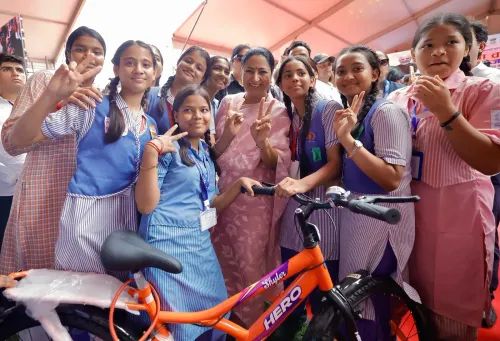
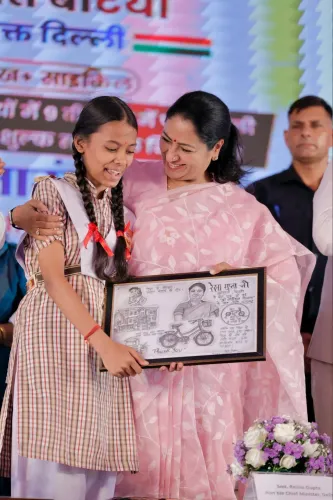
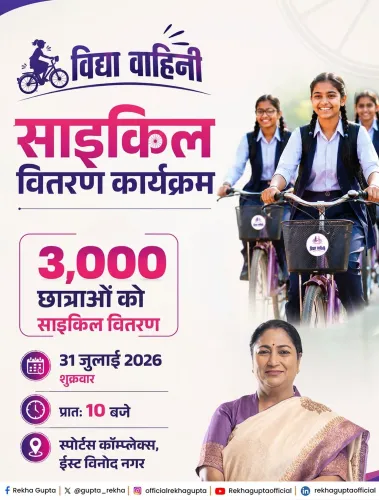
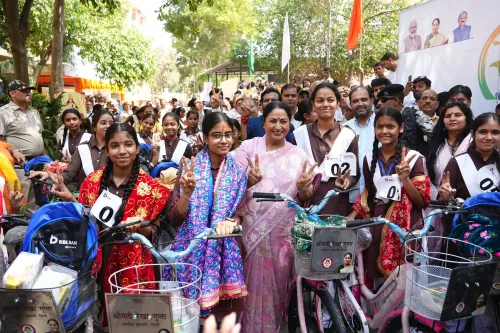
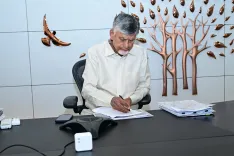
CM Rekha Gupta rolls out free bicycles for 1.40 lakh Delhi girls
Synopsis
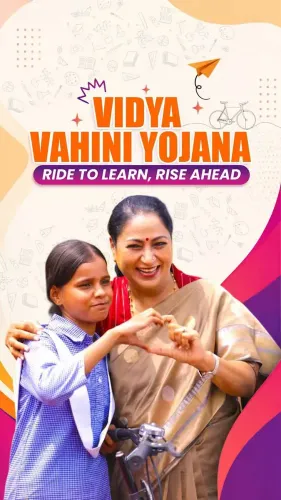
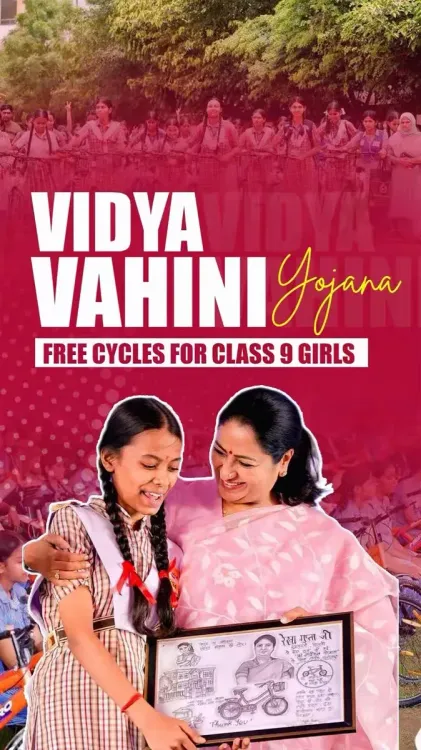
Delhi Chief Minister Rekha Gupta has announced free bicycles for 1.40 lakh Class 9 girl students under the Vidya Vahini Yojana, framing the initiative as part of PM Modi's girl-empowerment vision and the BJP's Seva Sankalp Abhiyan welfare campaign.
Key Takeaways
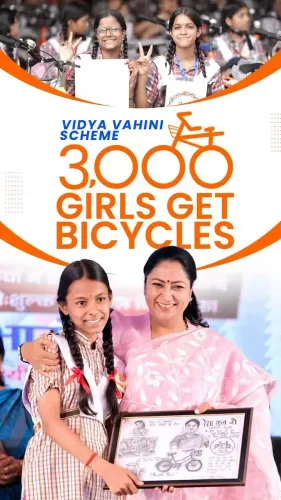
1.40 lakh Class 9 girl students in Delhi are receiving free bicycles under Vidya Vahini Yojana .
The scheme is aimed at removing mobility barriers to secondary education for adolescent girls.
CM Rekha Gupta framed the rollout as part of PM Narendra Modi 's vision of empowering daughters.
The announcement was made under the Seva Sankalp Abhiyan , a BJP welfare outreach campaign in Delhi.
Bicycle distribution for secondary-school girls has precedent in states like Bihar since the mid-2000s, with documented gains in enrolment.
Extension to additional classes and full rollout details are yet to be confirmed.
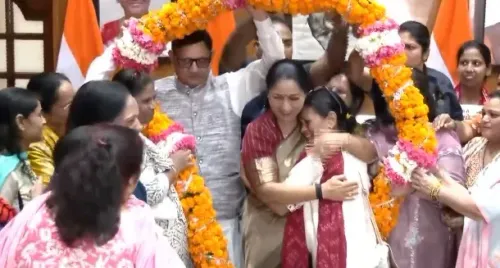
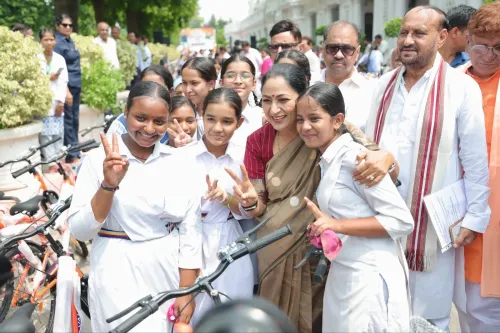
A simple bicycle — and the freedom it carries — is reaching 1.40 lakh Class 9 girl students across Delhi as Chief Minister Rekha Gupta announces the rollout of the Vidya Vahini Yojana on Thursday, 24 September 2026. The scheme, framed as a direct extension of Prime Minister Narendra Modi's vision of empowering daughters, aims to strip away one of the most stubborn barriers between a girl and her classroom: the distance she has to travel to get there.
What Vidya Vahini Yojana promises Delhi's schoolgirls
Under the scheme, every girl enrolled in Class 9 in Delhi's government schools is entitled to a free bicycle. The intent is pointed: by solving the daily commute problem, the programme targets the twin pressures of attendance drop-off and early school exit that tend to spike at the secondary level. CM Gupta described the initiative as part of a 'Seva Sankalp' — a pledge of service — 'to build a Delhi where every daughter moves ahead with confidence, learns without barriers and has every opportunity to shape her own future.'
The announcement came under the Seva Sankalp Abhiyan, a BJP-linked welfare outreach campaign in Delhi that spotlights social-sector delivery. By tying the bicycle programme to the campaign, the ruling party is using a concrete, tangible benefit — not an abstract policy — as its calling card with voters and communities.
A proven playbook, now arriving in the capital
Bicycle distribution for secondary-school girls is far from a new idea in Indian governance. Bihar pioneered the model in the mid-2000s under what became one of the most-studied girl-child education interventions in South Asia, recording measurable gains in secondary school enrolment among adolescent girls. Several other states followed. Delhi's adoption of the model is notable precisely because it is an urban context — the assumption has often been that mobility barriers are a rural problem. In a city of sprawling distances and uneven public-transport access, that assumption doesn't always hold.
The BJP's broader women's welfare messaging — from Beti Bachao Beti Padhao to targeted scholarship and skilling programmes — has consistently leaned on visible, deliverable benefits that reach a named beneficiary. A bicycle handed to a named girl in a named school is the archetype of that approach.
The 1.40 lakh number — and what comes next
The figure of 1.40 lakh beneficiaries covers the Class 9 girl student cohort across Delhi's government school network — a substantial single-year deployment. Whether the scheme extends to Class 10 and beyond, how procurement and distribution are structured, and what the rollout timeline looks like on the ground remain the practical questions to watch. The Seva Sankalp Abhiyan framing suggests the government intends to keep the visibility of this delivery high through the campaign cycle.
For 1.40 lakh girls in Delhi, the school run just got a two-wheeled upgrade. The bigger question is whether the wheels keep turning — and whether enrolment numbers move with them.
Point of View
Tangible, photographable benefit that travels directly to a named beneficiary. By deploying the bicycle programme under the Seva Sankalp Abhiyan umbrella, the Delhi government is simultaneously executing a welfare scheme and a political communication exercise, keeping grassroots visibility high. The urban framing is the genuine policy wrinkle — Delhi is not Bihar, and testing whether a mobility-access intervention proven in rural contexts translates to India's capital will be worth tracking. If enrolment and attendance data eventually back the spend, the scheme could strengthen the case for replicating it in other metropolitan school systems.
NationPress
24 Sept 2026
Frequently Asked Questions
What is Vidya Vahini Yojana in Delhi?
Vidya Vahini Yojana is a Delhi government scheme that provides free bicycles to Class 9 girl students enrolled in government schools, aimed at reducing mobility barriers and improving access to secondary education.
How many girls will get free bicycles under Vidya Vahini Yojana?
1.40 lakh Class 9 girl students in Delhi are set to receive free bicycles under the scheme, as announced by Chief Minister Rekha Gupta on 24 September 2026.
What is Seva Sankalp Abhiyan?
Seva Sankalp Abhiyan is a BJP-linked welfare outreach campaign in Delhi that highlights social-sector service delivery; the Vidya Vahini Yojana bicycle distribution was announced as part of this campaign.
Has any other Indian state given free bicycles to girl students?
Yes. Bihar launched one of India's earliest and most-cited bicycle distribution schemes for secondary-school girls in the mid-2000s, and several other states followed, with studies noting improvements in enrolment rates.
Will Delhi's free bicycle scheme be extended to classes beyond Class 9?
As of the announcement on 24 September 2026 , the scheme covers Class 9 girl students. Details on any extension to other classes or a broader rollout timeline have not yet been confirmed.