Arunachal CMO Greets Mishmi Community on Keh-Meh-Haa
Synopsis
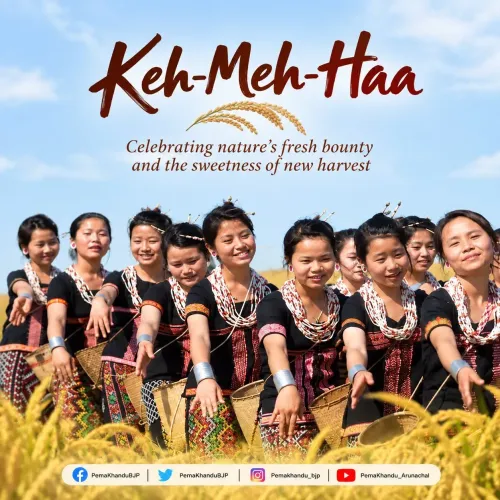
The Chief Minister's Office of Arunachal Pradesh greeted the Mishmi community on Keh-Meh-Haa, a traditional harvest festival observed in the Lohit, Anjaw and Dibang Valley districts, reflecting the state's broad recognition of its indigenous tribal calendar.
Key Takeaways
The Chief Minister's Office of Arunachal Pradesh extended greetings to the Mishmi community on 24 September 2026 .
Keh-Meh-Haa is the Mishmi tribe's traditional harvest festival marking the new agricultural season.
The Mishmi community is primarily settled in the frontier districts of Lohit , Anjaw , and Dibang Valley .
Arunachal Pradesh hosts one of India's highest concentrations of Scheduled Tribes , each with a distinct festival calendar.
State officials in Arunachal Pradesh routinely issue formal greetings on tribal harvest and seasonal festivals as a mark of institutional recognition.
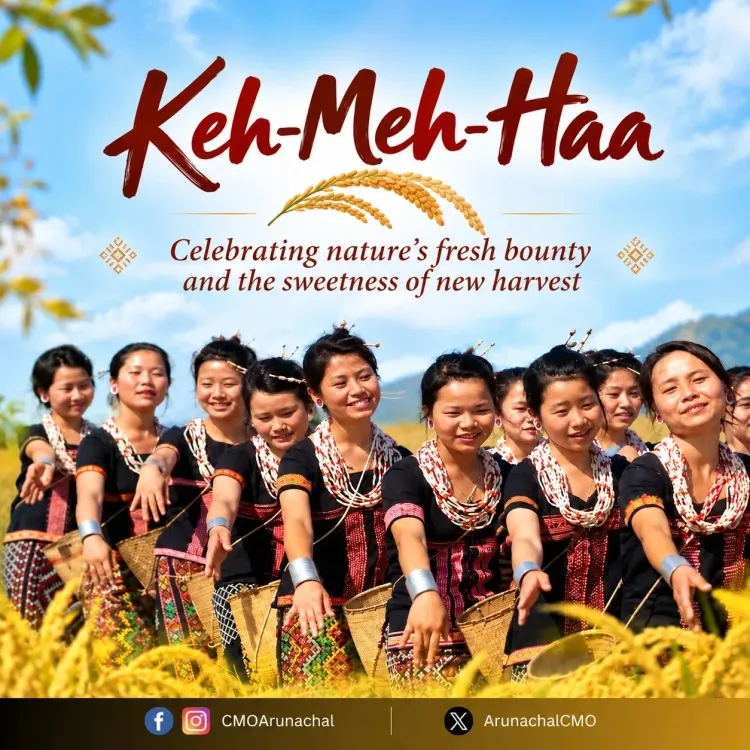
A new harvest season arrives in the hills of eastern Arunachal Pradesh, and the Chief Minister's Office of Arunachal Pradesh has extended warm greetings to the Mishmi community on the occasion of Keh-Meh-Haa, the tribe's traditional harvest festival.
The post, shared on Thursday, 24 September 2026, reads: 'Warm greetings to the Mishmi community on Keh-Meh-Haa! May the new harvest bring joy, prosperity and togetherness to every home.'
Keh-Meh-Haa and the Mishmi Heartland
Keh-Meh-Haa is a harvest festival rooted in the agricultural calendar of the Mishmi tribe, one of Arunachal Pradesh's most distinct indigenous communities. The Mishmis are spread primarily across the frontier districts of Lohit, Anjaw, and Dibang Valley — rugged, forested terrain along the state's eastern edge where community bonds are forged through shared cultivation cycles. The festival marks the close of the growing season and the arrival of fresh produce, bringing households together in celebration of the land's yield.A State That Counts Its Festivals
Arunachal Pradesh is home to a remarkable density of Scheduled Tribes, each carrying its own festival calendar. State officials routinely acknowledge these occasions — from the Nyokum of the Nyishi to the Ponung of the Adi — as a formal recognition that the northeast's cultural plurality is not incidental but foundational to the state's identity. The Mishmi community's Keh-Meh-Haa fits into this wider pattern of state-endorsed celebration of indigenous harvest traditions. For the Mishmi people, the greeting from the CMO's office affirms that their seasonal rhythms — tied to rain, soil and seed — hold a place in the official consciousness of the government they are governed by. Simple in words, the message carries the weight of institutional acknowledgement.Point of View
Formal acknowledgement of indigenous festivals reinforces the social compact between the government and its frontier communities. Arunachal Pradesh's governance model has long leaned on cultural recognition as a complement to infrastructure investment in its remote tribal districts. As the state navigates pressures of development and demographic change in its eastern hinterland, sustaining this calendar of official greetings keeps indigenous communities visible in the state's official narrative. It is soft governance, but in a region this sensitive, it is not without meaning.
NationPress
24 Sept 2026
Frequently Asked Questions
What is Keh-Meh-Haa?
Keh-Meh-Haa is a traditional harvest festival celebrated by the Mishmi tribe of Arunachal Pradesh, marking the arrival of the new agricultural season and the yield of fresh crops.
Who are the Mishmi people?
The Mishmi are an indigenous tribal community of Arunachal Pradesh, primarily inhabiting the frontier districts of Lohit, Anjaw and Dibang Valley in the state's far east.
Why did the Arunachal Pradesh CMO post about Keh-Meh-Haa?
The Chief Minister's Office of Arunachal Pradesh regularly extends greetings on tribal harvest and seasonal festivals to formally acknowledge the cultural practices of the state's many indigenous communities.
In which districts do the Mishmi people live?
The Mishmi community is concentrated in the districts of Lohit, Anjaw and Dibang Valley in eastern Arunachal Pradesh.
Does the Arunachal Pradesh government recognise tribal festivals officially?
Yes, state officials in Arunachal Pradesh routinely issue formal greetings and lend support to tribal harvest and seasonal festivals across the state's many Scheduled Tribe communities.