CM Pema Khandu Approves Arunachal Honey Policy 2026
Synopsis
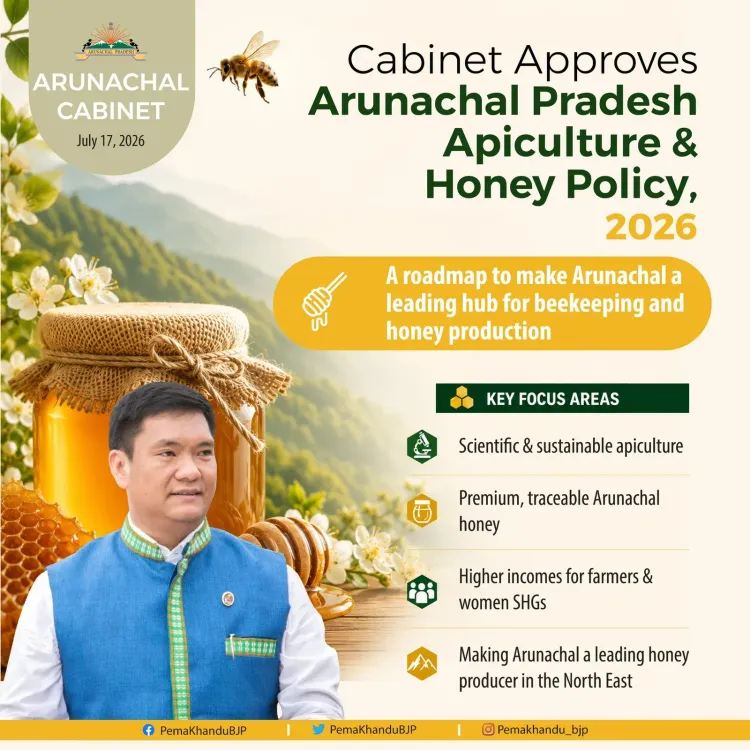
The Arunachal Pradesh cabinet, led by Chief Minister Pema Khandu, has approved the Apiculture and Honey Policy 2026 to establish the state as a scientific beekeeping hub, empower women SHGs and farmers, and position Arunachal Honey as a premium, traceable product in global markets.
Key Takeaways
The Arunachal Pradesh Apiculture and Honey Policy, 2026 was approved by the state cabinet on 17 July 2026 .
Chief Minister Pema Khandu announced the decision via his official X account as part of a broader set of cabinet decisions.
The policy aims to make Arunachal Pradesh a leading hub for scientific beekeeping and premium honey production.
Farmers and women self-help groups (SHGs) are the primary targeted beneficiaries for income generation.
The policy seeks to establish Arunachal Honey as a trusted, traceable product in global markets .
The state initiative aligns with India's National Beekeeping and Honey Mission (NBHM) launched in 2020 .
Arunachal Pradesh Chief Minister Pema Khandu announced on Friday, 17 July 2026 that the state cabinet has approved the Arunachal Pradesh Apiculture and Honey Policy, 2026, aimed at transforming the northeastern state into a leading hub for scientific beekeeping and premium honey production. The policy targets income generation for farmers and women self-help groups while positioning Arunachal Honey as a traceable, trusted product in global markets.
Context
In his post, CM Khandu stated that the policy 'will empower farmers and women SHGs, boost incomes, and position Arunachal Honey as a trusted, traceable global product.' The announcement came as part of a broader set of cabinet decisions highlighted under the hashtag #ArunachalCabinet and marks a significant step in the state's agricultural diversification agenda. The cabinet approval signals that a formal policy notification and implementation framework are expected to follow.
Arunachal Pradesh is home to exceptional floral biodiversity across its forests and hills, making it a naturally suited geography for apiculture. Scientific beekeeping — involving managed hive colonies, quality control, and traceability from hive to shelf — has long been identified as a high-value, low-input livelihood option for the state's rural communities.
Policy Backdrop
The state-level policy builds on the momentum of the National Beekeeping and Honey Mission (NBHM), launched by the Government of India in 2020 under the Ministry of Agriculture and Farmers Welfare to expand scientific beekeeping nationwide. The NBHM set a framework for states to develop their own apiculture ecosystems aligned with national production and export goals. Arunachal Pradesh's 2026 policy is a direct state-level articulation of those ambitions.
The broader push fits India's sustained effort since 2014 to double farmer incomes through diversification into high-value agricultural activities, particularly in the Northeast. States across the region have increasingly framed honey as an organic, export-ready product, with growing emphasis on certification, branding, and geographic indication tagging to command premium prices in international markets.
Stakeholders and Impact
Farmers and women self-help groups (SHGs) are the primary beneficiaries named in the policy. Women-led SHGs have been a consistent vehicle for rural livelihood programmes across Arunachal Pradesh and the wider Northeast, and the explicit inclusion of SHGs in the apiculture policy signals an intent to channel institutional support — training, equipment, and market linkages — through these grassroots structures.
For rural households, beekeeping offers a supplementary income stream that requires relatively low capital investment and can be integrated alongside existing farming activities. A state-backed traceability framework, if implemented, could allow Arunachal Honey to command premium pricing domestically and open pathways to export markets seeking certified organic and origin-verified products.
What's Next
Following the cabinet approval, stakeholders will watch for the detailed policy notification, which is expected to spell out budget allocations, training infrastructure, and implementation timelines. Potential tie-ups with central agencies for Geographical Indication (GI) tagging, digital traceability systems, and export linkages remain key areas to monitor. The success of the policy will depend significantly on the rollout of on-ground training programmes and the establishment of quality testing and certification infrastructure across the state's districts.
As Arunachal Pradesh marks a decade of the current administration under the #10yearsofteamarunachal banner, the apiculture policy represents an effort to leave a tangible economic legacy in the agriculture sector — one that ties the state's ecological wealth directly to rural incomes and global market access.
Point of View
2026 is a calculated move to convert the state's biodiversity advantage into an exportable economic asset, fitting squarely within India's broader Northeast development and farmer income-doubling agenda. By explicitly centering women SHGs as delivery channels, the policy also mirrors a well-established playbook across Indian states where institutional credit and training flow most efficiently through pre-existing SHG networks. The emphasis on traceability and global positioning suggests ambitions beyond domestic markets, likely anticipating GI tagging and organic certification as the next steps. Whether the policy translates into measurable income gains will hinge on the speed and quality of post-notification implementation — budget allocation, training infrastructure, and market linkage are the real tests ahead.
NationPress
16 Oct 2026
Frequently Asked Questions
What is the Arunachal Pradesh Apiculture and Honey Policy 2026?
The Arunachal Pradesh Apiculture and Honey Policy, 2026 is a state cabinet-approved policy designed to promote scientific beekeeping, boost honey production, empower farmers and women self-help groups, and position Arunachal honey as a premium, traceable product in global markets.
Who approved the Arunachal honey policy?
The policy was approved by the Arunachal Pradesh State Cabinet under Chief Minister Pema Khandu on 17 July 2026 .
How will the Arunachal honey policy benefit farmers and women SHGs?
The policy aims to empower farmers and women self-help groups (SHGs) by providing a structured framework for scientific beekeeping, which offers a supplementary, low-input income source alongside existing agricultural activities.
Is there a national beekeeping policy that supports this?
Yes. India launched the National Beekeeping and Honey Mission (NBHM) in 2020 under the Ministry of Agriculture to expand scientific beekeeping nationwide, and Arunachal Pradesh's 2026 policy builds on that national framework.
What makes Arunachal Pradesh suitable for honey production?
Arunachal Pradesh has rich floral biodiversity across its forests and hills, making it a naturally suited geography for apiculture and the production of premium, origin-specific honey varieties.