CM Pema Khandu Dedicates Bamboo & Cane Tech Centre in Arunachal
Synopsis
Arunachal Pradesh CM Pema Khandu on 15 June 2026 dedicated the APB&CTC at Gungu/Khamir — a skill and entrepreneurship hub built on PM Modi's 2017 reform that reclassified bamboo as a grass, unlocking commercial opportunities for bamboo-rich states like Arunachal Pradesh.
Key Takeaways
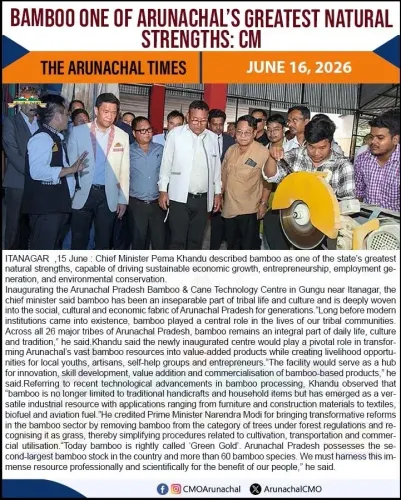
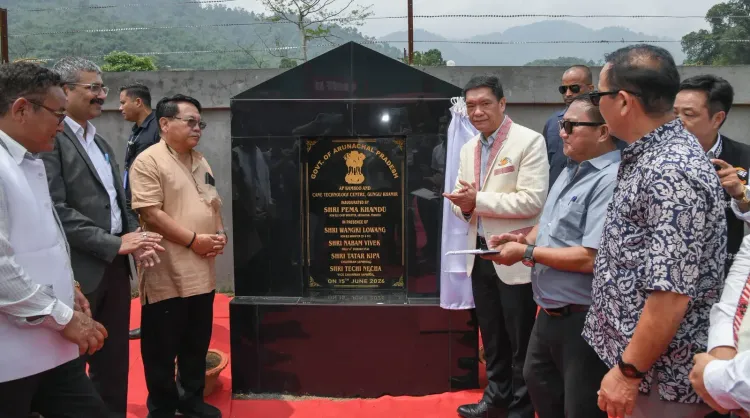
Chief Minister Pema Khandu dedicated the Arunachal Pradesh Bamboo & Cane Technology Centre (APB&CTC) at Gungu/Khamir on 15 June 2026 .
The centre focuses on skill development, innovation, entrepreneurship, and livelihood generation using bamboo and cane.
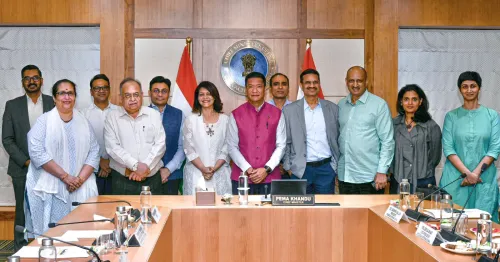
Forest Minister Wangki Lowang and MLA Nabam Vivek were present at the dedication ceremony.
The facility is built on the foundation of the 2017 Indian Forest (Amendment) Act , which reclassified bamboo as a grass and removed transit and felling restrictions.
CM Khandu credited Prime Minister Narendra Modi for the regulatory reform that opened commercial bamboo opportunities for Northeast states.
The centre is intended to help Arunachal's youth convert the state's bamboo reserves — referred to as 'Green Gold' — into sustainable income and employment.
Arunachal Pradesh Chief Minister Pema Khandu on Monday, 15 June 2026 dedicated the Arunachal Pradesh Bamboo & Cane Technology Centre (APB&CTC) at Gungu/Khamir to the people of the state, in the presence of Forest Minister Wangki Lowang, MLA Nabam Vivek, and other dignitaries. The centre is positioned as a hub for skill development, innovation, entrepreneurship, and livelihood generation centred on the state's bamboo and cane resources.
Context
Inaugurating the facility, Chief Minister Khandu described the APB&CTC as 'not merely a workshop' but a transformative institution where 'our youth can learn, create, produce, and transform Arunachal's Green Gold into sustainable income and employment opportunities.' The phrase 'Green Gold' — a widely used term for bamboo in Northeast India — underscores the state government's framing of bamboo as a high-value economic crop rather than a forest byproduct.
The centre at Gungu/Khamir is designed to anchor a bamboo value chain — from cultivation and processing to finished products — giving young people in the region access to vocational training and enterprise support under one roof.
Policy Backdrop
The inauguration draws directly on a landmark regulatory change at the national level. In 2017, the Indian Forest (Amendment) Act reclassified bamboo as a grass rather than a tree, effectively removing the transit permits and felling restrictions that had long constrained its cultivation, harvest, and commercial movement across state lines.
Chief Minister Khandu credited Prime Minister Narendra Modi for 'taking the historic decision to recognise bamboo as a grass and remove long-standing legal restrictions on its cultivation, harvest, and transportation,' calling it a 'visionary reform' that 'unlocked immense opportunities for bamboo-growing states like Arunachal Pradesh.' The 2017 amendment is widely regarded as the legal foundation on which states with large bamboo reserves — particularly in the Northeast — have been able to build commercial and institutional frameworks around the crop.
Stakeholders and Impact
Arunachal Pradesh holds some of the largest bamboo reserves in India, making the APB&CTC directly relevant to thousands of rural households and young job-seekers across the state. Bamboo cultivators who previously faced legal and logistical barriers to selling their produce commercially stand to benefit from both the regulatory change and the institutional infrastructure the centre provides.
Forest Minister Wangki Lowang and MLA Nabam Vivek were present at the dedication, signalling cross-departmental and legislative support for the initiative. The centre's mandate — spanning skill development, innovation, and entrepreneurship — positions it as a node connecting forest-based livelihoods to the broader rural economy of the state.
What's Next
Attention will now turn to the rollout of structured training programmes at the APB&CTC and whether the state government scales up similar bamboo value-chain infrastructure to other bamboo-rich districts of Arunachal Pradesh. The centre's success in generating measurable employment and enterprise outcomes will be the benchmark against which the investment is judged. If the model proves replicable, it could serve as a template for other Northeast states looking to monetise their bamboo reserves within the post-2017 regulatory framework.
Point of View
Reinforcing the BJP's Northeast development narrative ahead of any electoral cycle. The 'Green Gold' framing is deliberate: it rebrands a subsistence forest resource as a commercial opportunity, shifting the political conversation from welfare to enterprise. For Arunachal Pradesh, where forest-based livelihoods remain central to rural economies, a credible bamboo value chain could have outsized impact — but the real test lies in training throughput and market linkages, not the inauguration itself. The centre also fits a broader pattern of the NDA government using regulatory reform as the enabler and state governments as the delivery vehicle, a model that distributes credit across both tiers.
NationPress
15 Sept 2026
Frequently Asked Questions
What is the Arunachal Pradesh Bamboo & Cane Technology Centre?
The Arunachal Pradesh Bamboo & Cane Technology Centre (APB&CTC) at Gungu/Khamir is a state government facility dedicated to skill development, innovation, entrepreneurship, and livelihood generation using bamboo and cane resources. It was formally dedicated to the public by CM Pema Khandu on 15 June 2026.
Why was bamboo reclassified as a grass in India?
The Indian Forest (Amendment) Act of 2017 reclassified bamboo as a grass rather than a tree, removing the transit permits and felling restrictions that had long prevented farmers and cultivators from freely harvesting, transporting, and selling bamboo. The reform was aimed at unlocking the commercial potential of bamboo, particularly in Northeast India.
Who attended the inauguration of the APB&CTC?
Arunachal Pradesh Forest Minister Wangki Lowang, MLA Nabam Vivek, and other dignitaries attended the dedication ceremony alongside Chief Minister Pema Khandu.
How does the bamboo centre benefit Arunachal Pradesh youth?
The APB&CTC is designed to provide young people in Arunachal Pradesh with vocational training, innovation support, and entrepreneurship opportunities centred on bamboo and cane processing, enabling them to generate sustainable income from the state's abundant bamboo reserves.
What did PM Modi do for bamboo cultivation in India?
Prime Minister Narendra Modi's government passed the Indian Forest (Amendment) Act in 2017, reclassifying bamboo as a grass. This removed long-standing legal restrictions on bamboo cultivation, harvest, and transportation, making it commercially viable for farmers and states with large bamboo reserves, especially in the Northeast.