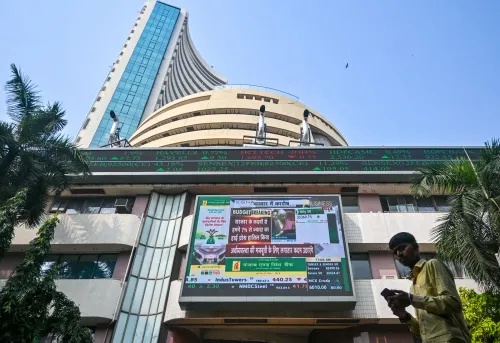
Sensex Drops 852 Points for 2nd Day on West Asia Crisis

Synopsis
Indian markets fell sharply for the second straight day on April 23, with Sensex losing 852 points and Nifty shedding 205 points as West Asia tensions, a surge in Brent crude to $105.86, a weakening rupee, and institutional selling triggered a broad risk-off selloff across auto, IT, banking, and realty sectors.
Key Takeaways
Sensex fell 852 points (1.09%) to close at 77,664 on April 23, 2025 , marking the second consecutive day of sharp losses.
Nifty 50 declined 205 points (0.84%) to settle at 24,173 , with an intraday low of 24,134.80 .
Nifty Auto, IT, PSU Bank, Realty, and Consumer Durables each dropped up to 2 per cent , while Pharma and Healthcare gained up to 2 per cent .
India VIX rose 1.58 per cent to near 20 , signalling elevated market fear and volatility.
Brent crude surged nearly 4 per cent to $105.86 per barrel amid supply fears linked to Strait of Hormuz tensions.
The Indian rupee weakened past the 84-mark against the US dollar , adding pressure on import costs and inflation.
Mumbai, April 23: Indian equity markets extended their losing streak into a second consecutive session on Thursday, April 23, as benchmark indices tumbled nearly 1 per cent each under the weight of escalating West Asia geopolitical tensions, particularly uncertainty surrounding the Strait of Hormuz and stalled Iran ceasefire talks. The selloff was broad-based, sweeping across sectors from auto and banking to IT and realty, signalling a deepening risk-off mood among domestic and institutional investors.
Market Close: Sensex and Nifty Settle Deep in Red
The BSE Sensex closed at 77,664, shedding 852 points or 1.09 per cent, while the NSE Nifty 50 ended at 24,173, declining 205 points or 0.84 per cent. At its worst intraday point, the Sensex slipped to 77,574 — a fall of nearly 1.2 per cent — while Nifty touched an intraday low of 24,134.80, down nearly 243 points.
Among the biggest laggards were Tech Mahindra, Infosys, Tata Motors Passenger Vehicles (TMPV), Mahindra & Mahindra, Eicher Motors, HDFC Bank, and ICICI Bank — a mix of technology, auto, and financial heavyweights that collectively dragged the indices lower.
Sector-Wise Damage: Auto, IT, Realty Lead the Decline
Sectoral indices bore the brunt of Thursday's selloff. Nifty Auto, Nifty PSU Bank, Nifty Consumer Durables, Nifty Realty, and Nifty IT each dropped up to 2 per cent, leading sector-level losses across the board.
In contrast, defensive plays offered a rare bright spot. The Nifty Healthcare and Nifty Pharma indices each gained up to 2 per cent, as investors rotated into traditionally safer segments amid the broader uncertainty — a classic flight-to-safety pattern seen during geopolitical shocks.
Broader market indices mirrored the weakness. The Nifty 100 fell 0.93 per cent, Nifty 200 declined 0.83 per cent, and the Nifty 500 slipped 0.79 per cent. Mid- and small-cap segments were not spared either — Nifty Midcap 50 shed 0.71 per cent, while both Nifty Smallcap 100 and Nifty Smallcap 50 fell 0.6 per cent each.
Volatility Spikes, Rupee Weakens Past 84-Mark
Market anxiety was further reflected in the India VIX — the fear gauge — which jumped 1.58 per cent to approach the 20-level, a threshold that typically signals elevated investor nervousness and potential for further sharp swings.
On the currency front, the Indian rupee weakened past the 84-mark against the US dollar, driven by strong dollar demand and a shift toward safe-haven assets globally. Currency analysts pointed to rising crude oil prices and a firmer US dollar index as twin headwinds compounding pressure on the rupee.
Meanwhile, global commodity markets reflected the geopolitical strain. Brent crude oil surged nearly 4 per cent to $105.86 per barrel, fuelled by supply disruption fears tied to tensions at the Strait of Hormuz — a critical chokepoint through which roughly 20 per cent of global oil supply passes.
Technical Outlook: Key Support and Resistance Levels
Market analysts noted that the Nifty 50 encountered stiff resistance near the 24,300 level, a zone that previously served as support but has now flipped into an immediate resistance band in the 24,300–24,400 range. This technical reversal signals persistent selling pressure at higher levels.
On the downside, the 24,100–24,000 zone is now the immediate support floor. A decisive breach below this band, experts warned, could trigger an accelerated slide toward the 23,800 level — a scenario that would erase much of the market's recent recovery gains.
Why This Matters: Broader Economic Implications for India
The current selloff is not happening in isolation. India imports over 85 per cent of its crude oil needs, making it acutely vulnerable to any sustained spike in global energy prices. A $10 per barrel rise in crude typically widens India's current account deficit by approximately 0.4–0.5 per cent of GDP, adding fiscal pressure on the government at a time when it is also managing post-election spending commitments.
Compounding this, institutional selling — particularly by Foreign Institutional Investors (FIIs) — has reinforced the risk-off sentiment. Rising crude prices feed directly into domestic inflation, potentially complicating the Reserve Bank of India's (RBI) monetary policy stance, especially if rate cut expectations get pushed back.
Notably, this two-day market decline comes just weeks after Indian indices had begun recovering from earlier global tariff-related volatility, underscoring how fragile the current rally was and how quickly external shocks can unwind domestic gains.
Investors and traders will closely watch developments in West Asia, Brent crude price movements, FII flow data, and the RBI's next policy signals in the sessions ahead. Any escalation at the Strait of Hormuz or a breakdown in diplomatic channels could deepen the correction further toward the 23,800–23,500 support zone.
Point of View
Every barrel spike is effectively a tax on Indian consumers and a headache for the RBI's inflation arithmetic. What's striking is that this selloff is accelerating precisely as Indian markets had begun to recover from earlier global trade war jitters — suggesting the rally was built on thin ice. The rotation into pharma and healthcare is telling: when even mid- and small-caps bleed, smart money isn't waiting for a turnaround signal.
NationPress
24 Sept 2026
Frequently Asked Questions
Why did the Indian stock market fall today on April 23, 2025?
Indian stock markets fell sharply on April 23, 2025, primarily due to escalating geopolitical tensions in West Asia, particularly uncertainty around the Strait of Hormuz and stalled Iran ceasefire talks. Rising crude oil prices, a weakening rupee, and institutional selling further intensified the risk-off sentiment.
How much did Sensex and Nifty fall on April 23?
The BSE Sensex dropped 852 points or 1.09 per cent to close at 77,664, while the NSE Nifty 50 fell 205 points or 0.84 per cent to settle at 24,173 on April 23, 2025. At intraday lows, Sensex touched 77,574 and Nifty hit 24,134.80.
Which sectors were most affected by the stock market fall?
Nifty Auto, Nifty PSU Bank, Nifty Consumer Durables, Nifty Realty, and Nifty IT were the worst-hit sectors, each falling up to 2 per cent. Defensives like Nifty Pharma and Nifty Healthcare bucked the trend, gaining up to 2 per cent.
What is the Nifty support level to watch after this decline?
Market analysts have identified the 24,100–24,000 zone as immediate support for the Nifty 50. A decisive break below this range could accelerate the decline toward the 23,800 level, while resistance now sits firmly in the 24,300–24,400 band.
How does the West Asia conflict affect India's economy and stock markets?
India imports over 85 per cent of its crude oil, making it highly sensitive to West Asia tensions that disrupt supply through the Strait of Hormuz. Rising crude prices widen India's current account deficit, weaken the rupee, stoke inflation, and complicate the RBI's monetary policy — all of which dampen investor sentiment and drag equity markets lower.