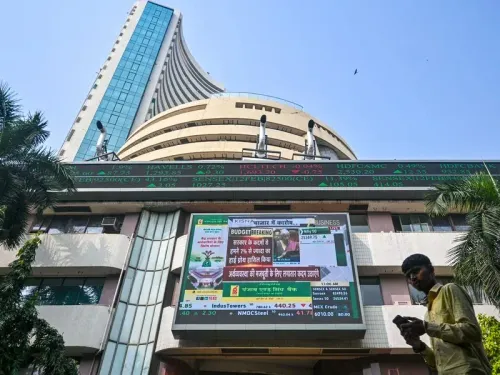
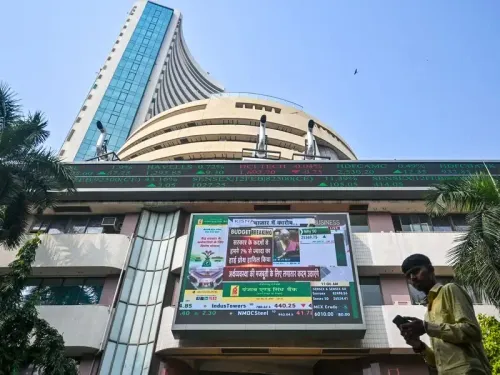
Sensex falls 583 points, Nifty below 24,000 as crude oil surges on US-Iran tensions

Synopsis
Brent crude surging toward $120 on US-Iran Strait of Hormuz fears dragged the Sensex down 583 points and pushed the Nifty below the 24,000 mark on 30 April — with the rupee weakening to 95.20, India's twin vulnerability to oil prices and currency pressure is back in sharp focus.
Key Takeaways
BSE Sensex fell 582.86 points (0.75%) to close at 76,913.50 on 30 April .
Nifty50 declined 180.10 points (0.74%) to 23,997.55 , slipping below the 24,000 level.
Brent crude reportedly surged near $120 per barrel after the US rejected Iran's peace proposal and intensified the Strait of Hormuz blockade.
Tata Motors Passenger Vehicles , Eternal , and Hindalco Industries were among the top Nifty losers; Nifty Metal and Nifty Consumer Durables led sectoral declines.
Nifty IT and Nifty Pharma outperformed as investors rotated into defensive sectors.
The Indian Rupee weakened towards 95.20 , with near-term support seen at 95.45 and resistance near 94.60 .
Indian equity benchmarks closed sharply lower on Wednesday, 30 April, as surging crude oil prices and escalating US-Iran geopolitical tensions rattled investor sentiment. The BSE Sensex fell 582.86 points, or 0.75%, to settle at 76,913.50, while the Nifty50 declined 180.10 points, or 0.74%, to close at 23,997.55 — slipping below the psychologically significant 24,000 mark.
What Triggered the Selloff
Brent crude prices surged sharply after reports indicated that the United States had rejected Iran's peace proposal and moved to intensify a blockade at the Strait of Hormuz, a critical global oil transit route. The development stoked fears of supply disruptions and renewed inflationary pressures, souring risk appetite across global equity markets. Crude prices reportedly approached $120 per barrel, a level that significantly worsens India's import bill outlook given the country's heavy dependence on oil imports.
Top Losers on the Nifty
On the index, Tata Motors Passenger Vehicles, Eternal, and Hindalco Industries emerged as the steepest losers. Cyclical and commodity-linked sectors bore the brunt of selling pressure, with the Nifty Metal and Nifty Consumer Durables indices among the worst performers, dragged down by concerns over rising input costs and global uncertainty. The broader market mirrored benchmark weakness — the Nifty MidCap index ended 0.98% lower, while the Nifty SmallCap index slipped 0.48%.
Defensive Sectors Provide Partial Cushion
Not all segments of the market succumbed to the selloff. Defensive pockets, including the Nifty IT and Nifty Pharma indices, managed to outperform the broader market, reflecting investor rotation into relatively insulated sectors during periods of global uncertainty. Analysts noted that sector-specific resilience in IT and pharma was, however, insufficient to offset the broader market decline.
Technical Levels to Watch
On the technical front, experts flagged 24,100–24,150 as an immediate resistance band for the Nifty, followed by the 24,300–24,400 zone as a crucial hurdle. On the downside, analysts said the 23,800 level remains a key support, where buying interest has previously emerged to prevent further decline. The Indian Rupee also came under fresh pressure, weakening towards 95.20 against the US dollar. According to an analyst, near-term support for the rupee is seen around 95.45, while resistance is placed near 94.60, with volatility expected to remain elevated.
Broader Market Outlook
Analysts said the session closed on a weak note as geopolitical tensions and rising crude oil prices dampened investor confidence broadly. This is the latest in a series of risk-off sessions triggered by US-Iran developments this month, underscoring how exposed Indian equities remain to global commodity shocks. With crude near multi-year highs and the rupee under pressure, markets will closely track any further escalation at the Strait of Hormuz and the next round of diplomatic signals from Washington and Tehran.
Point of View
The current account deficit math turns ugly fast, and the RBI faces a difficult choice between defending the currency and supporting growth. What is notable is that IT and pharma held up, signalling that domestic institutional and retail money is already rotating defensively — a pattern that, if sustained, could compress cyclical valuations further. The Strait of Hormuz angle deserves more attention than it is getting: any prolonged disruption there would not just spike fuel prices but also freight costs, hitting India's import-dependent manufacturing sectors at a particularly fragile moment.
NationPress
25 Sept 2026
Frequently Asked Questions
Why did the Sensex and Nifty fall on 30 April 2025?
The Sensex fell 582.86 points and the Nifty dropped 180.10 points on 30 April, primarily due to a sharp surge in Brent crude oil prices after reports that the US rejected Iran's peace proposal and intensified a blockade at the Strait of Hormuz. The resulting fears of supply disruptions and inflation dampened investor sentiment across global and Indian equity markets.
What level did Brent crude reach during the session?
Brent crude prices reportedly surged near $120 per barrel, according to market reports cited during the session. This sharp rally significantly worsened India's import bill outlook given the country's dependence on crude oil imports.
Which stocks and sectors were the worst hit on the Nifty?
Tata Motors Passenger Vehicles, Eternal, and Hindalco Industries were among the top losers on the Nifty. Sectorally, the Nifty Metal and Nifty Consumer Durables indices were the worst performers, weighed down by rising input cost concerns and global uncertainty.
Which sectors managed to outperform despite the market decline?
The Nifty IT and Nifty Pharma indices outperformed the broader market, acting as defensive pockets amid the selloff. Investors rotated into these sectors as they are relatively insulated from crude oil price shocks.
What are the key technical levels for the Nifty going forward?
Analysts have identified 24,100–24,150 as the immediate resistance band for the Nifty, with 24,300–24,400 as a crucial hurdle above. On the downside, 23,800 is seen as a key support level where buying interest has previously emerged to arrest declines.