Could Seoul's Stock Market Continue to Hit New Highs?
Synopsis
On January 16, South Korea's stock market set a new record, closing above 4,800 points. This remarkable achievement marks the continuation of a rally that has lasted for 11 sessions, driven primarily by semiconductor stocks. As the local currency weakens against the US dollar, the market capitalization reaches unprecedented levels.
Key Takeaways
Seoul's stock market closes at a record high of 4,840.74 .
11 consecutive days of gains driven by semiconductor stocks .
Total market capitalization surpasses 4,000 trillion won .
Foreign investors are key players, purchasing a net 405 billion won .
The local currency declines against the US dollar.
Seoul, Jan 16 (NationPress) The South Korean stock market closed at a new all-time high, surpassing 4,800 points on Friday, marking an impressive 11th consecutive session of gains as demand in the semiconductor sector continued to thrive. The national currency weakened against the US dollar.
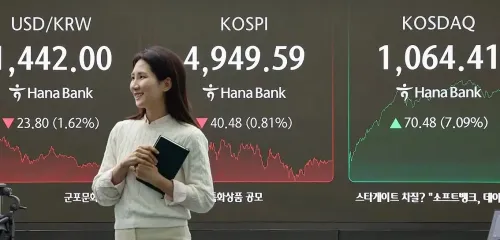
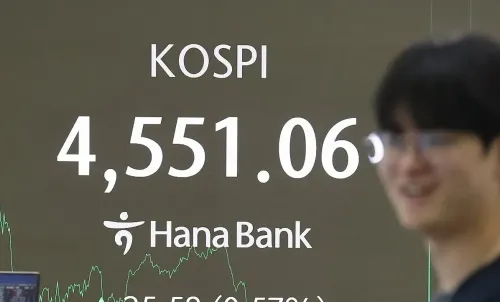
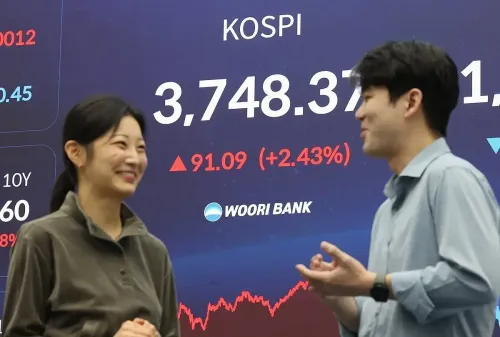
The KOSPI, which is the main stock index, increased by 43.19 points, or 0.9 percent, to settle at a record 4,840.74, as reported by Yonhap news agency.
During the day, the index reached an intraday high of 4,863.82 at 3:22 p.m.
This marks the 11th consecutive day of upward movement since the year began, consistently hitting new peaks.
Throughout this rally, the KOSPI has surged by nearly 15 percent, first breaching the 4,300-point threshold on January 2. It took just two days for the index to leap past 4,500 points before reaching the 4,800-point mark.
This rally builds on last year's significant gains, with the benchmark concluding 2025 at 4,214.17 on December 30, up from 2,398.94 at the year's start, yielding an annual return exceeding 75 percent.
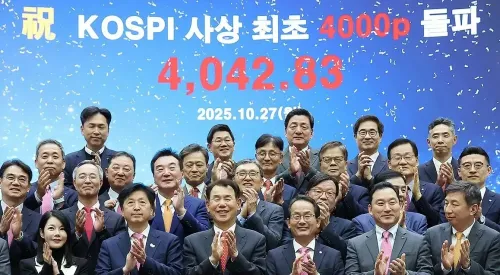
Reflecting this ongoing growth, the total market capitalization soared to 4,004.9 trillion won at the end of Friday’s trading, surpassing the 4,000 trillion-won milestone for the first time. This achievement came approximately three months after the market exceeded 3,000 trillion won in capitalization on October 15.
Trading activity was robust, with 701.2 million shares changing hands, valued at 26.6 trillion won (around US$18.1 billion), while decliners outnumbered gainers 504 to 373.
Foreign and institutional investors drove this rally, purchasing a net 405 billion won and 338.5 billion won worth of local stocks, respectively. In contrast, retail investors sold a net 938 billion won.
“The gains from Samsung Electronics propelled this record-breaking rally, following TSMC's recent growth report and the US-Taiwan trade agreement,” commented Lee Jae-won, an analyst from Shinhan Securities.
“The KOSPI is anticipated to continue its strong performance as major firms are expected to announce better-than-anticipated earnings,” he added.
Semiconductor stocks closed positively, with Samsung Electronics climbing 3.47 percent to 148,900 won, while SK Hynix advanced 0.93 percent to 756,000 won.
Energy company Doosan Enerbility surged 6.48 percent to 95,300 won, and the state-run Korea Power Corp. increased 1.67 percent to 54,700 won.
Samyang Foods, known for its popular spicy Buldak ramyeon, rose 0.25 percent to 1.2 million won, while Cosmax, a leading cosmetics manufacturer, jumped 3.14 percent to 187,300 won.
In contrast, Hyundai Motor, the top automobile manufacturer, dropped 2.13 percent to 413,000 won, and pharmaceutical giant Samsung Biologics fell 0.92 percent to 1.95 million won.
The currency was quoted at 1,473.6 won against the dollar at 3:30 p.m., a decline of 3.9 won from the previous session.
Bond prices, which inversely correlate with yields, closed higher. The yield on three-year Treasuries fell 1 basis point to 3.080 percent, while the return on the benchmark five-year government bonds decreased 0.4 basis points to 3.320 percent.
Point of View
I recognize the significance of this rally in the South Korean stock market. The sustained growth, particularly in the semiconductor sector, signals optimism for investors and reflects the broader economic recovery. However, we must remain cautious as market fluctuations can impact various sectors and individual investors. Our priority is to provide accurate and timely analysis to our audience.
NationPress
23 Sept 2026
Frequently Asked Questions
What caused the KOSPI to reach a record high?
The KOSPI reached a record high due to significant buying interest in semiconductor stocks, alongside positive market sentiment following favorable reports from major companies.
How has the market capitalization changed recently?
The total market capitalization has exceeded 4,000 trillion won for the first time, reflecting the strong performance of the stock market.
What trends can we expect in the KOSPI moving forward?
Analysts anticipate the KOSPI will continue to rise as major companies report better-than-expected earnings, sustaining investor confidence.
How did foreign investors impact the market?
Foreign investors played a crucial role in the rally, purchasing a net of 405 billion won in local shares, which significantly contributed to the market's upward momentum.
What are the implications of the won's decline against the US dollar?
The decline of the Korean won against the US dollar may affect import costs and inflation, which could influence investor sentiment and market dynamics.