Has KOSPI's Record Year Set the Stage for Continued Growth in 2026?
Synopsis
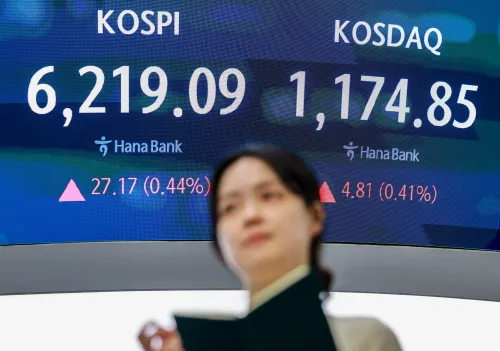
South Korea's stock market has experienced remarkable growth, driven by AI advancements and governmental reforms. As the KOSPI surpasses 4,000, experts predict continued upward momentum in the coming years, with President Lee Jae Myung aiming for a 5,000 milestone. Challenges such as currency fluctuations may impact this trajectory.
Key Takeaways
The KOSPI surpassed the 4,000 mark for the first time since 1983.
Projected growth to reach 5,500 points by 2026.
AI developments are driving stock market performance.
Government reforms aim to enhance market transparency and shareholder value.
Currency fluctuations could pose challenges for future growth.
Seoul, Dec 26 (NationPress) South Korea's stock market has had an extraordinary year, outshining both regional and global counterparts, primarily fueled by advancements in artificial intelligence (AI) and the government’s reformative actions in the market.
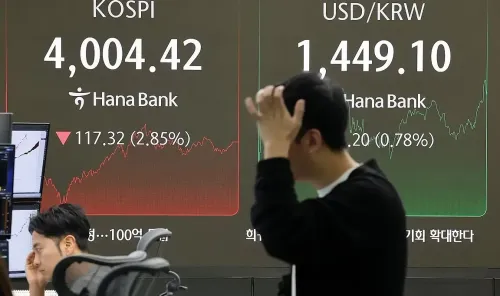
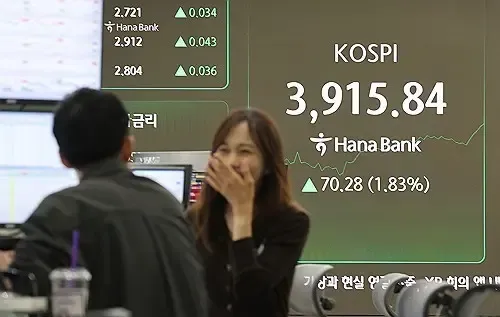
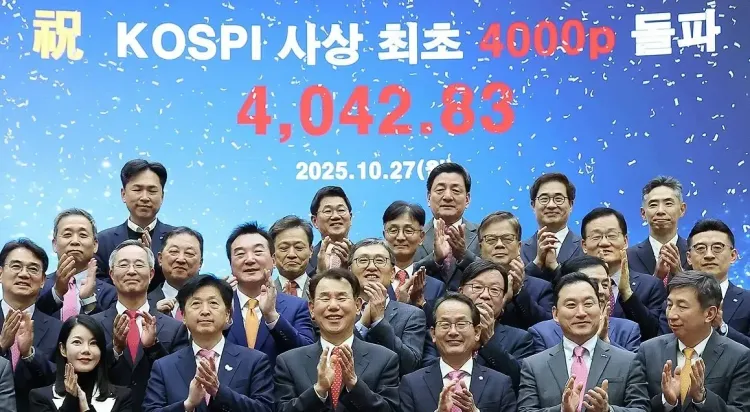
Once lingering around the 2,400 mark, the benchmark Korea Composite Stock Price Index (KOSPI) reached a historic high on Oct. 27, surpassing the 4,000 threshold for the first time since its inception in 1983, as reported by Yonhap.
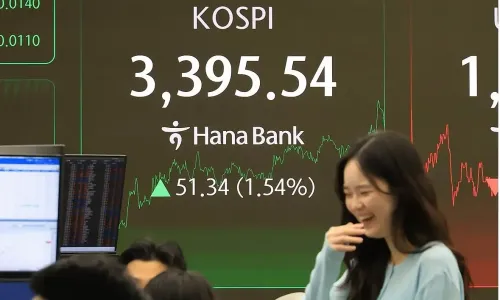
The KOSPI emerged as the top-performing stock index among the Group of 20 (G20) nations, soaring over 70 percent since the beginning of the year.
It even outperformed the world's leading stock markets, with the S&P 500 and the tech-heavy Nasdaq rising by 17.2 percent and 21.5 percent, respectively.
This unprecedented surge can be attributed to a potent mix of the global AI boom, significant foreign investments spurred by interest rate reductions, and supportive corporate reforms introduced by the new administration.
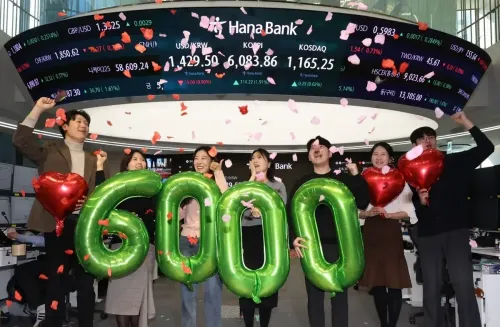
President Lee Jae Myung has committed to pushing the KOSPI beyond the 5,000 mark, focusing on improving market transparency, enhancing shareholder value, and reforming the capital market.
A third round of amendments to the Commercial Act is currently under consideration at the National Assembly. This proposed revision aims to enforce the cancellation of treasury stocks within a year, a move anticipated to boost shareholder returns.
This year, more than 20 companies listed on the KOSPI shattered their previous records. Notably, Samsung Electronics more than doubled its value, while its competitor SK hynix nearly quadrupled, spurred by global enthusiasm surrounding the AI chip supercycle.
Looking forward, market analysts maintain an optimistic perspective on the local stock market, predicting that the demand for AI-related infrastructure will remain strong in the coming year.
Park Se-young, executive director of Nomura Securities Co., noted, "Several data centers backed by major tech firms are set to be established around 2026 and 2027." She expects the KOSPI to soar to 5,000 next year, emphasizing that this trajectory could benefit not only local chipmakers but also a broad spectrum of Korean tech firms involved in the AI supply chain, extending from batteries to cooling system providers.
Many experts concur that the benchmark index is likely to continue its upward momentum in the upcoming year.
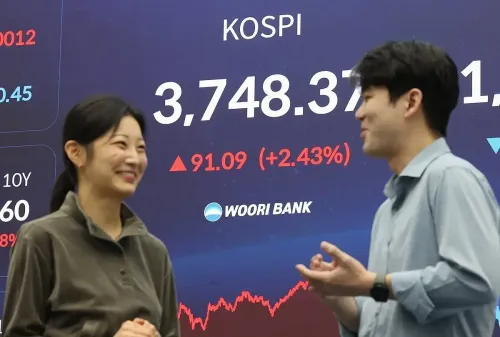
Daol Securities projects the KOSPI to fluctuate between 3,740 and 4,930 in 2026, while Hyundai Motor Securities has forecasted the KOSPI could reach up to 5,500 points.
Samsung Securities anticipates the index will stabilize within the 4,000-4,900 range, attributing potential volatility to significant events such as the mid-term elections in the United States scheduled for November.
However, the declining local currency may pose challenges for the equity market, as highlighted by Toss Securities Analyst Lee Young-gun in a report.
Recently, the South Korean won has experienced a decline against the US dollar, reaching an eight-month low of 1483.6 won per dollar on Tuesday.
Lee cautioned, "The foreign exchange rate influences both the capital movement of offshore investors and the competitiveness of the country’s exports. The recent depreciation of the won could exert additional downward pressure on the broader stock market."
"It appears improbable that the won-dollar exchange rate will revert to the low 1,000s in the near future. Investors should consider the current exchange rate as a potential 'new normal.'"
Point of View
I believe that the recent performance of the KOSPI highlights South Korea's economic resilience and its potential as a hub for technological innovation. The government's commitment to market reforms and AI advancements positions the nation well for sustained growth, though we must remain vigilant about potential currency fluctuations and their impact.
NationPress
30 Sept 2026
Frequently Asked Questions
What factors contributed to KOSPI's record performance?
The KOSPI's record performance is attributed to advancements in AI, strong foreign investments, and supportive government reforms.
What are the future projections for the KOSPI?
Experts project the KOSPI could reach as high as 5,500 points in 2026, driven by demand for AI-related infrastructure.
What risks could affect the KOSPI's growth?
The weakening local currency poses risks, as it could impact capital movements and export competitiveness.