South Korean Stock Market Plummets 8% After Trading Resumes Post-Suspension
Synopsis
On March 9, South Korean stocks witnessed a staggering drop of about 8% as the Korea Exchange resumed trading after a brief suspension. The decline is attributed to heightened market volatility following recent geopolitical tensions.
Key Takeaways
South Korean stocks dropped around 8% on March 9.
The decline followed a 20-minute trading suspension due to volatility.
The KRX activated a circuit breaker in response to the market plunge.
Geopolitical tensions have heightened investor anxiety.
Global oil prices continue to influence market dynamics.
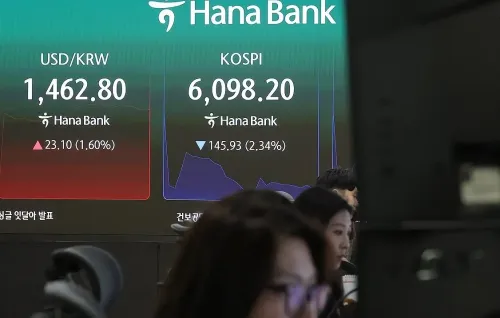
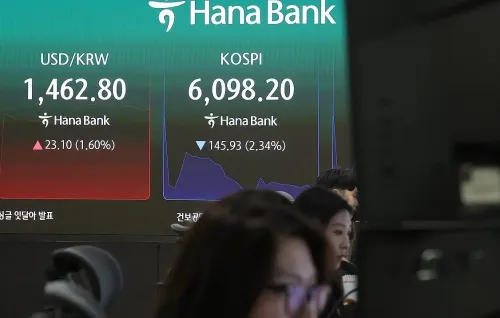
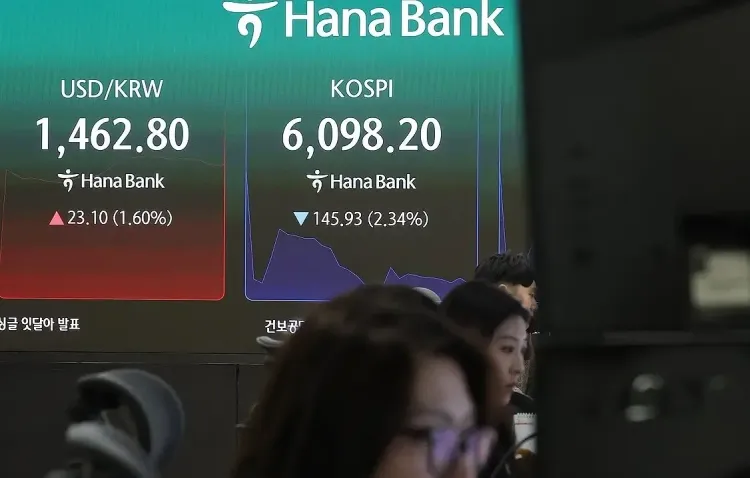
Seoul, March 9 (NationPress) - South Korean equities saw a dramatic decline of approximately 8 percent on late Monday morning after the Korea Exchange (KRX) resumed trading following a 20-minute suspension due to significant market fluctuations instigated by the recent US-Israeli military actions against Iran. The benchmark Korea Composite Stock Price Index (KOSPI) dropped 445.88 points, or 7.98 percent, settling at 5,138.99 by 11:20 a.m., according to reports from Yonhap news agency.
The KRX engaged a circuit breaker at 10:31 a.m. after the KOSPI experienced a plunge of 452.8 points, equating to 8.11 percent, to reach 5,132.07, resulting in a temporary trading halt of 20 minutes.
A circuit breaker is triggered when the index remains below 8 percent of the previous session's level for a continuous minute.
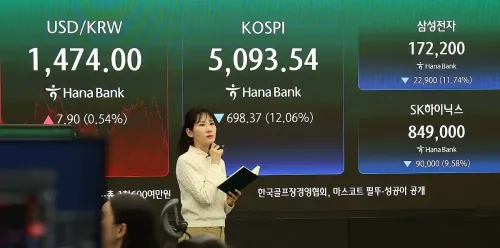
Additionally, the KRX had invoked a circuit breaker the previous Wednesday when the main index fell by 12.06 percent, marking the greatest single-day drop since September 12, 2001, in the wake of the September 11 terrorist attacks in the United States.
Earlier that day, the main exchange operator also enabled a sell-side sidecar, halting sales for five minutes due to the KOSPI 200 Futures index fluctuating by 5 percent or more for at least one minute.
Investors remained vigilant regarding global energy price fluctuations, with the U.S. benchmark West Texas Intermediate (WTI) crude oil surpassing US$100 per barrel on Sunday (U.S. time).
The market also responded to weaker-than-anticipated U.S. employment figures released last week, revealing a decline of 92,000 in nonfarm payrolls for February, falling short of market expectations for an increase of 59,000.
In Seoul, oil refiners exhibited mixed trading patterns; while SK Innovation decreased by 2.8 percent, S-Oil improved by 3.16 percent.
Major market player Samsung Electronics fell by 9.94 percent, and SK Hynix dropped 10.98 percent.
Financial stocks also faced losses, with KB Financial dropping 5.7 percent and Shinhan Financial declining 4.68 percent.
Hanwha Aerospace slid by 4.86 percent, while Hanwha Ocean lost 3.95 percent.
Conversely, POSCO International, a trading entity, rose by 11.06 percent amid positive investor sentiment regarding its energy business portfolio.
The Korean won was trading at 1,497.3 won per U.S. dollar, reflecting a decrease of 20.9 won from the previous session.
Point of View
The recent plunge in South Korea's stock market highlights the fragility of investor confidence amid global geopolitical tensions. The swift response from the KRX, including circuit breakers and trading suspensions, underscores the importance of market stability in uncertain times.
NationPress
26 Sept 2026
Frequently Asked Questions
What caused the recent decline in the South Korean stock market?
The decline was primarily triggered by extreme volatility associated with recent US-Israeli military actions against Iran, leading to a trading suspension on the Korea Exchange.
What is a circuit breaker in stock trading?
A circuit breaker is a regulatory measure that temporarily halts trading on an exchange when the market drops by a certain percentage, aimed at preventing panic selling.
How did the KOSPI index perform on March 9?
The KOSPI index fell by 445.88 points, or approximately 7.98 percent, settling at 5,138.99 by late morning.
What are the implications of the U.S. jobs data on the market?
Weaker-than-expected U.S. jobs data can negatively impact investor sentiment, as it suggests a slowdown in economic growth, further exacerbating market volatility.
How are oil prices affecting the South Korean market?
Rising global oil prices, such as WTI crude surpassing $100 per barrel, can impact South Korean stocks, particularly in the energy sector, leading to mixed trading results.