South Korea to Sustain Cooperative Talks with US on Tariffs
Synopsis
South Korea is committed to maintaining friendly negotiations with the United States over tariff issues to protect its trade agreements. Minister Kim Jung-kwan emphasizes the importance of ongoing support for local businesses amid fluctuating global trade conditions.
Key Takeaways
South Korea is engaging in ongoing 'amicable' talks to safeguard its trade agreements.
Minister Kim Jung-kwan emphasizes support for local businesses amidst trade uncertainties.
Supreme Court's ruling has significant implications for tariff policies.
Sections 122 and 301 of the Trade Act could impact future trade relations.
Proactive measures are being taken to manage potential trade challenges.
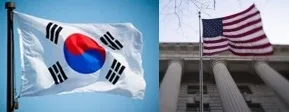
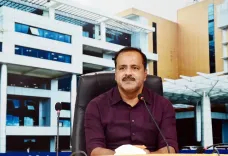
Seoul, Feb 23 (NationPress) South Korea is set to maintain its 'friendly' discussions with the United States regarding tariff matters, aiming to protect the advantageous export terms established through its trade agreement with the U.S., as stated by Seoul's Minister of Trade, Industry, and Resources on Monday.
Minister Kim Jung-kwan also pledged ongoing assistance for domestic companies to enhance their international competitiveness amidst unpredictable trade conditions, as reported by the Yonhap news agency.
"In line with the goal of maximizing national interests, the government will persist in fostering open communication and amicable dialogue to ensure that the beneficial export terms derived from the Korea-U.S. tariff agreement remain intact," he remarked, according to the ministry.
Kim shared these insights during a meeting with local business leaders to outline South Korea's approach following the U.S. Supreme Court's ruling that invalidated President Donald Trump's use of the 1977 International Emergency Economic Powers Act (IEEPA) to justify tariffs on South Korea and other trading partners, including reciprocal tariffs.
In response to the court's decision, Trump announced a new temporary global tariff of 15 percent and committed to introducing "new and legally compliant" duties to replace the invalidated reciprocal tariffs.
Kim indicated that the U.S. administration is likely to aggressively seek alternative strategies to uphold its extensive tariff policies, referencing Sections 122 and 301 of the Trade Act. He also noted that global trade uncertainties are expected to heighten.
Section 122 of the Trade Act of 1974 permits the U.S. president to address specific international payment issues through surcharges and other unique import restrictions, while Section 301 allows the U.S. Trade Representative's office to investigate unfair trade practices by foreign nations and take actions such as imposing tariffs.
When discussing the potential for Korea to be included in Washington's investigation under Section 301, Kim stated, "We are not making any assumptions," but emphasized the need for careful management of various trade matters to avoid being subjected to such actions.
"We will diligently pursue policies to reinforce our companies' competitiveness and diversify exports in anticipation of possible changes in export conditions. This will involve collaboration with relevant agencies and industry associations to provide timely tariff refund information to assist companies in navigating uncertainties related to this issue," Kim concluded.
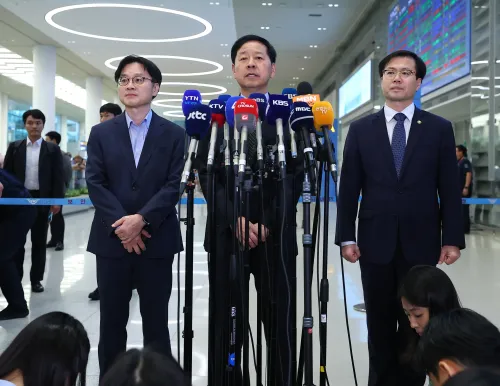
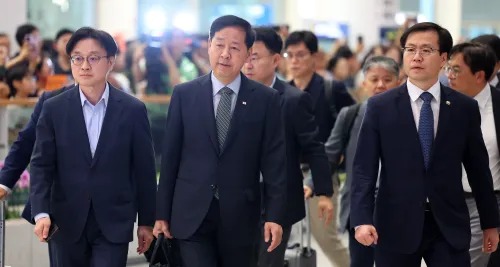
After the meeting, Kim informed reporters that the government is continuing its preliminary assessment of potential investment projects by Korea in the U.S., irrespective of the Supreme Court ruling.
Earlier this month, the government initiated a committee to commence this preliminary review as Trump threatened to increase reciprocal tariffs and auto duties on Korea back to 25 percent, citing delays in Seoul's legislative processes to implement the trade agreement finalized last year.
Point of View
The ongoing negotiations between South Korea and the U.S. regarding tariffs are critical for safeguarding trade agreements that affect local businesses and the overall economy. The government's proactive approach underscores a commitment to national interests while navigating global trade uncertainties.
NationPress
1 Oct 2026
Frequently Asked Questions
What is the main goal of South Korea's talks with the U.S.?
The main goal is to protect the favorable export conditions established through the bilateral trade agreement with the U.S.
Who is South Korea's Minister of Trade?
The Minister of Trade is Kim Jung-kwan.
What did the U.S. Supreme Court rule regarding tariffs?
The Supreme Court ruled against President Trump's use of the IEEPA to justify tariffs on South Korea and other countries.
What are Sections 122 and 301 of the Trade Act?
Section 122 allows the president to address international payment issues through special import restrictions, while Section 301 empowers the U.S. Trade Representative to investigate unfair trade practices.
How is South Korea preparing for potential changes in trade conditions?
South Korea is focusing on strengthening the competitiveness of its companies and diversifying exports while providing timely information on tariff refunds to address uncertainties.