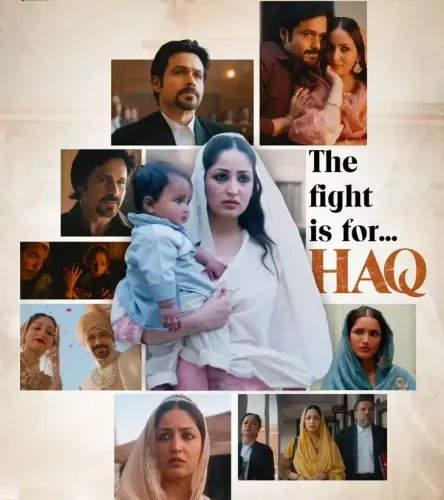
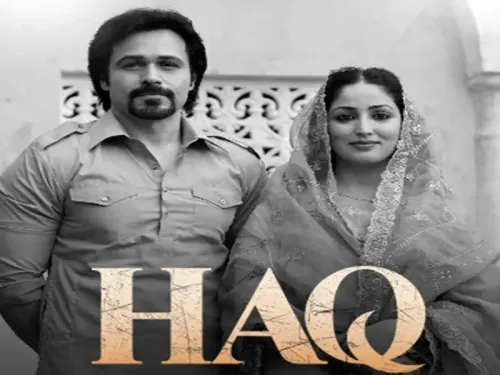
Is Emraan Hashmi Excited to Explore Distant Characters from His Belief System?

Synopsis
Emraan Hashmi shares insights on portraying characters far removed from his beliefs in his upcoming film ‘Haq’. He emphasizes the excitement of exploring different perspectives as an artist, offering a fresh take on personal and societal challenges.
Key Takeaways
Emraan Hashmi embraces roles that challenge his personal beliefs. ‘Haq’ draws from a significant legal case in India.
Portraying distant characters leads to personal and artistic growth.
The film addresses critical societal issues and women's rights.
Understanding diverse perspectives is essential for actors.
Mumbai, Nov 5 (NationPress) Actor Emraan Hashmi, preparing for the release of his upcoming film ‘Haq’, expressed that performers find it thrilling to portray characters that diverge from their own belief systems.
The actor elaborated during a chat with IANS at a luxurious hotel in the Juhu neighborhood of Mumbai. ‘Haq’ draws inspiration from the significant case of Mohd. Ahmed Khan v. Shah Bano Begum. In this case, Shah Bano, a 62-year-old Muslim woman, sought financial support from her husband following a divorce executed via triple talaq. The Supreme Court ruled in her favor, citing Section 125 of the Criminal Procedure Code, which asserts that maintenance is applicable to all citizens, regardless of religion.
In the film, Emraan portrays a character based on Mohd. Ahmed Khan, a lawyer. This role significantly contrasts with his own personal beliefs and worldview. When questioned about reconciling personal values with a character that opposes them, he remarked, “As an artist, you might embody roles that align with your ideology, but the essence of artistry lies in taking on characters that challenge your understanding. Through this journey, you gain deeper insights into these personas.”
Detailing his approach to such roles, he told IANS, “Upon reading the script, there’s a process of revisiting it, and while enacting the scenes emotionally, you begin to grasp the character’s origins and truths.”
He added, “This distance from your own beliefs makes it all the more fascinating for actors. The greater the divergence, the more intriguing it becomes, as you learn more about yourself. Portraying characters that resonate with your own experiences lacks excitement; it’s the unfamiliarity that presents the real challenge and a form of awakening.”
The ruling on the Mohd. Ahmed Khan v. Shah Bano Begum case triggered backlash from conservative Muslim factions who claimed it intruded upon Muslim Personal Law. Under political pressure, Prime Minister Rajiv Gandhi’s Congress (INC) government enacted the Muslim Women (Protection of Rights on Divorce) Act in 1986, effectively reversing the judgment and reinstating the community’s autonomy concerning personal laws. This action was perceived as an effort to placate conservative Muslim leaders, yet it faced widespread condemnation for undermining women’s rights and judicial independence. The case sparked a national discourse surrounding secularism, minority rights, and the necessity for a uniform civil code.
‘Haq’ is slated for release on November 7, 2025.
Point of View
Our approach remains steadfastly aligned with the nation’s core values. Emraan Hashmi's insights into portraying characters that challenge his beliefs not only reflect his growth as an actor but also highlight the broader societal dialogues around personal rights and beliefs, critical in today's India.
NationPress
28 Sept 2026
Frequently Asked Questions
What is the release date of ‘Haq’?
The film ‘Haq’ is set to be released on November 7, 2025.
What is the case that inspired the film ‘Haq’?
The film is inspired by the landmark case of Mohd. Ahmed Khan v. Shah Bano Begum, which addressed issues of maintenance and personal law.
What role does Emraan Hashmi play in ‘Haq’?
Emraan Hashmi plays a character based on Mohd. Ahmed Khan, a lawyer involved in the significant case.
Why does Emraan Hashmi find it exciting to play distant characters?
Emraan believes that portraying characters far removed from his beliefs allows for personal growth and a deeper understanding of diverse perspectives.
What were the societal impacts of the Shah Bano case?
The Shah Bano case ignited a national debate on secularism, minority rights, and the necessity for a uniform civil code in India.