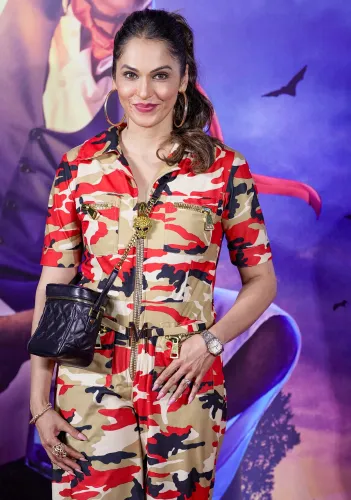
Isha Koppikar on student protests: Stop using 'dictatorship' casually

Synopsis
Actress Isha Koppikar has stepped into the student protest debate with a pointed message: the word 'dictatorship' is being used far too loosely, and democracy demands both free speech and responsibility. Her appeal to parents to teach children civics — not just academics — adds a dimension that goes beyond the usual celebrity commentary.
Key Takeaways
Actress Isha Koppikar shared a social media video on 24 July weighing in on ongoing student protests in Delhi and other parts of India.
She cautioned against using the word 'dictatorship' casually, distinguishing it from democracy where criticism of the government is permitted.
Koppikar asserted that every citizen has the right to question those in power, but said abusing or name-calling politicians is 'not maturity'.
She appealed to parents to teach children civics — including the difference between democracy and dictatorship — alongside academic subjects.
Her remarks stressed that 'real courage' lies in staying focused on substantive issues, not chasing trending hashtags.
Actress Isha Koppikar has entered the debate around ongoing student protests across India, urging citizens to stay anchored to substantive issues rather than amplify online noise — and cautioning against the casual misuse of the word 'dictatorship' in political discourse. Her remarks, shared in a video on social media, also carried a direct appeal to parents to impart civic education to their children alongside academic learning.
What Koppikar Said About the Protests
Addressing the wave of student demonstrations that have been reported in Delhi and several other parts of the country, Koppikar said the conversation online had drifted away from core concerns. 'These days, on social media, it seems that the real issue is left behind and the noise increases. If students are really concerned, then it should be about their future. It should be about their stress. It should be about what is happening to their families,' she said in the video.
She maintained that every citizen holds the right to question those in power, but drew a firm line at abuse and name-calling. 'It is every citizen's right to ask questions. But abusing or naming any politician is not the solution. Neither is it maturity,' she stated.
The 'Dictatorship' Warning
The sharpest part of Koppikar's message was directed at what she described as the careless deployment of the word 'dictatorship' in protest rhetoric. 'The word "dictatorship" is being used very casually. Democracy does not only mean freedom of speech. Democracy also means freedom of speech and responsibility. Dictatorship is where it is not possible to speak against the government or pay a heavy price. Therefore, it is not right to call anything a dictatorship immediately. Words also have a weight,' she said.
The actress emphasised that a functioning democracy accommodates diverse opinions, constructive criticism, and acknowledgment of good governance. 'We can all keep our own opinions. We can also ask questions to the government. And when good work is done, it is also necessary to give credit. This is the beauty of democracy,' she added.
Call for Civic Education at Home
Koppikar concluded with an appeal directed specifically at parents, urging them to teach children the distinction between democracy and dictatorship — and the responsibilities that accompany free speech. 'Teach your children not only academics but also civics. Explain to them the difference between democracy and dictatorship. Explain to them the responsibility of speech along with freedom of speech. And I explain to my daughter the same thing,' she said.
She pushed back against what she called performative dissent driven by the desire to appear cool online. 'To change every opinion into abuse or to say anything to look cool is not maturity. The real cool is the one who knows the facts, thinks and speaks with understanding, respects others and respects the democratic values of his country. Jai Hind,' she concluded.
Broader Context
The video arrives amid a period of heightened student-led protests in Delhi and other cities, with demonstrators raising concerns about issues ranging from academic pressure to policy grievances. Koppikar's intervention reflects a growing debate about the language and conduct of public dissent in India — and whether social media amplification is sharpening or distorting the core demands of student movements. Notably, several public figures have weighed in on the protests in recent weeks, underscoring how the demonstrations have moved beyond campuses into mainstream political and cultural discourse.
Point of View
But critics could argue that the line between legitimate hyperbole and factual mischaracterisation is precisely what protesters are contesting. The appeal to civic education is well-placed — but it sidesteps the harder question of whether institutional responses to dissent have themselves contributed to the language protesters are reaching for. Celebrity commentary on political protests rarely moves the needle; what matters is whether the underlying student grievances get the focused policy attention Koppikar herself says they deserve.
NationPress
23 Oct 2026
Frequently Asked Questions
What did Isha Koppikar say about the student protests?
Isha Koppikar said that online discourse around the student protests has drifted from core issues toward noise, and urged people to focus on students' futures, stress, and family concerns instead. She also cautioned against abusing or name-calling politicians, calling such behaviour immature.
Why did Isha Koppikar object to the use of the word 'dictatorship'?
Koppikar argued that 'dictatorship' is being used too casually in protest contexts. She defined dictatorship as a system where speaking against the government is impossible or comes at a heavy price — a condition she said does not apply when citizens can freely question those in power, as they can in a democracy.
What was Isha Koppikar's message to parents?
She appealed to parents to educate their children in civics alongside academics — specifically to explain the difference between democracy and dictatorship, and to instil a sense of responsibility that accompanies freedom of speech.
Which protests prompted Isha Koppikar's video?
The video was shared amid ongoing student protests reported in Delhi and several other parts of India. The demonstrations have centred on a range of concerns including academic pressure and policy grievances.
What did Koppikar say about freedom of speech in a democracy?
Koppikar said democracy means not just freedom of speech but also the responsibility that comes with it. She noted that democracy allows diverse opinions, constructive criticism, and acknowledgment of good governance — and that this distinguishes it from dictatorship.