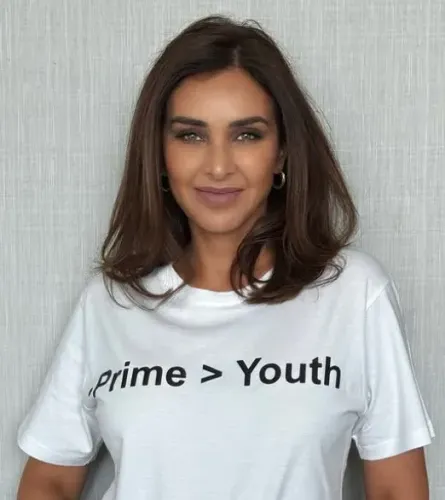
Lisa Ray on marrying at 40 after chemo menopause: 'Those first few years were volatile'

Synopsis
Lisa Ray didn't just share a personal story — she handed partners a practical framework. The actress, who entered chemo-induced menopause at 37 and married at 40, is now using her platform to break one of India's most persistent health silences, directing her message squarely at the men in the room.
Key Takeaways
Lisa Ray entered chemo-induced menopause at 37 following high-dose chemotherapy for multiple myeloma .
She met and married her husband at 40 , describing the early years of the marriage as 'volatile' due to ongoing menopausal effects.
Ray shared a six-point 'unofficial husband's guide' to supporting a partner through perimenopause and menopause on Instagram .
Her advice includes not dismissing feelings, recognising brain fog and sleep disruption as real symptoms, and avoiding the phrase 'calm down.' Ray is known for her role in the series 'Four More Shots Please!' and is a public advocate on women's health and cancer survivorship.
Actress Lisa Ray has spoken candidly about navigating the early years of her marriage while still experiencing the effects of chemo-induced menopause — a journey she describes as 'volatile' and one she hopes will help other couples facing similar challenges.
What Lisa Ray Shared
In a recent Instagram post, Ray revealed that she entered menopause at the age of 37 as a result of high-dose chemotherapy she underwent for multiple myeloma. She subsequently met and married her husband at 40, still in the midst of navigating menopause's aftermath. 'Entering marriage while experiencing the aftermath of menopause was…interesting. No wonder those first few years were volatile,' she wrote. 'Had I understood what was happening in my body, I might have thrown my husband a life raft.'
The 'Unofficial Husband's Guide'
Ray used the post to share what she called 'a very unofficial husband's guide to loving a woman through perimenopause and menopause.' Her advice to partners covered six key points: understanding that hormonal rage is not always personal; resisting the urge to immediately 'fix' emotions; offering space without making it feel like abandonment; recognising sleep disruption and brain fog as real symptoms; not dismissing a partner's feelings under the banner of menopause; and, above all, never saying 'calm down.'
'Mostly, though, stay curious. Her body is changing. Her relationship with herself may be changing too,' Ray wrote. She also acknowledged the toll on relationships, noting, 'It's the ones closest to us that get the unedited version because they are home. That doesn't mean they should become punching bags. It means we have to learn a new way of being with each other.'
Context: Cancer, Chemo, and Early Menopause
Ray, best known for her roles in films and the series 'Four More Shots Please!', was diagnosed with multiple myeloma — a form of blood cancer — and underwent aggressive treatment that triggered early menopause nearly a decade before the average age of onset. Her public disclosure adds to a growing body of celebrity-led conversations around women's health in India, where perimenopause and menopause remain significantly under-discussed topics in mainstream media.
This comes amid rising awareness globally around menopause in the workplace and in relationships, with advocates pushing for better medical education and partner support frameworks. Ray's post notably addresses men directly — an angle rarely foregrounded in Indian public discourse on the subject.
Closing Message
Ray ended her post on a note of solidarity: 'To the men navigating this alongside us: thank you for staying in the room. Even when you may occasionally need a helmet. Here's to us meno-survivors and to the men who love us.' The post has drawn widespread engagement, with many women sharing their own experiences in the comments.
Point of View
Bypassing the clinical language that keeps most menopause conversations inside gynaecology clinics. What's missing from the wider conversation, however, is institutional support: India has no workplace menopause policy, no standardised partner education in maternal or reproductive health programmes, and almost no mainstream media coverage of chemo-induced menopause specifically. Ray's disclosure is valuable precisely because it is public, but one celebrity post cannot substitute for the systemic awareness gap it inadvertently exposes.
NationPress
24 Aug 2026
Frequently Asked Questions
Why did Lisa Ray experience menopause at 37?
Lisa Ray entered menopause at 37 as a result of high-dose chemotherapy she underwent to treat multiple myeloma, a form of blood cancer. Chemo-induced menopause can occur when cancer treatment damages the ovaries, triggering early onset of menopause.
What did Lisa Ray say about her marriage and menopause?
Ray said that entering marriage at 40 while still experiencing the aftermath of chemo-induced menopause made the early years of her relationship 'volatile.' She wrote that a better understanding of her body at the time might have helped her support her husband through it more effectively.
What is Lisa Ray's 'unofficial husband's guide' to menopause?
It is a six-point list Ray shared on Instagram advising male partners on how to support women through perimenopause and menopause. Key points include not taking mood changes personally, avoiding the phrase 'calm down,' recognising brain fog and sleep disruption as real symptoms, and staying curious about the changes a partner is experiencing.
What is multiple myeloma, which Lisa Ray was diagnosed with?
Multiple myeloma is a cancer of plasma cells in the bone marrow. Ray has spoken publicly about her diagnosis and treatment for years, and her chemotherapy for the condition triggered early menopause at 37 — roughly a decade before the average age of natural menopause onset.
Why does Lisa Ray's menopause post matter beyond her personal story?
Ray's post is notable because it directly addresses male partners, an audience rarely targeted in menopause awareness messaging in India. It also brings visibility to chemo-induced menopause, a condition that affects cancer survivors but receives little mainstream coverage compared to natural menopause.