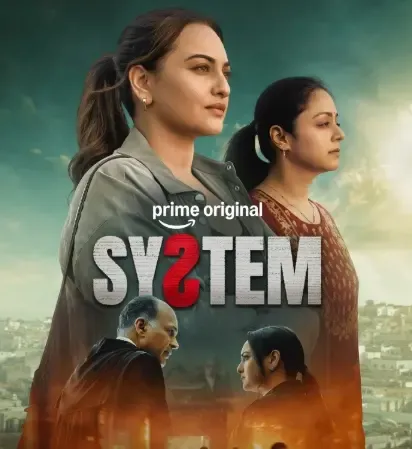
Sonakshi Sinha on cinema's role: 'Entertainment first, not moral lessons'

Synopsis
Sonakshi Sinha has drawn a firm line: filmmakers are storytellers, not moral guardians. Speaking at promotions for 'System' alongside Jyothika, she argued that ethics are taught at home and in school — not in cinemas — and that treating adult audiences as incapable of distinguishing fiction from reality is itself the problem.
Key Takeaways
Sonakshi Sinha rejected the view that cinema's primary role is social reform, calling entertainment the core purpose of filmmaking.
She argued that moral and ethical education belongs at home and in school, not in film narratives.
Sinha defended creative freedom, citing film rating systems as the appropriate safeguard for younger audiences.
She acknowledged that films like 'System' can provoke thought — but said that is a by-product, not an obligation. 'System' , produced by Pammi Baweja , Harman Baweja , and Smitha Baliga , premieres on Prime Video on 22 May .
Bollywood actress Sonakshi Sinha has pushed back against the widely held view that cinema's primary purpose is to serve as a vehicle for social change, asserting that storytelling and entertainment must come first. The actress made these remarks on 17 May in Mumbai during promotional events for her upcoming streaming film 'System', alongside veteran actress Jyothika.
What Sonakshi Said
Asked whether she agrees that films should be used to steer society in the right direction, Sinha was unequivocal. 'I actually don't agree with that because a film is made for entertainment as well. You should learn from your parents what is right and what is wrong. And you should learn this in school. This is not our job as film and creative people,' she said.
She extended the argument with a pointed example: 'Today, we will make a story about a lawyer, tomorrow we will make a story about a serial killer. It doesn't mean that you go and kill people.' The remark underlines her position that audiences are — and should be treated as — capable of distinguishing fiction from real-world conduct.
On Morality, Ratings, and Audience Responsibility
Sinha argued that moral frameworks are formed at home and in school, well before a viewer enters a cinema hall or opens a streaming app. 'Those morals and ethics are taught at home. And it's not our job to teach you. By the time you watch our film, we have ratings for the 12, 16, 18 year old audience because it's for a certain level of audience, who can understand it. And can differentiate between right and wrong,' she said.
She expressed frustration at recurring debates over on-screen content: 'A lot of the times, such a big conversation is made about — this is wrong, this should not be shown in a film. This should not be this, this should not be that. No, I'm sorry.' Her remarks reflect a broader tension in the Indian film industry between creative freedom and calls for socially responsible content.
Art as Reflection, Not Instruction
While firmly rejecting a prescriptive role for cinema, Sinha acknowledged that good storytelling can provoke thought. 'The audience should watch a film to be entertained by it. It's a story at the end of the day. Only then can we make good stories,' she said. She added that art is inherently a mirror of society: 'There are so many times where films are based on real life incidents, on true stories. Art is a reflection of society.' On 'System' specifically, she noted: 'If a film like 'System', for instance, forces you to think at home, that's a good thing. At least you're thinking about it.'
About 'System'
Produced by Pammi Baweja, Harman Baweja, and Smitha Baliga, 'System' is set to stream on Prime Video from 22 May. The film marks another streaming outing for Sinha, who has increasingly gravitated toward digital platforms in recent years. Jyothika, who features alongside her, was also present at the Mumbai promotional event.
Point of View
Social media mobs, and self-appointed cultural custodians — all claiming a stake in what stories get told and how. Her argument is not new, but it is rarely made this bluntly by a working actress mid-promotion. The more interesting tension she surfaces is structural: if ratings already gate content by age, why does the public debate treat every adult film as if it were being screened to impressionable children? The industry's reluctance to make this case collectively, film by film, is precisely why individual actors keep having to make it alone.
NationPress
1 Oct 2026
Frequently Asked Questions
What did Sonakshi Sinha say about cinema and social change?
Sonakshi Sinha said she does not agree that cinema's sole purpose is to bring about social change, arguing that films are made primarily for entertainment and that moral education is the responsibility of families and schools, not filmmakers.
What is Sonakshi Sinha's film 'System' about and when does it release?
'System' is a streaming film produced by Pammi Baweja, Harman Baweja, and Smitha Baliga, set to premiere on Prime Video on 22 May. Specific plot details were not disclosed during the promotional event.
Who appeared alongside Sonakshi Sinha at the 'System' promotions?
Veteran actress Jyothika joined Sonakshi Sinha at the promotional event held in Mumbai on 17 May.
How does Sonakshi Sinha view film ratings and audience responsibility?
Sinha pointed to existing age-based rating systems — for 12, 16, and 18-year-old audiences — as the appropriate mechanism to protect younger viewers, while arguing that adult audiences are fully capable of distinguishing fiction from real life.
Why do Sonakshi Sinha's remarks matter for the Bollywood debate on content?
Her comments reflect a long-running tension in Indian cinema between creative freedom and external pressure to make films that are explicitly socially instructive. By rejecting a prescriptive role for filmmakers, she is staking out a position that challenges both regulatory and public-opinion pressure on the industry.