Can Traditional Medicine Restore Balance in Life, Health, and Work?
Click to start listening
Synopsis
Prime Minister Narendra Modi emphasized the vital role of traditional medicine in restoring health balance at the WHO Global Summit on Traditional Medicine. He discussed the urgent need for equilibrium in life amidst modern challenges and launched several initiatives to promote this ancient wisdom.
Key Takeaways
- Traditional medicine can restore balance in health and lifestyle.
- PM Modi emphasized Ayurveda as a source of wisdom for achieving equilibrium.
- Global health challenges require urgent attention to imbalances.
- Innovative initiatives launched at the summit support traditional medicine.
- Research and regulation are vital for the future of traditional healthcare.
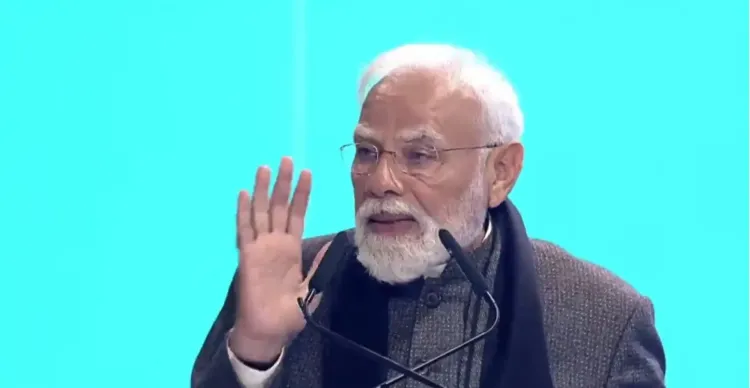
New Delhi, Dec 19 (NationPress) The global health challenges arising from imbalances in life, gut health, sleep, and workplace dynamics are significant. Prime Minister Narendra Modi emphasized the role of traditional medicine in restoring balance and enhancing well-being during the closing ceremony of the second WHO Global Summit on Traditional Medicine at the Bharat Mandapam on Friday.
The event, which took place from December 17 to 19, was a collaborative effort of the World Health Organisation (WHO) and the Ministry of Ayush.
Highlighting the summit's theme, “Restoring balance: The science and practice of health and well-being,” PM Modi pointed out that India's ancient wisdom, particularly Ayurveda, is fundamentally about achieving balance.
He stated, “In Ayurveda, balance is synonymous with health. A person who maintains this equilibrium is considered healthy.”
PM Modi addressed the growing imbalances in work-life, gut microbiome, sleep, and emotional health, asserting that they contribute to global health challenges. He noted that studies support this observation and declared that restoring balance is a pressing global need.
In the context of the 21st century, the Prime Minister stressed the importance of maintaining balance, especially as technologies like artificial intelligence and robotics transform human lives.
He warned that the shift in lifestyle, driven by convenient resources and reduced physical activity, poses unprecedented challenges to our health. “In traditional healthcare, we must not only address current needs but also consider our responsibilities toward the future,” he remarked.
PM Modi also raised the issue of safety and evidence in traditional medicine, asserting that “India is continuously working in this direction.”
He cited the example of Ashwagandha, which has been integral to traditional medicine for centuries. Its demand surged during the Covid-19 pandemic, leading to its adoption by various countries. India is dedicated to promoting Ashwagandha through rigorous research and evidence-based validation.
The convergence of traditional medicine and modern practices at the summit established a unique platform for innovation, with numerous initiatives launched that could potentially revolutionize the future of medical science and holistic health.
Furthermore, to empower traditional medicine, PM Modi called for enhancing research, leveraging digital technology, and establishing trustworthy regulatory frameworks globally.
During the summit, the Prime Minister introduced several groundbreaking Ayush initiatives, including the My Ayush Integrated Services Portal (MAISP), a comprehensive digital platform for the Ayush sector. He also unveiled the Ayush Mark, designed to serve as a global standard for the quality of Ayush products and services.
Additionally, he released a commemorative postal stamp honoring Ashwagandha, symbolizing the worldwide appreciation of India's traditional medicinal heritage.
The Prime Minister inaugurated the new WHO-South East Asia Regional Office complex in Delhi, referring to it as a “humble gift from India.”
Point of View
It is essential to recognize the significance of Prime Minister Modi's assertions regarding traditional medicine. His emphasis on restoring balance resonates deeply in today's fast-paced world, where health challenges are prevalent. The initiatives launched during the summit reflect India's commitment to integrating traditional wisdom with modern science, positioning the nation as a leader in global health.
NationPress
21/12/2025
Frequently Asked Questions
What is the main theme of the WHO Global Summit on Traditional Medicine?
The main theme of the summit was 'Restoring balance: The science and practice of health and well-being,' focusing on the importance of achieving equilibrium in health and lifestyle.
How does Ayurveda relate to health according to PM Modi?
PM Modi stated that in Ayurveda, balance is considered synonymous with health, and maintaining this equilibrium is crucial for overall well-being.
What initiatives were launched at the summit?
Several initiatives like the My Ayush Integrated Services Portal (MAISP) and the Ayush Mark were launched at the summit to enhance the quality and accessibility of traditional medicine.
What role did Ashwagandha play during the Covid-19 pandemic?
Ashwagandha saw a significant increase in demand during the Covid-19 pandemic as its benefits were recognized globally, leading to its adoption in various countries.
Why is traditional medicine important in modern times?
Traditional medicine is crucial in modern times as it offers insights and practices that can restore balance in an era marked by technological advancements and lifestyle changes.