Bessent: US Actions Kept Oil Near $100, Avoided $150 Surge
Synopsis
US Treasury Secretary Scott Bessent told Congress on April 24 that American sanctions relief kept global oil below $150 per barrel — a claim with massive implications for India's energy import costs. His testimony also revealed Washington's aggressive push into digital finance via the GENIUS Act, signalling a dual strategy to control both energy markets and the future of global money.
Key Takeaways
US Treasury Secretary Scott Bessent testified before a Senate panel on April 24, 2025 , stating that US policy kept global oil prices near $100 per barrel , preventing a surge to $150 .
Bessent rejected claims that sanctions relief benefited adversaries, calling the $14 billion Iran revenue figure a "myth" and arguing lower prices capped Russian oil earnings.
The US Treasury is funding implementation of the GENIUS Act to build expertise in digital assets , with Bessent warning that US financial leadership depends on dominating next-generation payment infrastructure.
IRS paper processing costs have been reduced from $45 million to $20 million under a technology-driven overhaul, with new data tools enabling proactive taxpayer compliance alerts.
Senator Jack Reed warned that every $1 invested in IRS enforcement returns $11 in recovered revenue, pushing back against spending cuts to the agency.
For India and other major Asian oil importers, US sanctions and supply policy directly determines fuel import costs, inflation trajectories, and currency stability through 2025 .
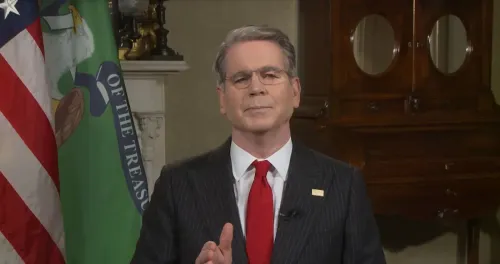
Washington, April 24, 2025 — US Treasury Secretary Scott Bessent told a Senate panel on Friday that deliberate American policy decisions on sanctions and energy supply prevented global oil prices from spiking to $150 per barrel, instead keeping them anchored near $100. Bessent's testimony laid out a sweeping strategy connecting energy market stability, sanctions relief, and US dollar dominance in global finance — with direct implications for major oil importers like India.
How US Sanctions Policy Stabilised Global Oil Markets
Bessent argued that targeted sanctions relief was the key lever that kept global energy markets well supplied during ongoing geopolitical tensions. "If we had not done that sanctions relief, they might have been at $150," he told lawmakers, adding that the market was kept "very well supplied."
He framed the policy as serving both domestic and international interests. "Just as you are concerned about gasoline prices for the American consumer and for our Asian allies, as are we," Bessent said — a statement that carries particular weight for India, one of the world's largest crude oil importers, which has been navigating discounted Russian crude purchases under Western scrutiny.
This approach reflects a deliberate balancing act: applying geopolitical pressure through sanctions while simultaneously ensuring that global supply does not collapse in ways that would harm allied economies and fuel inflation domestically.
Bessent Rejects Claims Iran and Russia Benefited from Relief
Bessent forcefully pushed back against bipartisan criticism that sanctions relief had inadvertently enriched adversaries like Iran and Russia. "The $14 billion is a myth," he said, dismissing assertions that Tehran had gained significant revenue from eased restrictions.
He deployed a pointed economic argument to counter the narrative that Russia profited from higher oil prices. "If Russia was selling their oil at a 20 per cent discount... 100 per cent of 100 is less than 80 per cent of 150," the Treasury Secretary explained — suggesting that lower global prices, even with volume discounts factored in, ultimately cap producer gains.
This argument is significant: it reframes sanctions relief not as a concession to adversaries, but as a strategic tool that limits their revenue ceiling while keeping allied economies insulated from price shocks.
Digital Finance and Dollar Dominance: Bessent's Strategic Vision
Beyond energy, Bessent outlined Treasury's growing focus on digital assets as a pillar of American financial leadership. He pointed to new funding to implement the GENIUS Act and build institutional expertise in "digital assets and global financial markets."
He warned that maintaining the US dollar's global reserve status requires active participation in financial innovation, not passive reliance on legacy systems. Digital assets, he said, could become "a very important payment rail" — a signal that Washington is preparing regulatory and institutional frameworks for a crypto-integrated global financial order.
This is notable context: the GENIUS Act, which governs stablecoin regulation, has been a flashpoint in US Congress, and Bessent's endorsement signals the Trump administration's intent to position the dollar-backed stablecoin ecosystem as a counterweight to rival digital currency initiatives, including China's digital yuan.
IRS Overhaul: Technology Over Spending
Bessent also defended a technology-driven transformation of the Internal Revenue Service (IRS), describing efforts to build a "digital first agency." He cited a dramatic reduction in paper processing costs — from $45 million to $20 million — as evidence that efficiency gains are outpacing spending cuts.
He described a new data-driven compliance model where the IRS proactively alerts taxpayers to audit risk. "We actually can go back to a taxpayer and say that you will likely be audited... would you like to redo it in advance?" he said — a preventive approach that he argued yields higher enforcement recoveries at lower cost.
However, Senator Jack Reed challenged this framing, warning that cuts to IRS enforcement would erode revenue collection. "Every dollar the agency invests in enforcement brings $11 back from tax cheats," Reed said, also noting that ordinary Americans are "paying more at the pump and for other everyday necessities."
What This Means for India and Global Energy Markets
India, as one of the largest beneficiaries of discounted Russian crude and a nation deeply sensitive to global oil price swings, sits at the intersection of every policy thread Bessent discussed. If US sanctions policy shifts — either tightening on Russia or loosening on Iran — New Delhi's energy import calculus changes significantly.
The $100 per barrel benchmark Bessent referenced is not merely a number — at that level, India's import bill remains manageable, the rupee faces less depreciation pressure, and the Reserve Bank of India retains more monetary policy flexibility. A spike to $150 would have cascading effects on Indian inflation, fiscal deficit, and current account balance.
As US-Iran nuclear negotiations and Russia-Ukraine conflict dynamics continue to evolve through 2025, Bessent's Senate testimony signals that Washington views energy price management as a geopolitical instrument — one that will remain calibrated to allied interests, including those in Asia.
Point of View
' including nations it simultaneously pressures on trade. The $14 billion Iran figure Bessent dismissed deserves independent scrutiny, not just a one-line rebuttal. Most critically, his digital assets push via the GENIUS Act signals that the real US power play in 2025 isn't just about barrels of oil — it's about who controls the next generation of global payment infrastructure.
NationPress
17 Sept 2026
Frequently Asked Questions
Why did Scott Bessent say oil prices were kept near $100?
US Treasury Secretary Scott Bessent said American sanctions relief and supply decisions prevented global oil prices from rising to $150 per barrel, keeping them near $100. He made these remarks while testifying before a Senate panel on April 24, 2025.
Did US sanctions relief benefit Iran or Russia?
Bessent rejected this claim, calling the $14 billion Iran revenue figure 'a myth.' He argued that lower global oil prices, even accounting for Russian discounts, ultimately limited producer revenues rather than boosting them.
What is the GENIUS Act and why did Bessent mention it?
The GENIUS Act is US legislation governing stablecoin and digital asset regulation. Bessent cited it as part of Treasury's strategy to maintain US dollar dominance by leading in digital finance and building payment infrastructure around dollar-backed digital assets.
How does US oil sanctions policy affect India?
India, as one of the world's largest crude oil importers, is directly impacted by global oil price levels. Keeping prices near $100 rather than $150 reduces India's import bill, eases inflation pressure, and gives the Reserve Bank of India more monetary policy flexibility.
What changes is Bessent making to the IRS?
Bessent described a technology-driven overhaul of the IRS aimed at creating a 'digital first agency.' Paper processing costs have been cut from $45 million to $20 million, and the agency is using data tools to proactively identify and prevent tax non-compliance before audits occur.