Is the Beijing Stock Exchange More of a Policy Tool than a Liquidity Hub?
Synopsis
Explore how the Beijing Stock Exchange acts as a strategic policy tool rather than a traditional liquidity hub, revealing insights into China's economic strategy. This new report sheds light on the BSE's unique role in shaping industrial objectives.
Key Takeaways
The BSE functions as a policy tool rather than a conventional liquidity-driven market.
Over 80% of listed firms are in strategic industries.
The BSE holds a market capitalization of over $129.1 billion .
Retail investors dominate, making up over 90% of trading activity.
Low liquidity is a deliberate choice to prioritize strategic financing.
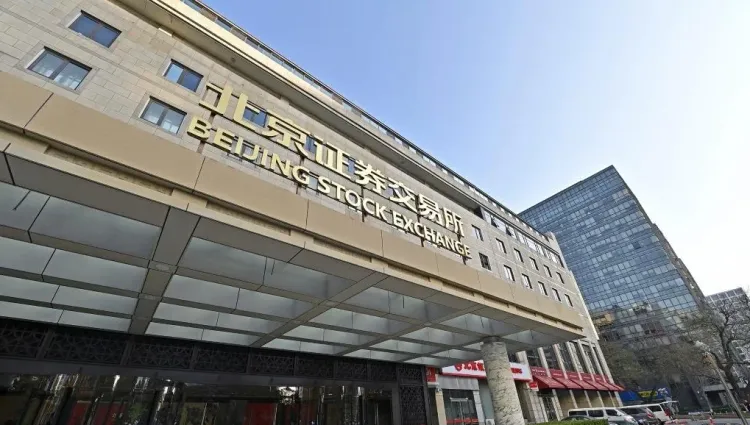
New Delhi, Feb 17 (NationPress) The Beijing Stock Exchange (BSE) unveils a significant aspect of China's political economy, indicating that capital markets serve more as policy instruments than liquidity-driven entities focusing on strategic industrial goals, as noted in a recent report by the East Asia Forum.
The report highlights that China utilizes capital markets as tools of industrial policy while acknowledging a degree of limited market liquidity.
“Aimed at financing 'little giant' companies in key sectors, the exchange emphasizes strategic allocation and regulatory coordination rather than trading volume,” the report states.
The total market capitalization of the BSE surpassed 900 billion yuan (approximately $129.1 billion). As the third stock exchange in China, the BSE does not aim to compete with the size of the Shanghai or Shenzhen exchanges.
As foreign listings for Chinese companies pose greater risks and foreign investors exercise caution regarding Beijing's influence, domestic markets like the BSE are tasked with financing innovation while ensuring financial stability.
“Consequently, over 80 percent of firms listed on the BSE operate in strategic emerging industries, and around 53 percent are part of China's Little Giants initiative—a government program that supports small firms in crucial technological fields,” the report adds.
Despite a surge in listings, the BSE is characterized by limited liquidity.
“The BSE’s investor composition is restricted. Retail investors predominate, facing high eligibility barriers, while institutional investors represent less than 10 percent of trading activity,” the report elaborates.
Small company sizes, minimal analyst coverage, and exclusion from benchmark indices diminish the exchange's appeal to institutional investors.
Thus, low liquidity is not merely a market failure but a calculated institutional trade-off, prioritizing strategic financing and regulatory control over market-driven price discovery.
“In contrast to the other exchanges, where stronger institutional engagement and clear exit strategies foster higher turnover and valuation premiums, the BSE serves as a stabilizing platform for firms unlikely to see rapid growth,” the report concludes.
Furthermore, it mentions that Beijing seems willing to accept low trading activity and limited price discovery in return for enhanced policy oversight and strategic capital distribution.
Point of View
I believe that the findings from the East Asia Forum regarding the Beijing Stock Exchange underscore a significant shift in how capital markets are perceived and utilized in China. This approach highlights the government's strategic focus on industrial growth over traditional market liquidity dynamics.
NationPress
19 Sept 2026
Frequently Asked Questions
What is the main function of the Beijing Stock Exchange?
The main function of the Beijing Stock Exchange is to act as a policy instrument that prioritizes strategic industrial objectives rather than merely serving as a liquidity-driven market.
How does the BSE support small firms?
The BSE supports small firms through initiatives like the 'Little Giants' program, which focuses on funding companies in strategic technological sectors.
What are the liquidity characteristics of the BSE?
The BSE is characterized by limited liquidity, with a predominance of retail investors and minimal involvement from institutional investors.
What is the significance of the BSE's market cap?
The BSE's total market capitalization exceeds 900 billion yuan, reflecting its role in financing innovation within China.
Why does Beijing tolerate low liquidity in the BSE?
Beijing appears willing to accept low liquidity in exchange for tighter policy control and strategic capital allocation.