Will Business Leaders from Pakistan and Afghanistan Reopen the Torkham Border Crossing?
Click to start listening
Synopsis
In a significant move towards economic cooperation, business leaders from Pakistan and Afghanistan are discussing the reopening of the Torkham border crossing. This initiative aims to reduce trade disruptions and promote economic stability in the region. Local protests underscore the urgency of this matter, as communities depend on cross-border trade for their livelihoods.
Key Takeaways
- Business leaders from Afghanistan and Pakistan are discussing reopening the Torkham border crossing.
- A joint delegation will negotiate actionable steps for reopening.
- The initial phase will allow stranded cargo containers to cross the border.
- Protests highlight the urgent need for economic stability.
- Both nations are encouraged to separate trade from political issues.
Kabul, Jan 5 (NationPress) Business leaders from Afghanistan and Pakistan engaged in discussions aimed at the reopening of the Torkham border crossing, which is essential for mitigating trade disruptions between the two countries, as reported by local media on Monday.
The Taliban-led Afghanistan Chamber of Commerce and Investment announced that they, along with their Pakistani counterparts, reached an agreement to form a joint delegation to negotiate the reopening of the Torkham border crossing, as per Afghanistan's Khaama Press.
According to a statement, Pakistan's Chamber of Industry proposed to hold discussions during a virtual meeting on Sunday, a suggestion welcomed by the Afghan side to alleviate trade issues. A 12-member delegation from each country is anticipated to meet in Jalalabad next week to deliberate on actionable steps.
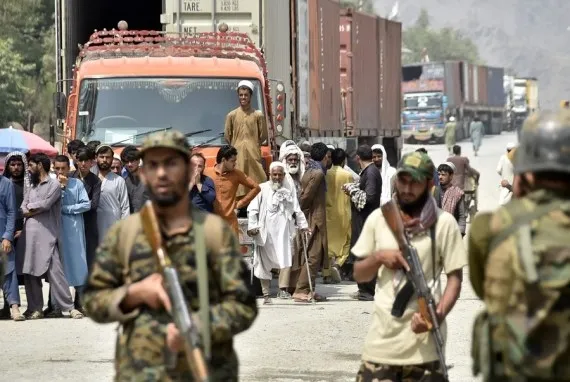
The chamber indicated that the initial phase would permit the passage of stranded cargo containers across the border, followed by further discussions regarding the complete reopening of the Torkham crossing.
The Torkham crossing is a vital trade route between Afghanistan and Pakistan, facilitating the movement of substantial quantities of food, fuel, and commercial goods between both nations.
On Sunday, residents in the Landi Kotal area of Pakistan's Khyber Pakhtunkhwa staged a protest demanding the swift reopening of the Torkham border, as reported by local media. Traders, transporters, tribal elders, daily wage earners, political party activists, and civil society members participated in the demonstration organized under the banner of the All Borders Coordinators Council.
Representatives from various organizations and groups directly affected by the border closure with Afghanistan since October 12 participated in the protest, according to the Dawn.
During the protest, speakers expressed that the border closure has resulted in the economic devastation of thousands, mostly tribesmen reliant on cross-border trade.
They emphasized the Torkham border as a crucial business gateway to Central Asia, stating that it serves as an economic hub for thousands of families whose livelihoods depend on it.
According to them, all commercial activities in the town have ceased due to the border closure.
Speakers highlighted that hundreds of families are facing severe poverty and economic challenges as a result of the closure, with many resorting to loans for survival.
They urged both Afghanistan and Pakistan to decouple bilateral trade from political and security matters and to facilitate frequent travel across the border.
"We also demand that influential tribal elders and trade representatives be included in future Pak-Afghan peace and trade dialogues, as they have historically contributed to resolving difficult issues between the two countries," they stated.
Point of View
It's crucial to recognize the importance of trade and economic stability for both Afghanistan and Pakistan. The reopening of the Torkham border crossing is not merely a logistical issue; it affects the livelihoods of countless families who rely on cross-border commerce. The bilateral discussions represent a step towards fostering cooperation and mutual benefit.
NationPress
09/01/2026
Frequently Asked Questions
What is the significance of the Torkham border crossing?
The Torkham border crossing is a crucial trade route between Afghanistan and Pakistan, facilitating the movement of food, fuel, and commercial goods.
Why are the talks happening now?
The discussions are taking place to address ongoing trade disruptions caused by the border closure, which has significantly impacted local economies.
What are the expected outcomes of the negotiations?
The goal is to allow stranded cargo to cross the border and eventually fully reopen the Torkham crossing for trade.
Who participated in the protests?
The protests included traders, transporters, tribal elders, daily wage earners, and civil society members demanding the reopening of the border.
How has the border closure affected local communities?
The closure has led to economic hardship for many families who depend on cross-border trade, with reports of increased poverty and reliance on loans.