Will US Senators Renew the Quantum Research Law?

Synopsis
A bipartisan group of US senators has introduced a new bill aimed at renewing and expanding the National Quantum Initiative, which seeks to enhance American leadership in quantum technology. This proposal emphasizes the importance of sustained investment in research for national security and economic competitiveness.
Key Takeaways
The bill seeks to renew and enhance the National Quantum Initiative.
It emphasizes the need for sustained government investment in quantum research.
The legislation aims to foster collaboration with trusted allies, particularly India.
New quantum research centers will be established to support innovation.
Industry leaders have expressed strong support for the initiative.
Washington, Jan 9 (NationPress) A bipartisan coalition of US senators has unveiled a proposal to renew and enhance a federal program designed to bolster American dominance in quantum technology. This legislation seeks to reauthorize the National Quantum Initiative, a program initially established in 2018 to manage federal research in quantum computing, networking, and sensing.
Supporters of the bill emphasized that ongoing government investment is crucial for safeguarding US national security and maintaining economic competitiveness, especially as other nations escalate their investments in this vital sector.
“Keeping the US at the forefront of quantum research and development is essential for both national security and technological progress,” stated Senator Ben Ray Lujan. He noted that the legislation aims to stimulate innovation across the country and assist regions already engaged in quantum research.
The proposed law also underscores the importance of collaboration with trusted allies, which is in line with the current US-India partnership focused on critical and emerging technologies, including quantum science.
Both Washington and New Delhi have recognized quantum research as a mutual priority within their existing bilateral technology frameworks. India has initiated a National Quantum Mission to cultivate domestic capabilities in computing, communications, and sensing.
Senator Maria Cantwell highlighted the vast potential of quantum technology. She emphasized the need for federal funding to transition research from laboratories into practical applications. Cantwell remarked that the initiative would bolster workforce development, reinforce supply chains, and generate high-skilled employment opportunities.
Republican Senator Todd Young articulated that the bill is essential for global competition, particularly against China. “We must ensure that the United States possesses the talent and research capabilities necessary to excel in the global tech arena and outpace China,” he stated.
Other lawmakers across the aisle expressed their support. Senator Dick Durbin asserted that investment in quantum research centers is imperative to uphold US leadership. Senator Steve Daines pointed out that quantum research already sustains jobs in states like Montana and requires long-term support.
Senator Marsha Blackburn noted that the United States cannot afford to lag behind its adversaries. Senator Tammy Baldwin emphasized the need for bipartisan collaboration to keep the nation competitive in emerging industries. Senator Ted Budd concluded that ongoing investment in quantum research is vital for national defense and economic growth.
The proposed legislation would prolong the National Quantum Initiative for an additional five years, extending it through December 2034. It would reauthorize quantum research and education initiatives at the National Institute of Standards and Technology and the National Science Foundation.
For the first time, the bill would also authorize quantum research efforts at the National Aeronautics and Space Administration, encompassing projects related to quantum satellite communications and quantum sensing.
The bill proposes the establishment of up to three new quantum centers at NIST and five new multidisciplinary quantum research and education centers at NSF. Lawmakers indicated that these centers would offer shared infrastructure and training opportunities for scientists and engineers.
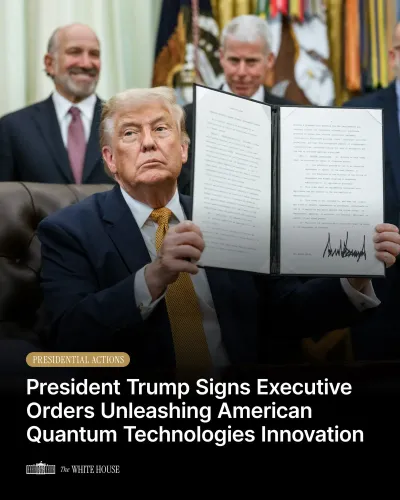
Senate Democratic Leader Chuck Schumer stated that quantum technology is crucial for security and job creation. He remarked that the legislation would ensure that quantum technologies are developed within the United States. Senator Mike Rounds noted that this proposal aligns with former President Donald Trump’s priority of preserving American leadership in quantum science.
Industry associations and technology firms have welcomed the initiative. The Quantum Industry Coalition expressed that the bill would reinforce US leadership in quantum computing, sensing, and networking. Companies like IBM, Microsoft, and Google urged Congress to act swiftly, stressing the need for consistent funding and public-private partnerships.
Since its inception in 2018, the National Quantum Initiative has contributed to the growth of US quantum research, supporting startups, academic investigation, and workforce development. Proponents of the bill argue that failing to renew the program could undermine US leadership as competition in quantum technology intensifies.
Point of View
The proposed legislation to renew the National Quantum Initiative signifies a critical step toward maintaining the United States' position as a leader in quantum technology. The bipartisan support for this measure highlights the recognition of quantum research as a strategic priority. As nations worldwide ramp up their investments in this domain, the urgency for sustained funding becomes paramount to safeguard national security and foster innovation.
NationPress
2 Oct 2026
Frequently Asked Questions
What is the National Quantum Initiative?
The National Quantum Initiative is a federal program established in 2018 to coordinate and promote research in quantum computing, networking, and sensing.
Why is the renewal of the National Quantum Initiative important?
Renewing the National Quantum Initiative is vital for maintaining US leadership in quantum technology, ensuring national security, and supporting economic competitiveness.
What will the new legislation do?
The new legislation aims to extend the National Quantum Initiative for five years and authorize new quantum research initiatives at various federal agencies.
How does quantum research impact job creation?
Quantum research has the potential to create high-skilled jobs and support workforce development in the rapidly evolving tech landscape.
What are the implications of US-India collaboration in quantum research?
The US-India collaboration on quantum research enhances both nations’ capabilities in emerging technologies and strengthens bilateral ties.