Is US Quantum Leadership at a Crossroads?

Synopsis
The US is in jeopardy of losing its quantum leadership as lawmakers stress the need for sustained investment and workforce enhancement. With rising competition from China, urgent action is required to maintain advancements in quantum science and technology. This article delves into the current challenges and necessary steps to secure US dominance in this critical field.
Key Takeaways
Investment in quantum research is crucial.
The workforce must be strengthened to meet industry demands.
China is rapidly closing the gap in quantum technology.
Stable supply chains are essential for US quantum startups.
Collaboration among government, academia, and industry is vital for success.
Washington, Jan 24 (NationPress) The United States faces the danger of relinquishing its quantum supremacy unless it prioritizes investment, enhances its workforce, and secures its supply chains, according to warnings from lawmakers and officials.
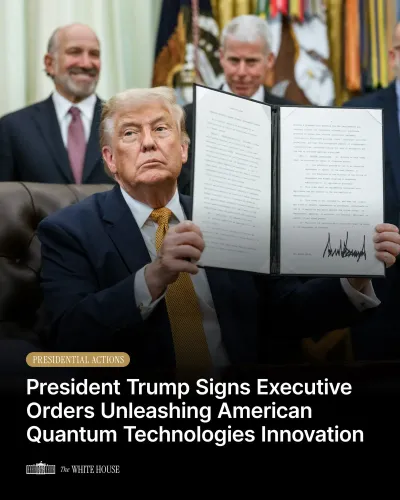
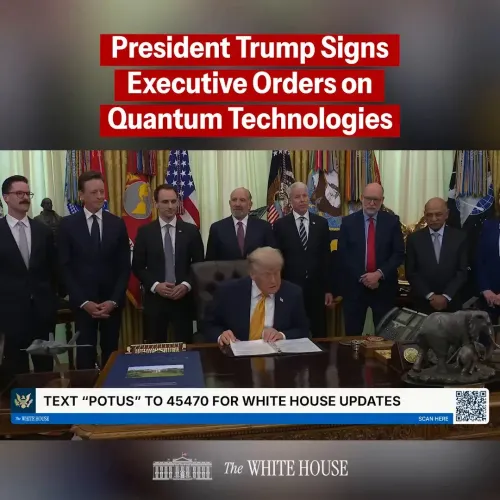
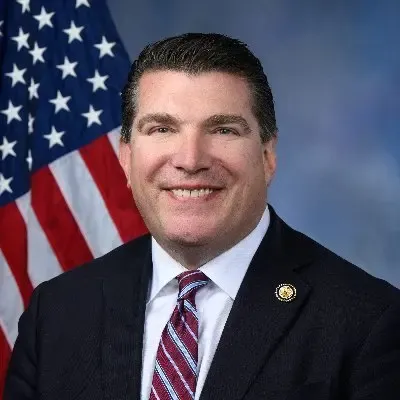
During a recent Congressional hearing, House Science, Space, and Technology Committee Chairman Brian Babin stated that the Trump administration recognized quantum science, technology, and engineering as a critical area for research and development.
As Congress deliberates on the reauthorization of the National Quantum Initiative, Babin highlighted that the legislation has made quantum research a national priority and has reshaped federal policy.
“These investments are crucial for achieving breakthroughs in quantum computing, sensing, and communications,” Babin remarked, emphasizing the need for the US to keep pace with competitors who are intensifying their efforts.
Ranking Member Zoe Lofgren pointed out that American leadership currently stands at a “critical juncture.” She cautioned that China has dramatically increased its spending and is narrowing the gap in research output and technological advancement.
“In 2024, the Chinese Communist Party allocated more than four times the amount the US spent on quantum R&D,” Lofgren stated. She noted that China declared a $138 billion fund in 2025 aimed at fostering emerging technologies, including quantum computing, and is now leading in areas like quantum communications.
Officials from essential science agencies acknowledged US strengths but cautioned about escalating risks.
James Kushmerick from the National Institute of Standards and Technology asserted that the US is in a “fierce international competition” and “cannot afford to ease up.” He highlighted NIST’s upcoming release of the first post-quantum cryptography standards aimed at safeguarding digital systems against prospective quantum threats.
“These standards are foundational for protecting trillions of dollars in global commerce,” Kushmerick said, emphasizing the urgency of rapid deployment.
Saul Gonzalez from the National Science Foundation remarked that years of early investment have fueled the present wave of quantum advancements but cautioned that talent shortages could hinder progress.
“The pool of skilled individuals is not meeting the industry's demands,” Gonzalez noted, stressing that quantum research requires the collaboration of physics, mathematics, engineering, and computer science.
NASA’s Mark Clampin indicated that quantum technologies are already being applied in space science, especially in sensing. He referenced the Cold Atom Laboratory aboard the International Space Station and new tools that could measure Earth's gravity with unprecedented accuracy.
“These capabilities facilitate applications such as drought monitoring, water management, and flood forecasting,” Clampin stated.
At the Department of Energy, Tanner Crowder mentioned that the National Quantum Initiative has led to the establishment of five multidisciplinary research centers and has improved collaboration among government, academia, and industry. He asserted that the US is now poised to advance in quantum-enabled supercomputing alongside artificial intelligence and high-performance computing.
Congress members from both parties expressed concerns regarding immigration policies, workforce pathways, and supply chains. Several warned that visa restrictions and uncertainties are discouraging foreign talent, which many witnesses deemed vital for maintaining US leadership.
Lawmakers also criticized tariffs and trade disruptions, arguing that increased costs for imported equipment are adversely affecting US quantum startups and impeding research. Kushmerick noted that industry partners have reported tangible effects and growing uncertainty.
“Uncertainty is detrimental to science,” he stated.
The hearing represented an initial move towards bipartisan reauthorization of the National Quantum Initiative. Babin mentioned that Congress aims to bolster US leadership, tackle workforce issues, and accelerate commercialization over the next five years.
Quantum technologies hold the promise of significant advancements in computing power, sensing, and secure communications. Witnesses concurred that sustained funding, a skilled workforce, and the ability to translate discoveries from laboratories to real-world applications will be essential in unlocking the full potential of quantum technologies beyond the research phase.
Point of View
I emphasize that the challenges faced by the US in maintaining its quantum leadership are significant. A collaborative approach involving government, academia, and industry is imperative. The urgency to invest in workforce development and stable supply chains cannot be overstated. Our nation's ability to innovate and lead in quantum technology is vital not just for our economy but for global competitiveness.
NationPress
2 Oct 2026
Frequently Asked Questions
What is the National Quantum Initiative?
The National Quantum Initiative is a federal effort aimed at accelerating quantum research and development in the United States, making quantum technology a national priority.
Why is quantum technology important?
Quantum technology holds the potential for transformative advancements in computing power, secure communications, and sensing, impacting various industries significantly.
How is US funding for quantum research compared to China?
Recent reports indicate that China has invested significantly more in quantum research compared to the US, raising concerns about American competitiveness in this crucial field.
What challenges does the US face in quantum research?
The US faces challenges such as workforce shortages, supply chain issues, and geopolitical competition, particularly from China, which is rapidly advancing in quantum technology.
How can the US maintain its quantum leadership?
To maintain its quantum leadership, the US must increase investment in research, enhance workforce training, and ensure stable supply chains to support innovation.