India hits 1,000 km quantum communication target in 3 years: Dr Jitendra Singh

Synopsis
India has hit a major quantum milestone — 1,000 km of secure quantum communication infrastructure built in just three years, less than half the projected timeline. With the National Quantum Mission's four thematic hubs accelerating, India is positioning itself as a serious contender in the global quantum race, backed by a youth-heavy demographic and a fast-expanding startup and patents base.
Key Takeaways
India completed 1,000 km of secure quantum communication in just three years — less than half the projected timeline under the National Quantum Mission .
The eight-year mission operates through four thematic hubs and institutional collaborations across the country.
A new skilling initiative by NSDC , Ethnotech , and Cambridge University Press and Assessment will train students in nine future-technology domains with globally recognised certifications.
India ranks third globally in the startup ecosystem and has crossed one lakh patents , a majority filed by Indian residents.
Nearly 70% of India's population is below 40 years of age, positioning the country as a potential global skilled workforce hub over the next two to three decades.
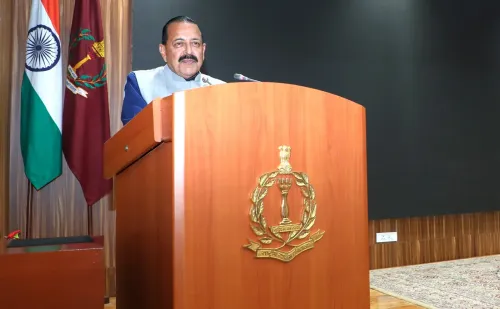
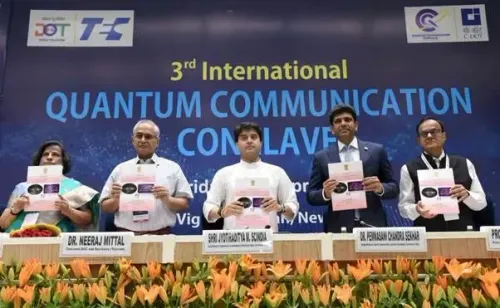
India has completed 1,000 kilometres of secure quantum communication infrastructure in just three years — less than half the originally projected timeline — Union Minister of State (Independent Charge) for Science and Technology Dr Jitendra Singh announced on Friday, 8 May in New Delhi. The milestone, achieved under the National Quantum Mission, signals a sharp acceleration in India's deep-tech ambitions.
National Quantum Mission: Key Progress
Dr Singh said the eight-year National Quantum Mission is advancing rapidly through four thematic hubs and active collaborations with institutions across the country. Achieving the 1,000 km secure quantum communication target in under three years — well ahead of the original schedule — marks one of the fastest quantum infrastructure buildouts in the Asia-Pacific region. The mission spans research in quantum computing, quantum communication, quantum sensing, and quantum materials.
Skilling India for Emerging Technologies
At the event, Dr Singh outlined a government initiative — developed in collaboration with the National Skill Development Corporation (NSDC), Ethnotech, and Cambridge University Press and Assessment — to train students across nine future-technology domains with globally recognised certifications. The domains include Artificial Intelligence, Cybersecurity, Quantum Technologies, and Semiconductor Design. The minister emphasised that continuous skilling and re-skilling have become essential given the pace of technological change.
India AI Mission and Innovation Milestones
The India AI Mission, launched in 2024, is building an ecosystem around compute infrastructure, curated datasets, and innovation incentives, Dr Singh said. He also pointed to India's broader innovation credentials: the country now ranks third globally in the startup ecosystem, has crossed one lakh patents — a majority filed by Indian residents — and stands among the top nations in scientific publications, with Indian research drawing increasing international citations.
Youth as the Cornerstone of Viksit Bharat
Dr Singh highlighted India's demographic advantage, noting that nearly 70 per cent of the population is below the age of 40 years. He said this presents a significant opportunity for India to emerge as a global skilled workforce hub over the next two to three decades. The minister said the country's youth are set to play the central role in building a Viksit Bharat by 2047, with emerging technologies — quantum, AI, semiconductors, and deep-tech — forming the backbone of that vision.
With the National Quantum Mission on track and skilling frameworks being institutionalised, the government's next challenge will be translating infrastructure milestones into commercial applications and globally competitive deep-tech enterprises.
Point of View
000 km of quantum communication in three years is a genuine infrastructure achievement, but the harder question is what rides on it. Secure quantum communication is only valuable if it underpins real applications — government networks, financial systems, critical infrastructure — and India has not yet publicly detailed what commercial or strategic use cases are live on this network. The National Quantum Mission's four-hub model is sound in principle, but hub-based research in India has historically struggled to bridge the gap between laboratory output and market deployment. The patents milestone is encouraging, though the quality and commercialisation rate of those filings matters more than the count. India's demographic dividend is real, but only if the skilling pipeline — NSDC certifications included — produces graduates that industry actually hires at scale.
NationPress
21 Sept 2026
Frequently Asked Questions
What is India's National Quantum Mission?
The National Quantum Mission is an eight-year government programme aimed at advancing quantum computing, quantum communication, quantum sensing, and quantum materials in India. It operates through four thematic hubs and collaborations with institutions across the country, and recently achieved the milestone of 1,000 km of secure quantum communication infrastructure in just three years.
How significant is the 1,000 km quantum communication milestone?
India completed 1,000 km of secure quantum communication in under three years — less than half the originally projected timeline. This makes it one of the fastest quantum infrastructure buildouts in the region and signals a significant acceleration in India's deep-tech capabilities.
What is the India AI Mission launched in 2024?
The India AI Mission, launched in 2024, is a government initiative focused on building a strong ecosystem around compute infrastructure, datasets, innovation incentives, and future skills. It aims to position India as a global leader in artificial intelligence development and deployment.
Which organisations are involved in the new technology skilling initiative?
The skilling initiative was developed in collaboration with the National Skill Development Corporation (NSDC), Ethnotech, and Cambridge University Press and Assessment. It aims to train students across nine future-technology domains — including AI, cybersecurity, quantum technologies, and semiconductor design — with globally recognised certifications.
Where does India rank globally in startups and patents?
India currently ranks third globally in the startup ecosystem and has crossed one lakh patents, with a majority of them filed by Indian residents. The country also ranks among the top nations in scientific publications, with Indian research receiving growing international citations.