India's Quantum Mission Achieves 1,000-km Secure Network in Under Three Years

Synopsis
India’s National Quantum Mission has successfully created a 1,000-km secure quantum communication network in less than three years, a milestone that showcases the country's rapid advancements in quantum technology. This achievement promises to enhance secure communications across various critical sectors.
Key Takeaways
1,000-km secure quantum communication network established in less than three years.
Developed using indigenous technology by QNu Labs.
Significant leap in India's quantum capabilities .
Aim to expand support for startups in the quantum sector.
Network operates effectively in challenging environments .
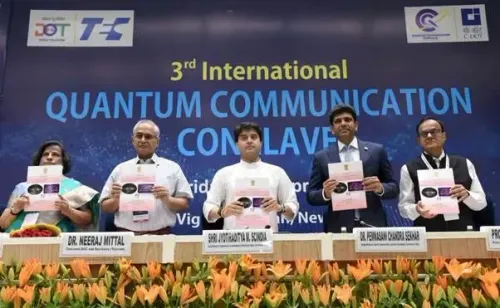
New Delhi, April 8 (NationPress) The National Quantum Mission of India has marked a significant achievement by establishing a 1,000-kilometre secure quantum communication network in under three years since its inception, as announced by Union Minister of State Dr. Jitendra Singh on Wednesday.
Initiated in October 2024, the mission aimed to create a 2,000-km quantum communication network over a span of eight years.
Completing half of this goal in less than three years is considered a substantial advancement, indicating swift progress in India's quantum technology capabilities.
During the session, Dr. Jitendra Singh emphasized the importance of transparency, improved evaluation processes, and broader awareness regarding government funding initiatives.
He also urged for enhanced communication strategies to underscore India's scientific accomplishments on a global stage.
The network has been developed using homegrown technology by QNu Labs, a startup backed by the mission, specializing in quantum-safe cybersecurity solutions.
Officials highlighted that this network stands as one of the longest deployments of quantum key distribution (QKD) worldwide.
DST Secretary Dr. Abhay Karandikar hailed this development as a milestone in secure communication, noting it reflects advancements ahead of scheduled timelines.
Quantum communication employs advanced encryption methods, which are vital for enabling highly secure data transmission.
This technology is anticipated to be instrumental in fortifying secure communications across critical sectors such as defense, banking, and essential infrastructure.
Officials pointed out that it can function effectively in challenging environments, including underwater and underground networks, expanding its applicability for both civilian and strategic purposes.
In addition to this achievement, the government is broadening its support for startups in the quantum domain.
Nine new startups have been incorporated under the mission, bringing the total number of supported entities to 17.
These startups are engaged in developing various advanced technologies, including quantum computing, sensing technologies, biosensors for disease identification, and precision electronic systems.
The review process has also revealed an increasing interest from the industry in research and innovation funding backed by the government.
The Technology Development Board has received over 100 proposals in just two months, while the Biotechnology Industry Research Assistance Council has seen nearly 200 applications in fields such as cancer research, gene therapy, and bio-manufacturing.
To assist startups, the government is employing new funding mechanisms like optionally convertible debt, which enables companies to secure funding without immediate equity dilution, thus attracting private investment.
Point of View
I appreciate the swift progress made by India's National Quantum Mission. The establishment of a 1,000-km secure quantum communication network in under three years not only highlights the country's commitment to advancing technology but also reinforces its position on the global stage in the realm of quantum capabilities. The expansion of support for startups in this field is a promising move that could lead to further innovations.
NationPress
18 Sept 2026
Frequently Asked Questions
What is the National Quantum Mission?
The National Quantum Mission is an initiative by the Government of India aimed at advancing quantum technology research and development, including the establishment of secure quantum communication networks.
How long did it take to build the 1,000-km network?
The 1,000-km secure quantum communication network was built in less than three years from the mission's launch in October 2024.
Who developed the quantum communication network?
The network was developed using indigenous technology by QNu Labs, a startup supported under the National Quantum Mission.
What are the potential applications of quantum communication?
Quantum communication can enhance secure data transfer in sectors like defense, banking, and critical infrastructure, and can operate in challenging environments.
How many startups are supported under the National Quantum Mission?
Currently, there are 17 startups supported under the National Quantum Mission, focusing on various advanced technologies.