Cambodia-Thailand border talks held at ASEAN-EU meet in Brunei

Synopsis
Less than four months after a ceasefire ended three weeks of armed conflict, Cambodia and Thailand are back at the diplomatic table in Brunei — but a new fault line has emerged. Thailand's reported move to scrap a 2001 maritime MoU is threatening to unravel the cooperative framework that underpinned their overlapping sea-boundary talks, with Phnom Penh warning the move would break from the spirit of international goodwill.
Key Takeaways
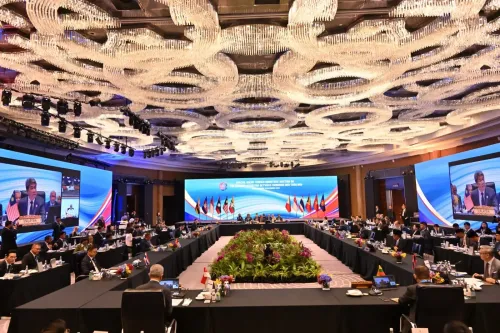
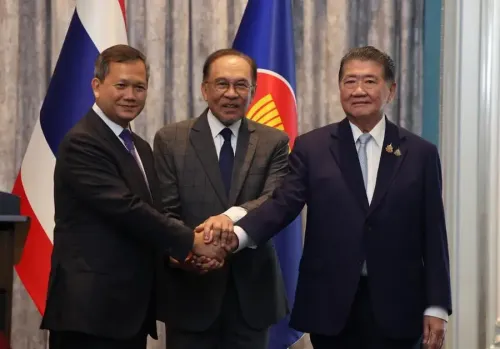
Cambodia FM Prak Sokhonn and Thailand FM Sihasak Phuangketkeow held border talks in Brunei on 28 April 2025 on the sidelines of the 25th ASEAN-EU Ministerial Meeting .
Cambodia and Thailand agreed to a ceasefire on 27 December 2025 after three weeks of armed conflict.
Thailand's National Security Council has reportedly confirmed the abolition of the 2001 Maritime MoU on overlapping sea claims.
Cambodia expressed deep regret on 24 April , warning that unilateral withdrawal would undermine the cooperative spirit of the agreement.
The Thai cabinet must still approve the National Security Council's recommendation before it takes effect.
Cambodia's Foreign Minister Prak Sokhonn met his Thai counterpart Sihasak Phuangketkeow on the sidelines of the 25th ASEAN-EU Ministerial Meeting in Brunei on Monday to discuss the bilateral border situation, according to a statement released by Cambodia's foreign ministry on Tuesday, 28 April. The talks, described as candid, covered confidence-building measures and the broader state of diplomatic relations between the two neighbours.
What Was Discussed
Both sides addressed the ongoing border situation, with Foreign Minister Sokhonn emphasising the need for adherence to international norms. "Achieving lasting peace between our two countries — thereby contributing to peace, stability, and unity within ASEAN — requires genuine commitment and full respect for international law, the ASEAN Charter, as well as all existing treaties and agreements that bind us," Sokhonn said.
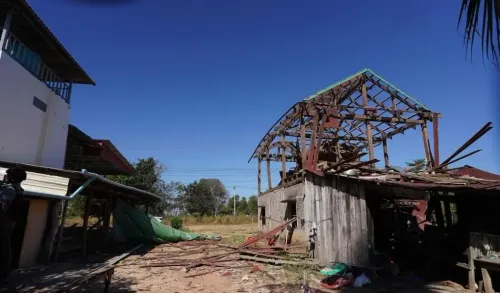
The meeting comes after Cambodia and Thailand agreed to an immediate ceasefire on 27 December 2025, following three weeks of armed conflict that caused casualties on both sides. The Brunei talks represent one of the first high-level diplomatic engagements since that agreement.
The Maritime MoU Dispute
A key flashpoint in the current diplomatic friction is the fate of the 2001 Maritime Memorandum of Understanding (MoU-2001), which governs the overlapping maritime claims to the continental shelf between the two countries. On 24 April, Cambodia formally expressed deep regret over Thailand's reported intent to unilaterally withdraw from the agreement.
In a statement released on Saturday, Cambodia's Ministry of Foreign Affairs and International Cooperation said the MoU-2001 "reflected the genuine will and common interest of both countries to pursue, in good faith, a mutually acceptable framework for the joint exploitation of resources in the overlapping claims area." It warned that Thailand's unilateral withdrawal "will be a step departing from the cooperative spirit underpinning the signing of this document."
Thailand's Position
Thai Prime Minister Anutin Charnvirakul revealed on Thursday that the National Security Council had confirmed the abolition of the MoU-2001, which was originally signed during the tenure of former Prime Minister Thaksin Shinawatra. He noted that the cabinet would review the decision "as soon as possible," and that National Security Council resolutions require cabinet approval before taking effect.
Thadawut Thatpitakkul, chief of staff of the Royal Thai Navy, told reporters that the MoU had been in use for many years "but had made no progress." He added that since Cambodia has now acceded to the United Nations Convention on the Law of the Sea (UNCLOS), both nations could negotiate within that framework instead.
What Comes Next
Cambodia has reiterated its commitment to both the letter and spirit of the MoU-2001, signalling it will resist any unilateral Thai move to scrap the agreement. The Thai cabinet's final decision on the National Security Council's recommendation remains pending. With the ceasefire still fragile and the maritime boundary unresolved, the diplomatic trajectory between Phnom Penh and Bangkok will be closely watched across the ASEAN region in the weeks ahead.
Point of View
Framed as a procedural reset under UNCLOS, is in practice a significant unilateral move that strips away the joint-development framework Cambodia has relied on. For ASEAN, a bloc that prizes non-interference and consensus, two member states locked in a post-conflict maritime standoff is an uncomfortable test of the grouping's conflict-resolution credibility — one the Brunei meeting alone is unlikely to resolve.
NationPress
17 Sept 2026
Frequently Asked Questions
What did Cambodia and Thailand discuss at the ASEAN-EU Ministerial Meeting in Brunei?
Cambodia's Foreign Minister Prak Sokhonn and Thailand's Foreign Minister Sihasak Phuangketkeow held candid talks on the bilateral border situation, confidence-building measures, and diplomatic relations. The meeting took place on the sidelines of the 25th ASEAN-EU Ministerial Meeting in Brunei on 28 April 2025.
What is the 2001 Maritime MoU between Cambodia and Thailand?
The MoU-2001 is a memorandum of understanding signed in 2001 governing the overlapping maritime claims to the continental shelf between Cambodia and Thailand. It established a framework for joint resource exploitation and maritime boundary delimitation in the disputed sea area.
Why does Thailand want to withdraw from the 2001 Maritime MoU?
Thailand's National Security Council confirmed the abolition of the MoU, with the Royal Thai Navy's chief of staff citing a lack of progress over many years. Thai officials also argued that Cambodia's accession to UNCLOS now provides an alternative negotiating framework.
When did Cambodia and Thailand agree to a ceasefire?
Cambodia and Thailand agreed to an immediate ceasefire on 27 December 2025, following three weeks of armed conflict that caused casualties on both sides.
What happens next in the Cambodia-Thailand border dispute?
The Thai cabinet must approve the National Security Council's recommendation to scrap the MoU-2001 before it takes effect. Cambodia has reaffirmed its commitment to the agreement and warned that unilateral withdrawal would depart from the cooperative spirit that guided its conclusion.