China's Underwater Data Centers: An Ecological Threat?
Synopsis
A recent report highlights the potential ecological risks posed by China's underwater data centers, warning of their impact on neighboring countries and global marine health. As China expands its AI capabilities, the environmental costs could be significant.
Key Takeaways
Environmental Hazard: China's underwater data centers release significant heat into the ocean.
Geopolitical Tool: The sea is being used for both resource extraction and political maneuvering.
Energy Consumption: Each pod consumes up to 1 megawatt of power, with plans for 100 pods.
International Concerns: The unilateral use of the ocean as a heat sink raises global regulatory issues.
Future of AI Exports: China aims to dominate the AI market with low-cost tokens.
New Delhi, April 16 (NationPress) Experts from the United States have issued warnings regarding China's newly established commercial underwater data centers, labeling them as a potential environmental threat due to the excessive heat they release into the surrounding waters, which could negatively affect neighboring nations like Vietnam and the Philippines.
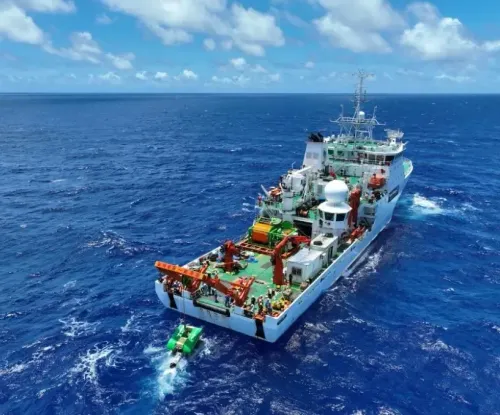
The first of these underwater facilities, created by Hailanxin, is located off the southeastern coast of Hainan Island in the shallow waters of the South China Sea. This center offers data storage and computational services for internet enterprises involved in artificial intelligence (AI) and big data, as reported by the Washington-based online magazine, The National Interest.
Previously, Hailanxin was recognized as a supplier for the Chinese Navy, specializing in intelligent ship systems, marine data information, and seabed mapping. In 2022, the U.S. Department of Commerce (DOC) placed the company on its blacklist, accusing it of potentially aiding Russia in monitoring submarines, divers, and naval vessels along the coastline of Ukraine, according to the article authored by Jeanette Tong.
The report emphasizes that China is exploiting the ocean not only as a resource but also as a geopolitical instrument, shifting the environmental burdens of AI growth onto a shared global resource while striving to become the leading supplier of affordable AI computational power.
A typical underwater data center pod utilizes between 500 kilowatts (kW) and 1 megawatt (MW) of energy. Hailanxin’s strategic plan includes the installation of 100 pods, which would result in an energy consumption of 50 to 100 megawatts.
When 100 MW of waste heat is continuously expelled into the ocean, it results in approximately 100 million joules of energy being added to the marine environment every second.
Even with advanced liquid-cooling technology and split cooling systems, the degree of thermal discharge is sufficient to significantly raise the temperature of tens of thousands of cubic meters of seawater in just one hour, as stated in the article.
The article further underscores China's inadequate environmental stewardship in its quest for economic advancement. The country’s control over rare earth mineral extraction has incurred a substantial ecological toll, damaging tens of thousands of square kilometers of land and water bodies, along with severe health ramifications for local communities. Each ton of rare earth extracted generates around 2,000 tons of waste byproduct and considerable volumes of hazardous wastewater.
While the current underwater data centers are situated in China’s coastal waters, distanced from neighboring nations like Vietnam and the Philippines, the ocean operates as an interconnected system. The heat released into these waters will eventually become part of global marine circulation. Hailanxin asserts that the maximum temperature increase at the outlet is a mere 2°C, which they claim is manageable—however, from a global commons perspective, the unilateral use of the ocean as a “free heat sink” breaches international regulations.
In the near future, China plans to begin distributing inexpensive AI tokens globally, powered by economical energy and naturally cooled underwater infrastructure. These tokens are set to become China's next celebrated high-tech export—following solar panels and electric vehicles (EVs)—and buyers worldwide are expected to eagerly embrace them, similar to how the environmental ramifications of silicon wafer production or EV battery manufacturing went largely unquestioned, as noted in the article.
Point of View
It's clear that while technological advancements are crucial for progress, they must be pursued responsibly. China's aggressive expansion into underwater data centers raises vital questions about environmental sustainability and international responsibility.
NationPress
16 Sept 2026
Frequently Asked Questions
What are the main concerns regarding China's underwater data centers?
Experts warn that these data centers release excessive heat into the ocean, which can negatively impact marine ecosystems and neighboring countries.
How is China using these data centers for its advantage?
China aims to leverage these facilities to enhance its AI capabilities and become a leading exporter of affordable AI technology.
What environmental impact do these data centers have?
The discharge of heat into the ocean can significantly raise water temperatures, potentially disrupting marine life and ecosystems.
Why was Hailanxin blacklisted by the U.S. Department of Commerce?
The U.S. blacklisted Hailanxin due to concerns that its ocean surveillance systems, developed with American technology, may have supported Russian military operations.
What does the future hold for China's AI technology exports?
China plans to export low-cost AI tokens powered by its underwater data centers, which may lead to widespread adoption despite environmental concerns.