What Is the Toll of Cyclone Ditwah in Sri Lanka?
Click to start listening
Synopsis
Cyclone Ditwah has devastated Sri Lanka, leading to a death toll of 334, with hundreds more missing. President Dissanayake has declared it the worst natural disaster in history and emphasized the government's commitment to recovery. As rescue efforts intensify, international collaboration is underway to support affected communities. Will Sri Lanka recover from this calamity?
Key Takeaways
- Cyclone Ditwah has tragically resulted in over 334 fatalities.
- The DMC reports 370 individuals are still missing.
- Kandy district is the worst-hit area.
- Efforts for rescue and recovery are ongoing.
- International assistance is being coordinated.
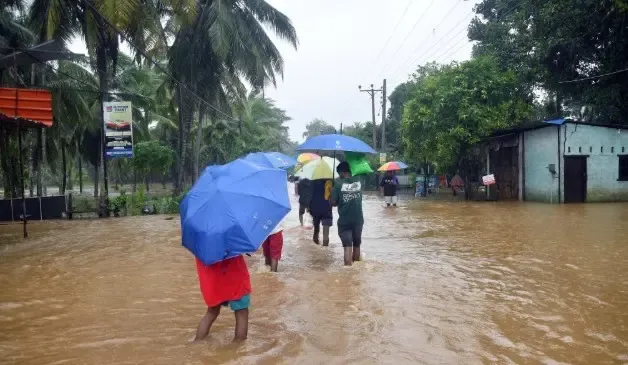
Colombo, Dec 1 (NationPress) The devastating impact of Cyclone Ditwah has resulted in the tragic loss of 334 lives, with 370 individuals still unaccounted for, according to reports from local media citing the Disaster Management Centre (DMC).
Kandy district has been the most severely affected, recording 88 fatalities and 150 missing. Other areas such as Badulla have reported 71 deaths, followed by 68 in Nuwara Eliya and 23 in Matale. The DMC indicates that around 1,118,929 people from 309,607 families across the nation have been impacted, as reported by the prominent Lankan media outlet, Daily Mirror.
Efforts to coordinate rescue operations in the hardest-hit regions have been hindered by ongoing communication issues.
In a bid to alleviate network congestion, the President's Media Division announced that Sri Lanka's telecommunications providers will prioritize emergency calls, thus bolstering the response framework.
Meanwhile, rescue teams from India are collaborating with the Sri Lanka Air Force, Navy, Army, Police, and local first responders to support communities affected by the floods.
Evacuation procedures, supply deliveries, and emergency aid initiatives are actively being conducted throughout the island.
Sri Lankan President Anura Kumara Dissanayake described the ongoing extreme weather situation as the most catastrophic natural disaster in the nation’s history, reaffirming the government’s commitment to full support for recovery efforts.
In a compelling address to the nation, the president stated that the government has a threefold duty during such crises: managing immediate emergencies, restoring normalcy, and rebuilding the nation to be stronger than before.
“When natural disasters occur, and we cannot avert their consequences, it is the government’s obligation to handle the emergency, return the nation to a state of normalcy, and enhance conditions beyond previous levels,” he emphasized. “We are dedicated to taking the necessary actions, regardless of the challenges.”
He reassured the public that the current State of Public Emergency is solely focused on disaster management and will not infringe on civil liberties. Urgent measures are being implemented to restore vital services like water supply, electricity, and communication networks disrupted in multiple areas, as reported by Xinhua news agency.
President Dissanayake pledged that all displaced persons will receive government support and that no one will be abandoned during this national emergency.
He commended the armed forces for their leadership in rescue and relief efforts, noting that thousands of personnel from the Army, Navy, and Air Force are tirelessly working to aid affected communities.
Dissanayake also called for international solidarity, expressing hope for support from friendly nations and the Sri Lankan diaspora in recovery and rebuilding efforts.
The president urged all political factions to unite during this crucial time.
Point of View
It is crucial to emphasize that the government must act decisively in the face of such a catastrophic event. The affected individuals and families deserve immediate aid and long-term support. The focus should be on unity, resilience, and rebuilding better as a nation. This disaster serves as a reminder of the importance of preparedness and collaboration among all sectors.
NationPress
01/12/2025
Frequently Asked Questions
What caused Cyclone Ditwah?
Cyclone Ditwah was caused by atmospheric conditions in the Indian Ocean that led to severe weather patterns affecting Sri Lanka.
How is the government responding to the disaster?
The government has declared a State of Public Emergency and is prioritizing disaster management and essential services restoration.
Are international teams involved in rescue efforts?
Yes, Indian rescue teams are collaborating with local forces to aid in recovery efforts for flood-affected communities.
What assistance is available for displaced individuals?
The government has pledged support for all displaced persons, ensuring no one is left without aid during this crisis.
How can the public help those affected by the cyclone?
The public can contribute by donating to reputable organizations involved in relief efforts or volunteering their time to assist in local initiatives.