Pete Hegseth defends Trump's $1.5 trillion defence budget, Iran war gains

Synopsis
US Defence Secretary Pete Hegseth told the Senate Armed Services Committee that Trump's $1.5 trillion military budget — a roughly 50% jump from the current outlay — is non-negotiable given global threats from China, Russia, and Iran. He also claimed US operations have left Iran 'completely incapable at scale' of rebuilding its defence infrastructure, raising the stakes on ongoing nuclear diplomacy.
Key Takeaways
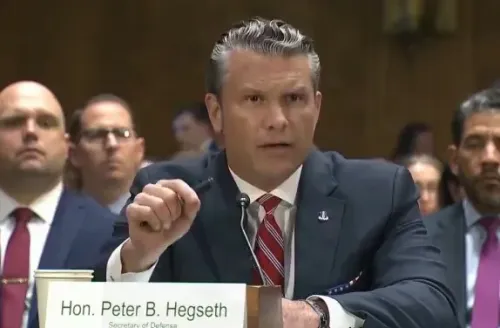
Pete Hegseth defended a $1.5 trillion military budget before the Senate Armed Services Committee on 1 May .
The proposed outlay marks a sharp increase from roughly $1 trillion in fiscal year 2026 defence spending.
Hegseth cited a 7% pay rise for junior enlisted personnel and plans to eliminate all "poor or failing barracks." Pentagon initiatives have reportedly driven more than $50 billion in private-sector investment, 280 new or expanded facilities , and over 70,000 new jobs .
On Iran , Hegseth claimed US operations have left Tehran "completely incapable at scale" of rebuilding key defence infrastructure.
The budget targets deterrence across drones, missile defence, and nuclear forces amid tensions with China , Russia , and Iran .
US Defence Secretary Pete Hegseth on 1 May mounted a forceful defence of President Donald Trump's proposed $1.5 trillion military budget before the Senate Armed Services Committee, arguing it reflects "the urgency of the moment" and is essential to counter a rapidly deteriorating global security environment. The request, if approved, would mark a sharp increase from the roughly $1 trillion defence outlay in fiscal year 2026.
A Generational Reset of US Military Strength
Hegseth framed the record budget proposal as a generational overhaul of American military power, highlighting investments in industrial capacity, advanced weapons systems, and troop welfare. He pointed to a 7% pay increase for junior enlisted personnel and pledged to eliminate "all poor or failing barracks."
"The $1.5 trillion budget will ensure that the United States continues to maintain the world's most powerful and capable military," Hegseth told senators, adding that the proposal would "position our forces for the current and future fights" while reversing years of "underinvestment and mismanagement."
The secretary also cited more than $50 billion in private-sector investments driven by Pentagon initiatives, including 280 new or expanded facilities and more than 70,000 new jobs, describing it as "a historic demonstration of American manufacturing and defence revitalisation."
Pentagon Shifts to a Business Model
Hegseth stressed efforts to overhaul the Pentagon's procurement system, saying the department had shifted "from a bureaucratic model to a business model" aimed at delivering faster and more cost-effective outcomes. He argued that the budget was designed to restore deterrence across multiple domains, including drones, missile defence, and nuclear forces.
"This is a warfighting budget," he said. "Every policy we pursue… serves to ensure that this department remains laser focused on increasing lethality and survivability."
Iran Operations: 'Stunningly Effective'
On the ongoing conflict with Iran, Hegseth described US military operations as highly effective, insisting that Washington had significantly degraded Tehran's capabilities. He claimed Iran was now "completely incapable at scale" of rebuilding key elements of its defence infrastructure.
"Our military objectives have been stunningly effective," he said, adding that the campaign had strengthened US leverage to prevent Iran from acquiring nuclear weapons. "We've put the president in a very strong position to ensure Iran never gets a nuclear weapon," Hegseth told the committee.
He also pushed back against criticism of the war effort, warning that "defeatist words" from political opponents risk undermining military gains. "The biggest adversary we face at this point are the reckless naysayers and defeatist words," he said, characterising the administration as confronting "a 47-year threat" with "courage no other president has had."
Recruitment and Morale on the Rise
Hegseth underscored what he described as improvements in recruitment and morale, saying young Americans were joining the military "at historic numbers" and that retention rates were rising. "We fight to win in every scenario," he said.
Broader Geopolitical Context
The proposed budget comes amid heightened geopolitical tensions involving China, Russia, and Iran. The US has steadily expanded defence spending in recent years, driven by strategic competition with China and ongoing conflicts in Europe and the Middle East. Whether Congress will approve the full request — representing a roughly 50% increase over the current outlay — remains to be seen, with Senate deliberations expected to intensify in the weeks ahead.
Point of View
And conflating military success with nuclear non-proliferation leverage is a significant leap. Meanwhile, the roughly 50% jump in spending from FY2026 comes at a time when domestic fiscal pressures are mounting; Congress will want granular accountability that a 'business model' framing alone does not provide. The real test of this budget is not the headline figure but whether the procurement overhaul actually delivers faster, cheaper capability — something the Pentagon has promised, and underdelivered on, for decades.
NationPress
17 Sept 2026
Frequently Asked Questions
What is Trump's $1.5 trillion defence budget proposal?
It is a record US military spending request proposed by President Donald Trump, defended by Defence Secretary Pete Hegseth before the Senate Armed Services Committee on 1 May. The budget represents a sharp increase from roughly $1 trillion in fiscal year 2026 and targets investments in advanced weapons, drones, missile defence, nuclear forces, and troop welfare.
Why is the US defence budget increasing so sharply?
Hegseth cited a rapidly deteriorating global security environment, including strategic competition with China, the ongoing conflict with Iran, and tensions involving Russia. He argued that years of 'underinvestment and mismanagement' required a generational reset of US military strength.
What did Hegseth say about the US conflict with Iran?
Hegseth claimed US military operations against Iran have been 'stunningly effective,' leaving Tehran 'completely incapable at scale' of rebuilding key elements of its defence infrastructure. He argued the campaign has strengthened Washington's leverage to prevent Iran from acquiring nuclear weapons.
How does the $1.5 trillion budget affect US troops?
The proposed budget includes a 7% pay increase for junior enlisted personnel and a commitment to eliminate all 'poor or failing barracks.' Hegseth also said young Americans are joining the military 'at historic numbers' and that retention rates are rising.
Will Congress approve the $1.5 trillion defence budget?
That remains uncertain. Senate deliberations are expected to intensify following Hegseth's testimony. The roughly 50% increase over the current fiscal year outlay is likely to face scrutiny over fiscal impact and accountability, even from within the Republican-controlled Senate.