Is the Pakistani Military Reshaping the Nation's Democracy?
Click to start listening
Synopsis
Pakistan is witnessing a subtle yet impactful shift towards military dominance in governance, with the military establishing a facade of civilian authority. This analysis reveals how political parties are facilitating this transformation, raising concerns about the future of democracy in the nation.
Key Takeaways
- Military dominance is reshaping Pakistan's governance.
- Political parties are facilitating military influence instead of resisting it.
- Constitutional amendments are consolidating military power.
- The judiciary is being increasingly subdued.
- Democracy in Pakistan is being dismantled gradually.
New Delhi, Dec 4 (NationPress) Pakistan is undergoing a subtle yet significant constitutional gerrymandering, whose effects are not evident through loud street demonstrations. Instead, a gradual and systematic transition is being directed by a more assertive military establishment, supported by compliant political parties eager to acquiesce. The aim of this change is straightforward: to convert Pakistan into a military-controlled hybrid authoritarian regime with a veneer of civilian governance.
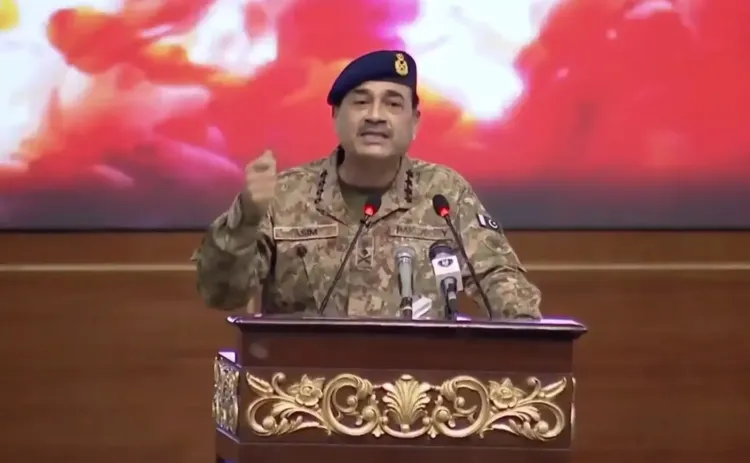
The principal architect of this new paradigm is Field Marshal Asim Munir, arguably the most powerful army chief in Pakistan's history. Under his leadership, the military has transcended the historical norm of behind-the-scenes control and sporadic coups.
The current strategy seems focused on embedding structural dominance into legal frameworks, bureaucracy, and constitutional text, ensuring that military authority is no longer an anomaly but rather the foundation of the state.
This transformation did not occur suddenly. It started with seemingly minor amendments to Pakistan's military laws (Army/Air Force/Navy) in 2023, which were supported by political parties without any dissent both inside and outside the National Assembly.
These modifications expanded the jurisdiction of military courts, allowing civilians to be tried under military law.
This came on the heels of the violent anti-government protests that erupted on May 9, 2023, when demonstrators targeted numerous military installations across Pakistan, including in Lahore and Peshawar.
Among the hundreds of protestors, the most notable target of this broadened legal authority has been former Prime Minister Imran Khan, who remains imprisoned with his wife, Bushra Bibi, facing numerous charges that critics argue are politically motivated rather than judicial in nature.
From that point, the military's influence has infiltrated civilian domains more deeply.
Munir's consolidation strategy involved the traditional method of appointing military officers to critical civilian roles in organizations such as NADRA, WAPDA, and SUPARCO. The appointment of Lt. Gen. Asim Malik as the Director-General of Pakistan's powerful intelligence agency, ISI, and as National Security Adviser marked a significant transition.
This crucial civilian position, which historically served as a bridge between civilian governance and military command, has now become a non-existent boundary.
However, the most important restructuring has arisen through constitutional amendments.
The 26th Amendment, enacted in late 2024, extended the tenure of military service chiefs from three to five years, with potential extensions corresponding to those extended terms.
This effectively allows a single military chief to influence Pakistan’s governance for over a decade, as is the case with Asim Munir, who appears likely to remain in office until at least 2032.
Concurrently, the amendment expanded the government's involvement in judicial matters, tightening political oversight over judicial appointments and administration. The judiciary was the last institution that the military establishment couldn't directly influence.
The 27th Amendment goes even further.
It formalized Munir's new designation as Chief of Defence Forces (CDF), a title that elevates the Army Chief to the supreme commander of Pakistan’s military forces. It also assigned him a greater role in managing the country's nuclear assets, which were previously overseen by the prime minister's strategic command.
While Pakistan has long been a nuclear-capable state under strict military oversight, the legal formalization of this role marks a definitive departure from previous uncertainties. Consequently, civilian oversight, which was already weak, is now further diminished.
It's important to recognize that the consolidation of power by military leaders is not a new phenomenon in Pakistan.
From Ayub Khan to Zia ul-Haq and Pervez Musharraf, military leaders have reshaped the political landscape to their advantage, but typically following military coups. What sets the current situation apart is the remarkable willingness of key civilian institutions, especially political parties, to not only accept this shift but also actively facilitate this power acquisition.
Furthermore, the 27th Amendment essentially bifurcated Pakistan's highest judicial authority, the Supreme Court, by establishing a new Federal Constitutional Court (FCC) while significantly curtailing the Supreme Court’s discretionary powers, such as suo moto.
The timing and purpose of this amendment are clear, as this restructuring limits the Supreme Court’s ability to oversee the military-driven changes that are now being formalized into law. As a result, the judiciary, which once functioned as an unpredictable counterbalance to military authority, is now largely subdued. This shift has led to a perception of Pakistan’s courts as instruments legitimizing the very forces that are reshaping them.
In this military power consolidation, the involvement of Pakistan's major political parties has been facilitative. Rather than resisting the encroaching military dominance in civilian governance, they seem to be vying for its endorsement, demonstrating how civilian leadership remains contingent on military approval.
Consider the role of the Sharif family’s Pakistan Muslim League-Nawaz (PML-N). The party seemingly became the principal beneficiary of the military-backed ousting of Imran Khan’s government in 2022. Shehbaz Sharif ascended to the prime ministership for the remainder of the National Assembly’s term. Interestingly, during this period, the PML-N government appointed Asim Munir as Army Chief, bypassing several senior officers.
Its reward soon followed as the party reaped the benefits of military electoral manipulation during the controversial 2024 general elections, positioning Shehbaz Sharif to form the government once more.
Similarly, the Pakistan People's Party (PPP), once regarded as a champion of civilian resistance against military authoritarianism, is now willingly partnering with the PML-N in facilitating the military's entrenchment.
The result is a political environment where parties no longer strive to govern based on popular support, institutional accountability, or democratic legitimacy, if any remains, but rather through their closeness to the military. Although the appearance of democracy persists, the center of power has decisively tilted towards the military. This results in a managed system where rituals may continue, but the outcomes are predetermined. The implications of this system will be profound.
Pakistan has long grappled with the balance between civilian governance and military supremacy. However, what distinguishes the current situation is the political class's willing facilitation of the establishment's encroaching dominance and the military's shedding of its traditional covert control.
Thus, democracy in Pakistan, however fragile it may have been, is not fading through a dramatic collapse but is being dismantled piece by piece through amendments, appointments, legal reforms, and political compromises.
Point of View
I believe it is crucial to remain vigilant about the ongoing shifts in Pakistan's political structure. The military's encroachment on civilian governance must be scrutinized to ensure that the democratic principles our nation is built upon are not eroded silently.
NationPress
04/12/2025
Frequently Asked Questions
What is the current state of democracy in Pakistan?
Democracy in Pakistan is facing significant challenges as the military asserts its dominance over civilian governance, with political parties facilitating this shift.
Who is Field Marshal Asim Munir?
Field Marshal Asim Munir is the current Chief of Army Staff of Pakistan, recognized for his influential role in the military's increasing control over the state.
What are the 26th and 27th Amendments?
The 26th Amendment extends the tenure of military chiefs, while the 27th Amendment formalizes the Chief of Defence Forces' role, consolidating military power over civilian institutions.
How have political parties reacted to military influence?
Political parties in Pakistan have largely accepted and facilitated military influence, prioritizing their survival and alignment with military interests over democratic principles.
What impact does this military dominance have on citizens?
The military's dominance undermines democratic processes, limiting citizens' voices and participation in governance, which could lead to long-term consequences for political stability.